
Balancing Stealth and Sovereignty: The RCAF’s Potential Gripen-F-35 Hybrid Strategy
The Royal Canadian Air Force stands at a pivotal crossroads in its modernization journey. As geopolitical tensions rise, particularly with strained relations involving the United States, Canada is actively exploring the acquisition of Saab Gripen E fighters to complement its ongoing commitment to the Lockheed Martin F-35 Lightning II. This potential mixed fleet represents more than a procurement decision; it reflects a strategic recalibration aimed at balancing advanced stealth capabilities with operational flexibility, industrial sovereignty, and cost-effective homeland defense. The move comes amid the long-delayed replacement of the venerable but aging CF-18 Hornet fleet, a process that has spanned decades of political debate and shifting priorities.
The history of Canadian military aviation is one of remarkable achievement and adaptation. The RCAF traces its roots to the early 20th century, formally established in 1924. During the Second World War, it expanded dramatically, becoming the fourth-largest air force in the Allied powers with over 215,000 personnel at its peak and playing crucial roles in the Battle of Britain, Bomber Command operations over Europe, and maritime patrols across the Atlantic. Post-war, the force modernized rapidly during the Cold War, contributing to NATO defenses with aircraft like the CF-100 Canuck and later the CF-104 Starfighter. The unification of the Canadian Armed Forces in 1968 integrated the RCAF into a unified command structure, a move intended to enhance efficiency but one that also brought challenges in maintaining distinct air power identity. By the 1980s, the acquisition of the CF-18 Hornet marked a significant leap, providing Canada with a multirole fighter capable of fulfilling both NORAD continental defense commitments and overseas expeditionary roles in conflicts such as the Gulf War and operations over Libya and Kosovo.
Today, the RCAF operates as a vital component of Canada’s defense posture, with approximately 12,000 regular force personnel, nearly 2,000 reservists, and around 1,500 civilians supporting a fleet of roughly 400 aircraft, though serviceability rates have hovered around 40 percent in recent assessments due to maintenance demands on aging platforms. Its current fighter force centers on about 76 CF-18 Hornets, supplemented by second-hand Australian models, many of which are decades old and increasingly difficult to sustain. These aircraft handle a broad spectrum of missions, from Arctic sovereignty patrols and NORAD intercepts to international deployments. The RCAF also boasts advanced transport assets like the CC-177 Globemaster III and CC-130 Hercules, rotary-wing support with CH-147F Chinooks and CH-148 Cyclones, and maritime patrol capabilities. However, the fighter fleet’s limitations have created capability gaps, straining the force’s ability to meet simultaneous domestic and alliance obligations. High operational tempos, personnel shortages nearing 2,000 active members, and readiness concerns have underscored the urgency of fleet renewal.
The decision to procure up to 88 F-35As in 2023 followed years of evaluation under the Future Fighter Capability Project. Canada had participated in the Joint Strike Fighter program since the late 1990s, securing industrial benefits for domestic companies. The F-35, with its fifth-generation stealth, advanced sensor fusion, and network-centric warfare advantages, promised unparalleled interoperability with U.S. and NATO forces. Initial deliveries of the first batch of 16 aircraft are underway, with training commencing at facilities like Luke Air Force Base in Arizona. Yet, ballooning costs, supply chain dependencies, and evolving geopolitical dynamics – exacerbated by public statements from U.S. leadership regarding tariffs and sovereignty – prompted Prime Minister Mark Carney’s government to review the remaining order. This reevaluation opened the door to alternatives, with Saab’s Gripen E emerging as a strong contender that had placed second in earlier assessments.
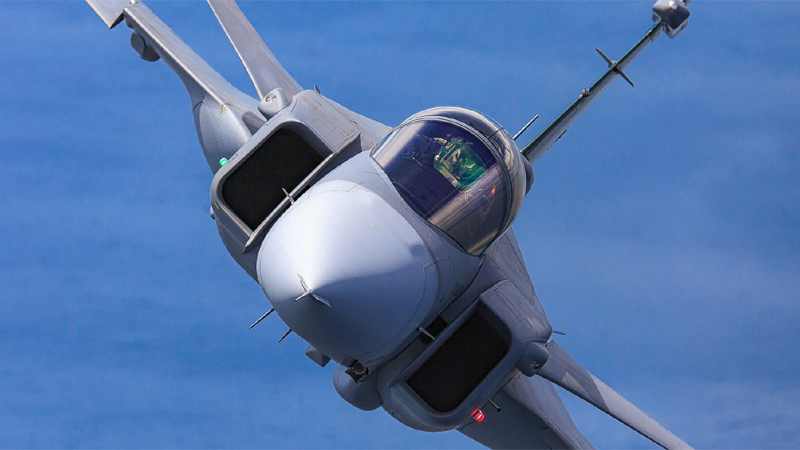
The Gripen E represents the pinnacle of Sweden’s fighter philosophy: a lightweight, agile, multirole platform designed for high availability, rapid turnaround, and independent operations in contested environments. Powered by a General Electric F414G turbofan engine delivering around 22,000 pounds of thrust, the single-seat Gripen E achieves a top speed of Mach 2, a combat radius exceeding 800 kilometers on internal fuel, and a maximum takeoff weight of 16,500 kilograms. It features an advanced ES-05 AESA radar, infrared search and track (IRST) systems, and sophisticated electronic warfare suites providing spherical coverage for both defensive and offensive applications. The aircraft’s sensor fusion and human-machine interface, including wide-area displays and AI-assisted decision support, enhance pilot situational awareness without overwhelming cognitive load. With ten hardpoints, it can carry a diverse weapons load, including up to seven Meteor beyond-visual-range missiles – widely regarded as superior in range and performance to many alternatives – alongside IRIS-T short-range missiles, precision-guided munitions, and reconnaissance pods. Its design emphasizes ease of maintenance, with a combat turnaround time as short as 15-25 minutes, often requiring minimal ground support equipment, making it ideal for dispersed operations from austere bases.
What distinguishes the Gripen E further is its emphasis on operational independence and upgradability. Unlike more complex platforms that demand extensive infrastructure, the Gripen can operate effectively from roads or short runways, a capability honed by Sweden’s "Bas 90" doctrine for survival in high-threat scenarios. Saab has offered substantial technology transfers, potential local assembly in Canada, and a full manufacturing and R&D hub, promising thousands of high-skilled jobs and greater control over sustainment. This contrasts with the F-35’s deeper integration into a U.S.-led ecosystem, where software updates and munitions compatibility often require allied approvals. For Canada, with its vast territory and Arctic responsibilities, the Gripen’s lower operating costs, high sortie generation rates, and reduced logistical footprint could prove advantageous for routine patrols and quick-response sovereignty missions.
Canada’s consideration of a split fleet – potentially around 30-40 F-35s for high-end, stealth-dependent operations in contested airspace or coalition warfare, paired with 60 or more Gripens for day-to-day NORAD duties and domestic defense – addresses multiple imperatives. The F-35 excels in stealth penetration and data-sharing within integrated air defense networks, bolstering Canada’s contributions to NATO and NORAD. However, over-reliance on a single U.S. platform raises concerns about vulnerability to political or supply disruptions. A mixed fleet mitigates this by diversifying sources, enhancing resilience, and fostering industrial benefits. Saab’s willingness to localize production aligns with Canadian goals for economic sovereignty, especially amid debates over defense spending and supply chain security. Public opinion polls have shown strong support for incorporating the Gripen, reflecting broader sentiments favoring balanced alliances without excessive dependence.
Challenges remain, including ensuring interoperability between the platforms, particularly in secure data links like Link 16, where U.S. approvals could influence operations. Training, maintenance infrastructure, and pilot transition from the CF-18 would require significant investment. Critics argue the Gripen, while capable as a 4.5-generation fighter, lacks the F-35’s all-aspect stealth and sensor dominance for the most demanding future threats. Proponents counter that in a Canadian context – focused on vast airspace defense rather than deep strike penetration – the Gripen’s strengths in affordability, availability, and adaptability outweigh pure technological edges. Ongoing evaluations and negotiations will determine the final mix, but the trajectory signals a pragmatic evolution for the RCAF.
This potential hybrid approach could revitalize the RCAF, ensuring it remains a credible contributor to continental and international security while building domestic resilience. As Canada navigates an era of great-power competition and climate-driven Arctic challenges, investing in a versatile, sovereign-minded fighter fleet positions the force for decades of effective service. The decision will shape not only air power but also Canada’s strategic autonomy in an increasingly uncertain global landscape.