
Bird of Prey: Airbus Unveils Autonomous Drone Hunter to Counter Kamikaze Threats
In the rapidly evolving landscape of modern warfare, where low-cost kamikaze drones have become a dominant asymmetric threat, traditional air defense systems often find themselves economically disadvantaged. Expensive missiles designed for high-end threats are frequently tasked with neutralizing inexpensive one-way attack UAVs, leading to unsustainable cost ratios. Enter the Bird of Prey, Airbus’s latest innovation in counter-unmanned aerial systems (C-UAS), which promises to restore balance through autonomy, reusability, and dramatically lower engagement costs.
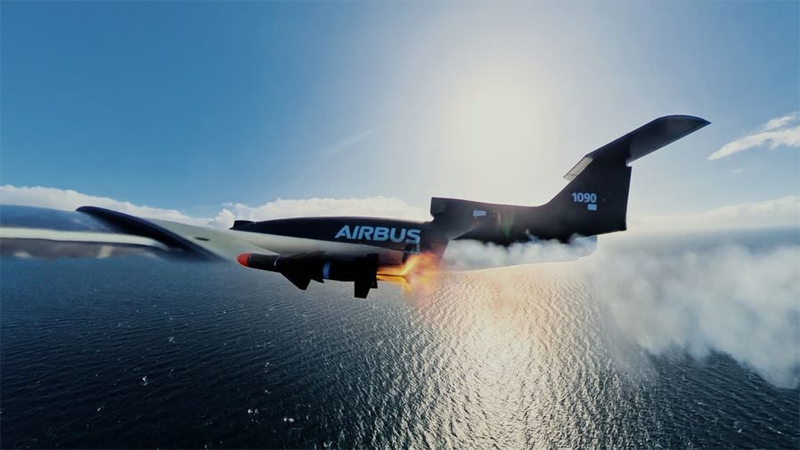
Developed in a remarkably short nine-month timeline, the Bird of Prey completed its first successful demonstration flight on March 30, 2026, at a military training area in northern Germany. During the test, the uncrewed interceptor autonomously searched, detected, classified, and engaged a simulated medium-sized kamikaze drone target using a lightweight air-to-air missile. This milestone marks a significant step forward in creating a mobile, AI-driven layer for integrated air and missile defense architectures, particularly within NATO frameworks.
The Bird of Prey is based on a modified Airbus Do-DT25 target drone platform. It measures 3.1 meters in length with a 2.5-meter wingspan and has a maximum takeoff weight of 160 kg – roughly comparable to a large motorcycle. This compact size enhances its deployability while maintaining high-subsonic performance capabilities derived from the base platform. The prototype carried four Mark I missiles, while the operational version is designed to handle up to eight. These missiles, developed in partnership with German startup Frankenburg Technologies, represent a breakthrough in interceptor economics. Each Mark I is only 65 cm long, weighs less than 2 kg, and features a “fire-and-forget” guidance system with an effective range of up to 1.5 km. Equipped with a fragmentation warhead optimized for short-proximity neutralization, the missiles enable the reusable Bird of Prey to engage multiple threats in a single sortie at a fraction of the cost of legacy systems.
Frankenburg Technologies’ CEO Kusti Salm highlighted the innovation: the integration creates “a new category of low-cost, mass-produced interceptor missiles on a drone, creating a new cost curve for air defense.” Airbus Defence and Space CEO Mike Schoellhorn emphasized its strategic value, noting that integration into Airbus’s Integrated Battle Management System (IBMS) positions the Bird of Prey as a “true force multiplier” within broader NATO-compatible air defense networks. The platform is intended to complement existing layered defenses, filling gaps against proliferating drone swarms seen in conflicts like the Russia-Ukraine war, where Russia produces an estimated 250 kamikaze drones daily.
Unit costs for the Bird of Prey are projected in the range of 1 to 5 million euros, making it competitive in a global C-UAS market driven by urgent needs for scalable solutions. Live-fire tests with warheads are planned throughout 2026, paving the way for potential commercialization and adoption by armed forces seeking affordable, autonomous responses to one-way attack drones such as Iranian-designed Shahed variants or their derivatives.
The rise of kamikaze drones has fundamentally altered aerial warfare economics. In Ukraine, inexpensive Shahed-136-style loitering munitions have forced defenders to expend high-value interceptors like Patriot missiles or NASAMS rounds, sometimes costing millions per engagement against targets worth tens of thousands of dollars. This imbalance has accelerated global efforts to develop “drone-on-drone” or kinetic interceptor solutions that prioritize cost-effectiveness, autonomy, and reusability. Airbus’s Bird of Prey exemplifies this shift toward systems that can loiter, hunt, and neutralize multiple threats without draining expensive missile inventories.
Beyond Europe, numerous notable projects are advancing the field of interceptor drones and related C-UAS technologies. These efforts span kinetic collisions, net captures, projectile-based systems, and hybrid approaches, often leveraging AI for detection and engagement in GPS-denied or electronically contested environments.
One prominent example comes from the United States, where Anduril Industries has developed the Anvil autonomous air vehicle (AAV). Part of Anduril’s broader Lattice AI-powered command-and-control ecosystem, the Anvil is designed for kinetic interception of Group 1 and 2 UAS threats with minimal collateral damage. It operates autonomously after being cued by sensors, providing visual confirmation to human operators before engagement. A munition variant, Anvil-M, extends capabilities against faster or more heavily armed targets. Anduril has also pursued the Roadrunner family, including reusable VTOL platforms that can be stored in containerized “Nests” for rapid deployment. These systems have seen testing and funding through U.S. Department of Defense initiatives, including collaborations with Lockheed Martin for radar integration in exercises like Desert Guardian.
Another U.S. effort involves AeroVironment’s Freedom Eagle-1 (FE-1), selected for the Army’s Long-Range Kinetic Interceptor (LRKI) and Next-Generation C-UAS Missile programs. Awarded a $95.9 million contract, the FE-1 serves as a low-cost surface-to-air interceptor primarily targeting longer-range one-way attack drones and similar UAS. It integrates into existing systems like the Low, Slow, Unmanned Aircraft Integrated Defeat System (LIDS), offering an affordable kinetic layer alongside established effectors like the Coyote interceptor. Raytheon previously competed with Coyote Block 2 variants, which have already achieved combat kills.
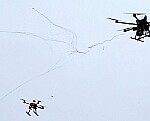
Fortem Technologies’ DroneHunter F700 takes a non-destructive approach in many scenarios. This AI-powered interceptor uses net guns to entangle target drone rotors, forcing them to crash or descend safely. It supports multiple net attachments and can handle a wide range of drone sizes, from small quadcopters to larger fixed-wing models. The system emphasizes precision and reduced risk of debris in sensitive areas, with human oversight options. Similar net-based concepts appear in systems from OpenWorks Engineering.
In Ukraine, battlefield necessity has driven rapid innovation in low-cost interceptors. The Sting family of interceptor drones – developed by various Ukrainian teams – includes bullet-shaped quadcopters capable of high-altitude engagements against Shahed-type threats. These systems often rely on FPV-style control augmented by radar cues and can achieve speeds up to 195 mph for kamikaze-style collisions or explosive payloads. Other Ukrainian projects include the Bullet (a jet-assisted high-speed interceptor from General Cherry), P1-Sun (3D-printed, reaching 300 km/h), and Octopus 100 (mass-produced in the UK). Systems like VARTA’s DroneHunter mount dual 12-gauge barrels for close-range buckshot neutralization, while the Chief-1 uses twin-barrel setups against both aerial and ground targets. Initiatives such as Clear Sky and ODIN have deployed thousands of these low-cost “drone-vs-drone” solutions, reportedly accounting for a significant portion of Shahed interceptions.
Israel’s RAFAEL Advanced Defense Systems is advancing with the Hunter Eagle (a compact VTOL interceptor for urban environments) and the upcoming Ghost Hunter, slated for demonstrations in 2026 and deliveries in 2027. These kinetic platforms build on Israel’s layered defense expertise, complementing systems like Iron Beam lasers. European efforts include NATO-aligned projects like the Merops (or Project Eagle) system, which has seen U.S. Pentagon deployment for Shahed threats in the Middle East. Merops uses AI-driven surveyors and autonomous interceptors tested in Ukraine, with claims of high effectiveness in contested airspace.
Other notable mentions include Germany’s potential contributions through startups and AI-swarm coordination platforms like Alpine Eagle Sentinel, as well as hybrid systems blending electronic warfare with kinetic options. The UK’s DragonFire laser and various microwave or directed-energy projects (e.g., THOR) offer non-kinetic alternatives, but kinetic drone interceptors remain crucial for scenarios where jamming fails or physical destruction is required.
The proliferation of these projects underscores a broader trend: the “democratization” of air defense through affordable, attritable, and intelligent systems. Traditional high-end missiles will continue to play a role against sophisticated threats, but interceptor drones like the Bird of Prey, Anvil, Freedom Eagle-1, and Ukrainian Sting variants are essential for handling massed low-cost swarms. Challenges remain, including integration into command networks, operation in electronic warfare-heavy environments, regulatory hurdles for autonomy, and ensuring positive identification to avoid friendly fire or civilian risks.
As tests progress in 2026 and beyond, the Bird of Prey could accelerate European defense industrial collaboration, particularly with startups like Frankenburg. Its seamless fit into IBMS and NATO architectures positions it as a complementary asset rather than a standalone solution – part of multi-layered defenses that combine radars, jammers, lasers, guns, and kinetic interceptors.
The success of Airbus’s rapid development demonstrates how agile partnerships between established primes and innovative startups can deliver capabilities at speed. In an era where drones redefine conflict – from tactical battlefield strikes to strategic infrastructure attacks – systems like the Bird of Prey represent not just technological progress but a strategic necessity. By inverting the cost equation, these interceptor drones promise to make defending airspace more sustainable, allowing militaries to preserve high-value assets for truly high-threat scenarios while economically neutralizing the drone hordes that have become the new normal in modern warfare.
Looking ahead, further advancements in AI for swarm coordination, improved sensors for all-weather detection, and modular payloads could enhance these platforms even more. International cooperation will be key, as threats like kamikaze drone barrages transcend borders. Whether through European initiatives, U.S. DIU programs, or Ukrainian battlefield improvisations, the global push for effective drone interceptors signals a paradigm shift in air defense – one where agility, autonomy, and economics take center stage alongside raw firepower.
The Bird of Prey has only just begun its hunt, but it joins a growing flock of solutions aimed at taming the skies dominated by inexpensive, expendable threats. As 2026 unfolds with more live tests and potential procurements, the future of C-UAS looks increasingly like a drone-eat-drone world – efficient, intelligent, and far more balanced than before.