
Bird of Prey Matures at Farnborough – Airbus presented a Cost-Effective Counter to One-Way Attack UAVs
Four months after its headline-grabbing first flight, Airbus Defence and Space has brought the Bird of Prey to the Farnborough International Airshow 2026, transforming an ambitious nine-month prototype into a tangible, sovereign European solution poised for operational testing and international interest.
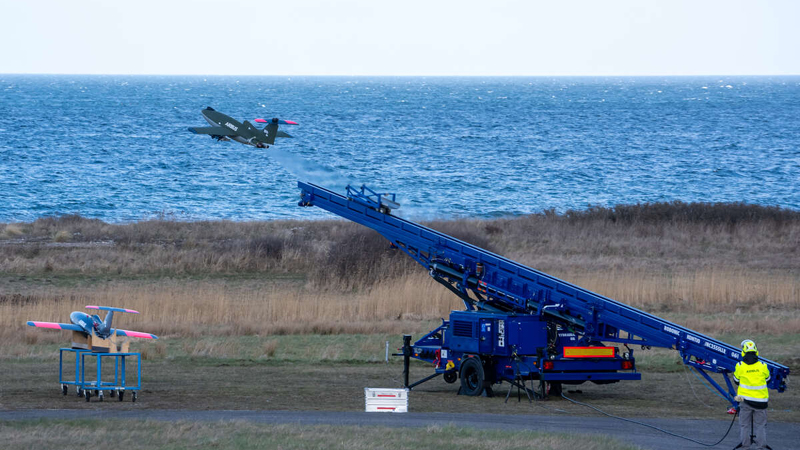
When Airbus first revealed the Bird of Prey in late March 2026, the story was one of remarkable speed: a modified Do-DT25 target drone turned autonomous hunter that successfully detected, classified, and engaged a medium-sized kamikaze target with a Frankenburg Mark I missile in northern Germany. That demonstration flight already hinted at a game-changing approach to the unsustainable economics of drone defence. Now, at Farnborough, the system has stepped firmly into the next chapter – public unveiling, refined operational concepts, and clear positioning as a reusable, multi-shot layer within NATO-integrated air defence.
The core platform remains elegant in its pragmatism. Roughly three metres long with a 2.6-metre wingspan and 160 kg maximum take-off weight, the catapult-launched Bird of Prey retains high-subsonic performance while emphasising mobility and recovery. Parachute retrieval allows rearming and rapid redeployment, a decisive advantage over expendable missiles. The prototype demonstrated with four Mark I missiles; the operational configuration targets up to eight of these lightweight (under 2 kg, 65 cm long), fire-and-forget interceptors. Each carries a fragmentation warhead optimised for proximity kills at ranges up to 1.5 km – enough to neutralise multiple Shahed-style threats in a single sortie at a fraction of traditional costs.
What has evolved since April is the emphasis on integration and scalability. Airbus highlighted seamless compatibility with its Integrated Battle Management System (IBMS), enabling the Bird of Prey to slot into broader NATO command-and-control architectures as a mobile, complementary effector. This addresses a key gap exposed in Ukraine, where daily waves of one-way attack drones – often exceeding 100–200 launches – have strained high-value air defence inventories. By fielding a reusable platform that can hunt, engage, return, and reload, Airbus is directly inverting the cost-exchange ratio that has favoured attackers.
Partnerships forged in the initial phase have also deepened. Estonian start-up Frankenburg Technologies continues to refine the Mark I family, with Airbus executives at Farnborough underscoring the “new cost curve” created by pairing low-cost missiles with a recoverable carrier. Live-warhead testing continues through the remainder of 2026, building directly on the March success. Industry observers note the programme’s agility: from concept to demonstrated intercept in nine months, and now to public showcase and customer engagements just four months later.
This Farnborough appearance comes amid a crowded field of counter-drone innovations, many of which were also on display or referenced in concurrent briefings. The Bird of Prey’s airborne, multi-shot reusability sets it apart from several peers. Anduril’s Roadrunner-M, for instance, offers vertical take-off, loiter, and optional recovery with high subsonic speed and modularity, but functions more as a ground-launched, rapidly deployable “reusable missile.” Lockheed Martin’s MORFIUS X-Rotor brings reusable airborne high-power microwave effects capable of neutralising dozens of drones per flight – complementary in directed-energy terms but different in engagement mechanics. Raytheon’s Coyote effectors, already battle-proven within the U.S. Army’s LIDS (Low, Slow, Small Unmanned Aircraft Integrated Defeat System), provide expendable kinetic and non-kinetic options that integrate into layered architectures much like the Bird of Prey aspires to do.
Non-kinetic and hybrid approaches remain strong: Fortem’s DroneHunter F700 continues to excel in net-capture for low-collateral scenarios, while directed-energy systems (lasers and microwaves) offer near-zero per-shot costs once powered. Ukrainian battlefield improvisations – Sting-family interceptors, jet-assisted designs, and mass-produced FPV hunters – have validated the drone-on-drone concept at scale, often achieving hundreds of Shahed interceptions monthly through sheer volume and low unit costs. Israel’s ongoing work with kinetic VTOL platforms and Rafael’s layered systems further illustrates the global convergence on affordable, attritable solutions.
Where the Bird of Prey stands out in this evolving ecosystem is its European sovereignty and focus on medium-altitude, multi-threat persistence. Free of ITAR constraints and built on proven Airbus airframe heritage, it appeals to nations prioritising supply-chain resilience and NATO interoperability. Projected unit costs in the low millions of euros position it competitively against both high-end missiles and emerging low-cost interceptors. As one senior Airbus representative noted at the show, the goal is not to replace existing defences but to give them breathing room – preserving expensive SAM rounds for sophisticated cruise missiles or aircraft while the Bird of Prey handles the proliferating drone hordes.
Challenges remain, of course. Effective operation against very small or highly manoeuvrable quadcopters, performance in heavy electronic warfare environments, and reliable recovery in forward areas will require further validation in the upcoming live-fire campaign. Regulatory and ethical questions around greater autonomy levels persist across the industry. Yet the rapid maturation from March demo to July showcase demonstrates Airbus’s commitment to delivering at pace.
As 2026 progresses, the Bird of Prey story is shifting from promising prototype to potential programme of record. Additional trials, customer briefings at Farnborough, and ongoing integration work suggest first operational capability could arrive sooner than many expected. In a conflict landscape defined by daily drone attrition, systems that combine autonomy, reusability, and economic sense are no longer optional – they are essential.
The Bird of Prey has taken its first hunts and is now circling wider skies. If the next phase of testing matches the momentum of its early development, Europe – and its partners – may soon field a practical, scalable answer to one of modern warfare’s most pressing imbalances. The drone hunter is no longer just a concept. It is gaining altitude, and the flock of solutions it joins is growing stronger by the month.