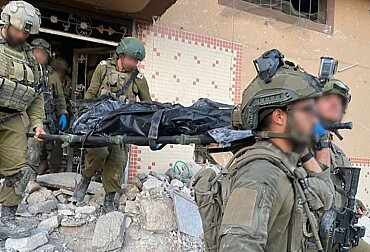

Iran Just Smashed a Key US Air Base in Kuwait - New Images Reveal the Damage
Fresh satellite imagery and released footage indicate that Iran’s missile and drone strikes caused serious damage at Al-Udairi Air Base in northern Kuwait, a critical US military facility better known as Camp Buehring. The visual evidence points to a direct hit on infrastructure essential to American operations in the Middle East, including hangars, maintenance areas, weapons storage, and personnel shelters.
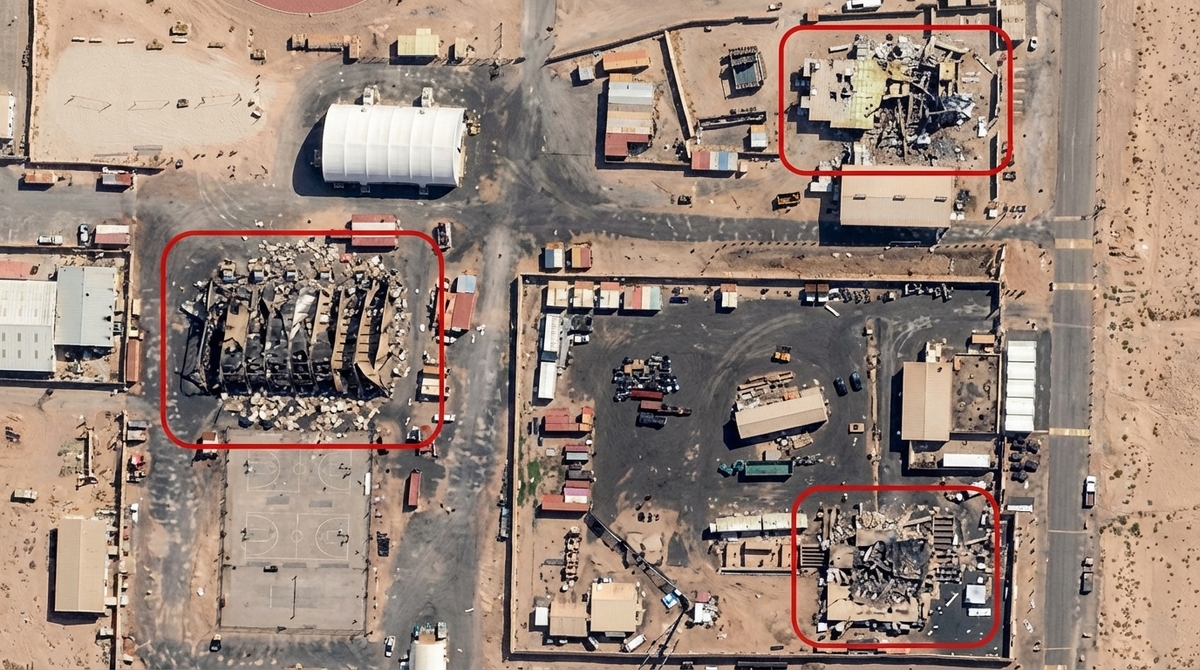
The attack appears to have struck one of the US Army’s most important strategic hubs in the region. Located in the desert near the Iraqi border, Al-Udairi serves as a major logistics and deployment center supporting operations across Western Asia. The base plays a central role in moving forces, equipment, and supplies, while also supporting aviation, artillery, and armored units.
Footage released by IWN shows a stark aftermath: destroyed hangars, wrecked military equipment, and visibly damaged shelters used by personnel on the ground. Satellite analysis reportedly suggests that Iranian munitions were capable of penetrating defensive structures, amplifying the scale of the destruction and raising new questions about the effectiveness of protective measures at key American installations.
The material damage alone is significant. Maintenance facilities and weapons depots are not secondary assets – they are the backbone of sustained military readiness. If those systems are knocked offline, even temporarily, the effects ripple across deployment schedules, aircraft support, vehicle readiness, and munition availability. In a region where speed and flexibility are critical, any disruption at a hub like Camp Buehring can weaken the broader operational picture.
But the strike’s implications go beyond damaged buildings and equipment. According to the reported assessment, the attack also degraded the base’s ability to function as a command node for coordinating US and NATO activity in the region. That makes the strike strategically more serious than a simple infrastructure hit. It suggests Iran was not just trying to cause physical damage, but to disrupt operational coherence and complicate command and control.
That matters because Al-Udairi is more than a staging area. It helps connect logistics, force movement, and regional planning in a single location. An attack that compromises those functions can create pressure across multiple missions at once, from deployment readiness to joint coordination.
The broader message is difficult to ignore. Iran appears to have demonstrated an ability to reach and damage a heavily used US military site that sits at the heart of regional operations. If the reported imagery analysis is accurate, the strike also highlights the growing challenge of defending fixed installations against missiles and drones that can overwhelm or bypass layers of protection.
For Washington and its regional partners, the damage at Al-Udairi may become another warning that large, permanent military hubs are increasingly exposed in a threat environment shaped by precision strikes, persistent surveillance, and low-cost unmanned systems. Rebuilding damaged facilities is one challenge. Restoring confidence in the survivability of those bases may prove harder.