Kim Reaffirms “Unwavering” Support for Moscow, Formalizing a Partnership That Reshapes the Ukraine Conflict
In the heart of Pyongyang on April 26 and 27, 2026, North Korean leader Kim Jong-un hosted a high-level Russian delegation. State media reports from the Korean Central News Agency detailed a series of meetings and ceremonies where Kim publicly reaffirmed North Korea’s steadfast support for what he described as Russia’s “just holy war” against Ukraine. This rhetorical escalation, paired with the unveiling of a new memorial honoring North Korean soldiers killed in combat alongside Russian forces, marks a significant moment in the evolving partnership. Formalized through a comprehensive mutual defense treaty signed in 2024, this alliance carries profound strategic implications not only for the battlefield in Ukraine but for the broader architecture of global power.
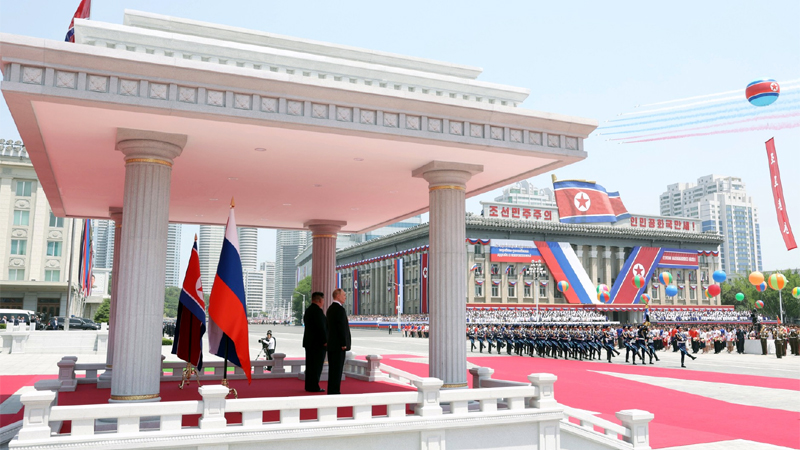
The events unfolded against a backdrop of deepening military cooperation. Russian Defense Minister Andrey Belousov, State Duma Speaker Vyacheslav Volodin, and other senior officials arrived in the North Korean capital to participate in the inauguration of the Memorial Museum of Combat Feats at the Overseas Military Operations. This complex, located on Saeppyol Street – translated as “New Star” in honor of the fallen – commemorates the sacrifices of North Korean troops deployed to Russia’s Kursk region, where they helped repel Ukrainian incursions and contributed to what Moscow calls the liberation of the area roughly a year earlier. Kim Jong-un personally toured the site with his Russian guests, viewing captured Western weapons on display, including German-made tanks.
During meetings with Belousov and Volodin, Kim expressed his “conviction that the Russian army and people will surely win victory in the just holy war.” He pledged that North Korea would “as ever fully support the policy of the Russian Federation to defend its national sovereignty, territorial integrity, and security interests.” The memorial serves both as a tribute and a propaganda tool, transforming loss into a narrative of heroic internationalism that “legitimizes” further involvement in the conflict.
This public reaffirmation comes at a pivotal juncture in the Ukraine conflict. Since late 2024, North Korea has supplied not only troops but also vast quantities of artillery shells, missiles, and other munitions that have sustained Russian offensives. The deployment of soldiers to Kursk represented a qualitative leap, moving from logistical support to direct combat participation. Strategically, this has allowed Russia to conserve its own manpower for other fronts while testing combined operations. Ukrainian forces have reported intense engagements with these troops, whose willingness to absorb heavy casualties aligns with Pyongyang’s doctrine of “relentless assault”.
The foundation of this cooperation is the Treaty on Comprehensive Strategic Partnership, signed by Kim and Russian President Vladimir Putin in Pyongyang in June 2024 and subsequently ratified by both sides. Article 4 of the treaty obligates each party to provide “military and other assistance with all means in its possession without delay” if the other falls victim to armed aggression, invoking the right to self-defense under the UN Charter. While framed defensively, the pact has effectively enabled offensive collaboration in Ukraine. It establishes mechanisms for joint defense capability building, intelligence sharing, and technological exchanges, including potential advancements in missiles and nuclear-related fields that worry Western analysts.
Major strategic implications for the conflict in Ukraine are already evident. Russia’s ability to draw on North Korean resources has prolonged its campaign, blunting Western sanctions and military aid to Kyiv. Estimates suggest North Korean munitions have constituted a significant portion of Russia’s artillery fire in key battles, while troop deployments have freed Russian units for maneuvers elsewhere. This support reduces Moscow’s urgency for negotiations, as it can sustain losses and maintain pressure. For Ukraine and its allies, the partnership raises the specter of a wider war, with North Korean involvement potentially inviting further escalation or complicating peace initiatives. Intelligence reports indicate ongoing rotations of North Korean personnel, suggesting the commitment is not temporary but part of a long-term strategy to exhaust Ukrainian resistance.
Beyond the immediate theater, the repercussions ripple across global geopolitics. The Russia-North Korea axis strengthens ties within what some call the “axis of autocracies,” linking Moscow, Pyongyang, and Beijing in a loose but increasingly coordinated front against Western influence. China, while maintaining deniability, benefits indirectly as the partnership diverts U.S. and European resources from the Indo-Pacific. South Korea and Japan face heightened concerns, with Pyongyang’s combat experience potentially enhancing its own capabilities and emboldening provocations on the peninsula. The mutual defense clause in this treaty could theoretically be extended to other unforeseen situations, which increases the risk of horizontal escalation – for example, if tensions were to flare up in Asia, Russia might feel compelled to respond in a similar manner, although the question of whether it would have sufficient resources to do so is a relevant one.
Economically and technologically, the partnership circumvents sanctions. Russia provides North Korea with oil, food, and advanced military technology in exchange for manpower and weapons, creating parallel supply chains resistant to Western pressure. This model of rogue-state cooperation challenges the effectiveness of international isolation strategies and could inspire similar arrangements elsewhere, from Iran to Venezuela. Diplomatically, it undermines efforts by the United Nations and Western powers to isolate either regime, as their mutual validation normalizes defiance of global norms.
As analysts assess the long-term trajectory, several scenarios emerge. The alliance could deepen further, with joint exercises, technology transfers accelerating North Korea’s nuclear and missile programs, and potential Russian support in any future Korean conflict. Conversely, overextension might strain resources on both sides. For Ukraine, the immediate challenge is adapting to this reinforced adversary while appealing for sustained Western backing that matches the scale of external support flowing to Moscow.