
Russia Promised Four Tu-160M - Only Two Arrived. What Went Wrong
Russia has replaced the head of Tupolev, the state-linked aircraft maker responsible for its strategic bomber fleet, in a move that highlights growing pressure on the country’s ability to sustain and expand long-range aviation programs. According to a report by Defense Express, citing Russian industry sources, 37-year-old Yuri Ambrosimov has been appointed chief executive, replacing 76-year-old Aleksandr Bobryshev.
Ambrosimov’s promotion comes roughly a year after a previous round of management rotations at Tupolev in 2024. But the timing is notable: the company is reportedly facing escalating disputes with Russia’s Ministry of Defense over defense contracts that were not fulfilled on time—disputes that have now spilled into court rulings and additional lawsuits.
A leadership change amid legal and financial pressure
Defense Express reports that the leadership change followed accumulated complaints from the Russian defense ministry regarding failures to deliver contracted work. In May 2025, the Moscow Arbitration Court ruled in favor of the ministry in a case filed in summer 2024, ordering Tupolev to pay 3 billion rubles. In June 2025, the ministry filed an additional lawsuit for 0.9 billion rubles, also tied to unmet obligations.
Ambrosimov is not an outsider brought in to “clean house.” He previously served as deputy managing director for economics and finance, suggesting the Kremlin and industry leadership may be prioritizing financial control and contract discipline as much as engineering output.
Why Tupolev matters: the bomber backbone
Tupolev manufactures and supports Russia’s key strategic aircraft, including:
- Tu-22M3 long-range bombers (and their modernization to Tu-22M3M)
- Tu-160 strategic bombers (including the Tu-160M reproduction program)
- Tu-95MS strategic bombers
It also produces the Tu-214 airliner, a program that Russian sources have repeatedly discussed as potentially “dual-use.”
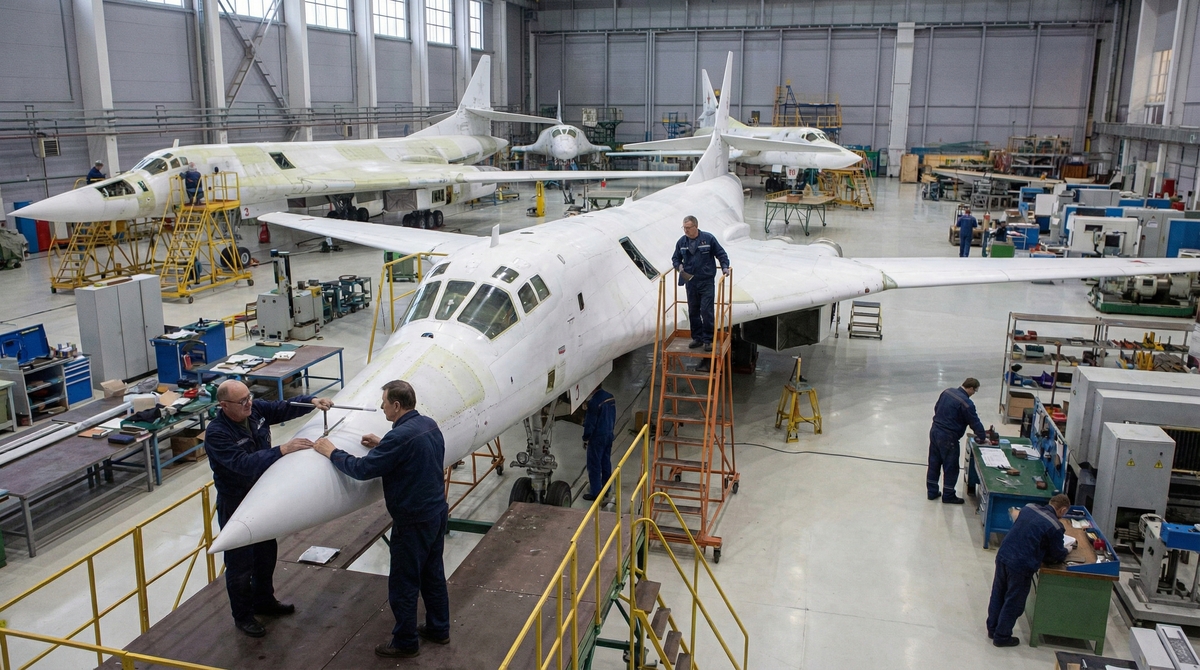
Much of this work is concentrated at the Kazan Aircraft Plant, Tupolev’s main production base. Kazan is where Tu-214s are built, Tu-160M bombers are assembled from Soviet-era airframes under the reproduction program, and Tu-22M3 aircraft are upgraded to the Tu-22M3M standard. In other words, one facility sits at the junction of Russia’s strategic bomber sustainment and its attempt to revive domestic civil aviation production.
Court claims hint at the scale of the problem
Defense Express suggests the defense ministry’s claims are likely linked to incomplete maintenance or upgrade work on strategic aircraft. Open-source figures cited in the report illustrate how quickly costs escalate:
- A single Tu-160M bomber: roughly 15–16 billion rubles
- Tu-95MS repair/modernization: about 3.77–5.3 billion rubles per aircraft (depending on facility)
That context makes the ministry’s combined 3.9 billion rubles in claims look less like a dispute over a major production batch and more like a symptom of bottlenecks affecting even limited overhaul work. As Defense Express notes, that sum would cover, at most, the overhaul of one Tu-95MS.
Delays ripple through strategic aviation programs
The legal disputes are occurring alongside reported delivery slippages in Russia’s flagship bomber efforts.
Tu-160M deliveries: Defense Express reports the defense ministry was scheduled to receive four Tu-160M bombers in 2025, aircraft that had been rolled out at Kazan between 2022 and 2023. However, only two were transferred to the Russian armed forces in early 2026, with the reasons for the delay not publicly disclosed.
Tu-22M3M modernization: Progress has been even slower than earlier ambitions suggested. Only two aircraft have reportedly been upgraded—one in 2018 and another in 2023—despite previous statements from plant management about plans to modernize up to 30 long-range bombers.
Taken together, the pattern points to a production system struggling to convert plans and rollouts into consistent handovers—whether due to supply constraints, workforce limitations, subcontractor failures, quality-control issues, or financing and contract-management breakdowns.
The “civil” Tu-214 problem is also a military capacity signal
Tupolev’s troubles are not confined to defense programs. Defense Express reports that the company planned to deliver three Tu-214 airliners in 2023 but delivered none. In 2024, the plan called for ten, but only one was delivered.
Those shortfalls have reportedly triggered lawsuits from commercial customers. One prominent example cited is a 6.2-billion-ruble claim filed by Russian company Tatneftover undelivered aircraft.
The Tu-214 program draws particular attention because it is produced at the same Kazan facility as strategic bombers. Russian commentators have previously argued the airliner could be adapted into a “mobilization missile carrier” capable of carrying cruise missiles such as Kh-101 or Kh-22—a concept that, even if speculative, underscores how civil output and military capacity are intertwined when they share tooling, labor, and supply chains.
What the reshuffles suggest
Defense Express argues that repeated management changes at Tupolev indicate Russian authorities recognize deeper problems in technological capability and production capacity across the aviation sector—and are attempting to address them through leadership replacements at key enterprises.
But leadership changes alone rarely resolve structural constraints. If the underlying issues involve industrial throughput, component availability, certification bottlenecks, or the ability to modernize aging airframes at scale, a new CEO may primarily be tasked with triage: renegotiating schedules, limiting penalties, prioritizing the most politically sensitive programs, and restoring a minimum level of predictable delivery.
For Russia’s long-range aviation, the stakes are high. Strategic bombers are not only weapons platforms but also symbols of great-power status. When deliveries and upgrades stall—while courts record billion-ruble disputes with the defense ministry—the result is a visible strain on one of the most prestige-heavy segments of the Russian defense-industrial base.