
Russia’s Indonesia Visit Signals a Wider Push for Reach in the Indo-Pacific
Russia’s latest naval visit to Indonesia is more than a routine port call. The arrival of a Russian Navy task group near Jakarta on March 31, 2026, brings together several threads of Moscow’s regional strategy: naval signaling, long-range strike capability, and earlier ambitions to secure access for strategic aviation close to Australia.
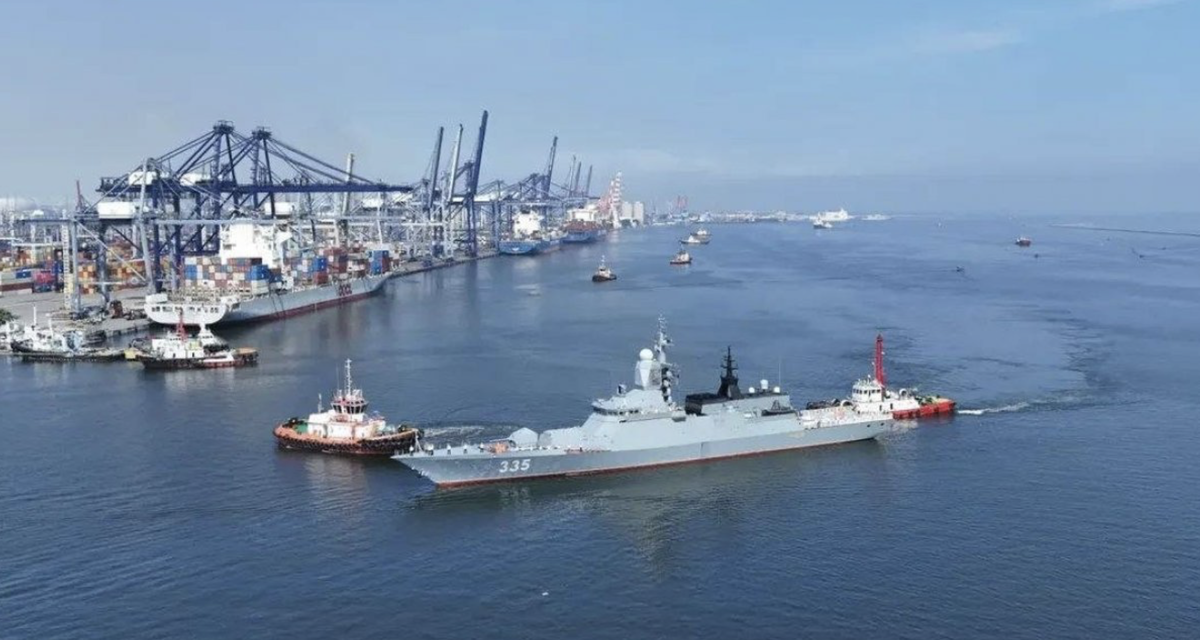
According to the Indonesian Navy, the visiting Russian group includes the Gromkiy missile corvette, a Project 636.6 diesel-electric submarine capable of launching Kalibr cruise missiles, and the Andrey Stepanov ocean-going tug. Officially, the deployment is being presented as part of efforts to strengthen defense cooperation between Russia and Indonesia. Yet the composition of the group — especially the presence of a Kalibr-capable submarine — gives the visit a broader military and political meaning.
The deployment comes after earlier Russian interest in leasing an Indonesian airbase that could support long-range aircraft, including Tu-95MS strategic bombers and Il-76 transport aircraft. Although that plan has not materialized, the current naval visit shows that Moscow still views Indonesia as a useful partner and geographic access point in the Indo-Pacific.
A Small Task Group With Strategic Messaging
On paper, the Russian naval group is modest. It is not a carrier strike group or a large amphibious force. But its individual components matter.
The Gromkiy, a Project 20380 corvette, is designed for coastal and near-sea operations and is typically armed with Kh-35U anti-ship missiles. These missiles give the vessel a credible surface-strike role, particularly in littoral waters.
More significant is the presence of the Project 636.6 submarine. This class is commonly associated with quiet diesel-electric operations and can carry up to four Kalibr-family cruise missiles in standard configuration. These may include the 3M14 land-attack variant and the 3M54 anti-ship variant.
That matters because Kalibr missiles are not simply tactical weapons. They are also tools of strategic signaling. Their presence allows Russia to demonstrate that even a relatively small naval deployment can carry long-range strike potential.

The inclusion of the Andrey Stepanov tug is also notable. Russian naval deployments often rely on support vessels for extended operations far from home waters. While a tug is not a combat ship, its presence underlines the logistical reality of Russian blue-water activity: Moscow can still send naval assets abroad, but it must carefully support them.
Indonesia’s Balancing Act
For Indonesia, the Russian visit fits into a long-standing pattern of strategic balancing. Jakarta has historically avoided aligning too closely with any single great power. It maintains defense ties with Western countries, works with regional partners, and has also purchased Soviet and Russian military equipment in the past.
Indonesia currently operates several Soviet- and Russian-made combat aircraft, including Su-27SK, Su-27SKM, Su-30MK, and Su-30MK2 fighters. This legacy makes Russia a familiar defense partner, even if Moscow’s role in Indonesia’s procurement strategy has weakened in recent years.
A key example came in February 2022, when Indonesia abandoned plans to buy Russian Su-35S fighters and instead selected French Rafale aircraft. That decision reflected both practical and geopolitical considerations, including the growing complications of dealing with Russia’s defense industry under international pressure.
At the same time, Indonesia joined the BRICS bloc in January 2025, a move that gave Moscow another diplomatic channel to frame relations with Jakarta as part of a wider non-Western political architecture.
This does not mean Indonesia is moving into Russia’s orbit. Rather, Jakarta appears to be preserving room for maneuver — engaging Russia where useful, while continuing to diversify its defense and diplomatic relationships.
The Shadow of Manuhua Airbase
The naval visit is especially interesting because it follows earlier Russian interest in access to an Indonesian airbase. In 2025, attention focused on Manuhua airfield, located near Australia. Russian Tu-95MS strategic bombers and Il-76 transport aircraft had previously landed there in 2017, and Russia later reportedly requested access for long-range aviation operations.
A leased or regularly accessible airbase in Indonesia would have been a major strategic asset for Moscow. It could have extended the operational reach of Russian long-range aviation into the Indo-Pacific and created a new pressure point near Australia.
However, the relevance of such plans may have declined after Operation Spiderweb on June 1, 2025, which reportedly inflicted significant losses on Russia’s strategic aviation. If Russia’s long-range bomber fleet has been weakened, its ability to exploit far-flung airbase access may be more limited than before.
Even so, the earlier airbase discussions show the scale of Russian ambitions. Moscow was not merely looking for symbolic defense engagement. It was exploring ways to establish operational depth in a region far from its traditional military theaters.
Why This Matters for the Indo-Pacific
Russia’s naval presence in Indonesia should be viewed in the context of broader Indo-Pacific competition. The region is already shaped by the military activities of the United States, China, Australia, Japan, India, and Southeast Asian states. Russia is not the central player, but it is trying to remain visible.
For Moscow, deployments like this serve several purposes.
First, they signal that Russia is not isolated, despite the war in Ukraine and Western sanctions. A naval visit to a major Southeast Asian country helps Moscow project diplomatic normalcy.
Second, they remind regional actors that Russia still has military tools beyond Europe. Even limited deployments can carry political weight when they include missile-armed ships and submarines.
Third, they support Russia’s defense diplomacy. Indonesia may no longer be moving forward with the Su-35 deal, but it remains a country with a history of Russian equipment and defense engagement.
For Indonesia, the calculation is different. Hosting a Russian naval visit allows Jakarta to demonstrate an independent foreign policy. But it also requires caution, especially given Indonesia’s proximity to Australia and the sensitivity of any Russian military activity in the region.
A Symbolic Visit With Real Military Undertones
The arrival of the Russian task group near Jakarta should not be overstated. It does not mean Russia is establishing a permanent military foothold in Indonesia. Nor does it indicate that Jakarta is abandoning its balanced foreign policy.
But the visit is still meaningful.
The combination of a missile corvette, a Kalibr-capable submarine, and past Russian interest in Indonesian airbase access points to a larger pattern. Moscow is searching for ways to keep strategic relevance in the Indo-Pacific, even as its resources are strained elsewhere.
For Indonesia, the event highlights the complexity of its position: open to cooperation, cautious about alignment, and determined to preserve strategic flexibility.
In that sense, the Russian naval visit is not just about ships arriving in Jakarta. It is about influence, access, and the quiet competition for military presence in one of the world’s most important regions.