
The End of Russian Carrier Dreams: Kuznetsov Scrapped After Billions Wasted
The Admiral Kuznetsov, commissioned in 1991 as the Soviet Union’s last major surface warship project, stands as a poignant symbol of the USSR’s maritime ambitions and Russia’s subsequent struggles to maintain blue-water naval power. This heavy aircraft-carrying cruiser (officially classified as such to comply with treaty restrictions) measures approximately 305 meters (1,000 feet) in overall length, with a full-load displacement of around 58,600 tonnes. It features a distinctive ski-jump ramp for short takeoff but arrested recovery (STOBAR) operations, allowing it to embark fixed-wing aircraft like the Su-33 Flanker and MiG-29K Fulcrum fighters, along with Ka-27/31 helicopters for anti-submarine and search-and-rescue roles. Its air wing typically numbers up to 24–36 fixed-wing aircraft and helicopters, supplemented by a heavy offensive armament suite – including 12 P-700 Granit anti-ship missiles–to justify its “cruiser” designation under international conventions like the Montreux Treaty for Black Sea access.
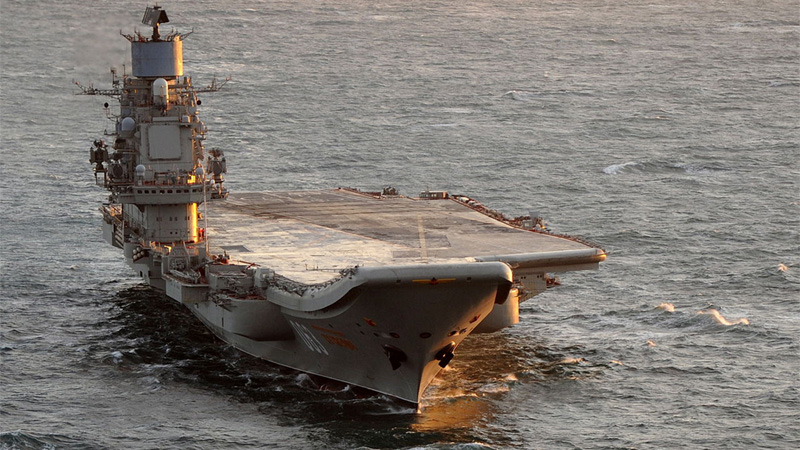
Despite its imposing size and capabilities on paper, the Kuznetsov has had a troubled career marked by limited operational history. It conducted several Mediterranean deployments in the 2000s and early 2010s but saw only one significant combat outing: supporting Russian operations in Syria from late 2016 to early 2017. That mission exposed serious deficiencies, as two aircraft – a Su-33 and a MiG-29K – were lost in non-combat accidents due to issues with the arrestor wires and flight deck operations, highlighting chronic structural and mechanical defects, including unreliable propulsion and persistent black smoke from its boilers.
Since 2017, the ship has been undergoing a major overhaul and modernization at the Zvezdochka shipyard in Murmansk, intended to extend its service life, upgrade electronics, weapons systems, and the flight deck, and replace key components like boilers. However, the process has devolved into an extended saga of setbacks. A 2018 incident saw the PD-50 floating dry dock sink, causing a massive crane to crash onto the deck and inflict hull damage. This was followed by devastating fires in 2019 (killing two workers and injuring others during welding) and 2022, which further delayed progress and added to repair costs. These mishaps, combined with funding constraints, supply issues, and broader industrial challenges, pushed back initial completion targets from around 2022 to later dates, with optimistic projections once eyeing 2024–2025.
Recent developments indicate the project has effectively ended. By mid-2025, Russian officials suspended modernization work, with sources in the United Shipbuilding Corporation and naval leadership declaring further investment unjustifiable. The carrier was mothballed by late 2025, leaving Russia without an operational aircraft carrier for the foreseeable future. Estimates of the modernization’s total cost vary but have exceeded 100 billion rubles (roughly equivalent to hundreds of millions of USD, depending on exchange rates), approaching or surpassing a third of the projected expense for an entirely new carrier. This expenditure has proven difficult to defend amid Russia’s ongoing war in Ukraine, where resources prioritize ground forces, artillery, drones, and missiles over expensive surface assets.
The Kuznetsov’s fate underscores a deeper strategic shift. Russia has long viewed itself primarily as a continental and Arctic power rather than a global expeditionary one with overseas bases or colonies requiring carrier-based air projection. Senior officers, including former Pacific Fleet commander Admiral Sergei Avakyants, have argued that large aircraft carriers are increasingly vulnerable in modern warfare – potentially "destroyed in minutes" by hypersonic missiles, advanced anti-ship weapons, or swarms of low-cost drones and missiles. The Black Sea Fleet’s losses to Ukrainian sea drones and cruise missiles since 2022 have reinforced this view, emphasizing asymmetric, defensive, and submarine-focused capabilities over blue-water carrier groups.
Plans for a successor, such as the ambitious Project 23000E Shtorm (Storm) – a proposed 100,000-ton nuclear-powered supercarrier – have remained conceptual since the mid-2010s, hampered by funding shortages, technical hurdles, and shifting priorities. No new carrier is under construction in Russian shipyards, and any future program appears deferred indefinitely, possibly beyond 2030–2035 if pursued at all.
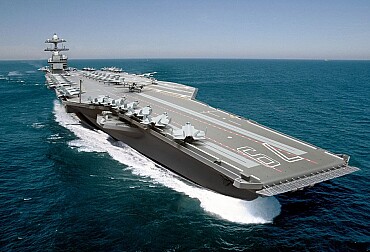
In the global context, Russia’s carrier absence highlights its diminished standing in blue-water naval competition. The U.S. Navy operates 11 nuclear-powered supercarriers, China has three (with more under construction), and even France maintains the nuclear-powered Charles de Gaulle. For Moscow, however, the Kuznetsov’s retirement is more symbolic than a critical strategic loss. Russia’s core security focuses on defending its vast northern Arctic flank – where melting ice opens new routes and potential conflicts–protecting submarine bastions in the Barents and Kara Seas for nuclear deterrence, and securing coastal zones. These missions align better with submarines, corvettes, frigates, and shore-based aviation than with a single, high-maintenance carrier.
Ultimately, the Admiral Kuznetsov’s saga – from Soviet-era pride to a costly, smoke-belching relic—mirrors broader post-Soviet challenges in sustaining advanced naval programs amid economic pressures, corruption allegations, and evolving warfare realities.