
The Unjammable Threat: How Fiber-Optic Drones Changed the Ukraine War in 2025
By 2025, the war in Ukraine has transformed into a grueling paradox. While the front lines are moving more than they did in previous years, the conflict has hardened into a grinding war of attrition. Moscow is increasingly desperate to project an image of inevitable victory to influence U.S.-brokered peace talks, yet the reality on the ground tells a story of high costs, "borrowed" victories, and a radical shift in how modern wars are fought.
From Mass Assaults to "Infiltration Warfare"
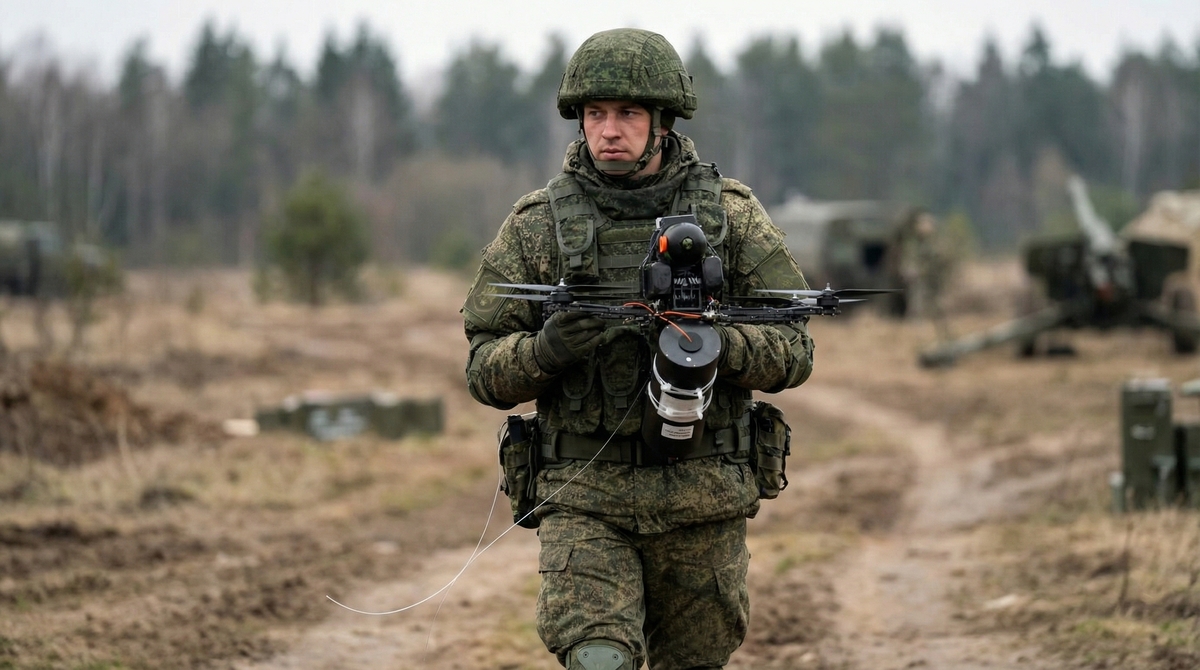
The days of massive Russian armored columns charging across open fields are largely over. In 2025, the Russian military has pivoted toward small-unit tactics to navigate a battlefield saturated with surveillance.
- Small Assault Groups: Russia now relies on tiny teams to probe weak points and gradually "seep" into Ukrainian positions.
- Incremental Gains: This approach was pivotal in the near-capture of Pokrovsk and Myrnohrad, allowing Russia to claim roughly 5,000 square kilometers of territory this year.
- The Drone Factor: In an environment where anything that moves is seen, large formations have become targets. Small, dispersed units are the only way to survive.
The Rise of the Fiber-Optic Drone
The technological arms race saw a significant tilt toward Moscow in late 2024, accelerating throughout 2025. Russia’s focus on scale and reliability has created a new nightmare for Ukrainian defenders.
The standout innovation of 2025 has been the fiber-optic drone. Connected by physical cables, these drones are immune to electronic jamming, making them lethal tools for disrupting supply lines. Moscow has also professionalized its drone corps, moving away from "hobbyist" deployments to centralized drone units that use a master-apprentice system to train elite operators.
The "Logistics Paradox"
Despite the Kremlin’s claim that the Russian defense industry is fully mobilized, the military remains a chaotic hybrid of state power and volunteer-funded survival.
- The Shadow Economy: Pro-war bloggers and volunteer groups are the real backbone of the front-line supply chain, raising funds for basic essentials like tires, body armor, and communication gear.
- Disposable Logistics: The Russian army now relies heavily on modified civilian vehicles. These "Frankenstein" cars often have a lifespan of only a few days on the battlefield before being destroyed by FPV drones.
Capture on Credit: The Propaganda Trap
A persistent issue for the Russian high command in 2025 is the practice of inflated reporting. Field commanders frequently report that a town has been "liberated" before the fighting has actually stopped—a tactic known as "capture on credit."
This creates a deadly cycle: once a victory is officially declared in Moscow, support for the units in that sector is often reduced. This leaves Russian soldiers vulnerable to counterattacks, as seen in the repeated, failed attempts to secure Kupiansk.
Why a Decisive Victory Remains Out of Reach
Despite capturing Huliaipole and Siversk due to Ukrainian manpower shortages, Russia remains unable to deliver a "knockout blow." Military analysts point out that while Russia holds the strategic initiative, its gains are tactical, not transformational.
To achieve a true breakthrough, Russia would need a massive concentration of troops that it simply does not have. For now, the war remains a series of costly, slow-motion lunges—a strategy that secures territory but fails to end the war.