
U.S. Army Unveils M1E3 Abrams Prototype: Lighter, Smarter, and Ready for Tomorrow’s Battlefield
The future of the American main battle tank is taking shape in the spotlight at the North American International Auto Show in Detroit, where the first early prototype of the M1E3 Abrams was unveiled on January 14-15, 2026. This unveiling marks a significant milestone in the U.S. Army’s efforts to modernize its armored forces, introducing a redesigned platform that addresses evolving battlefield threats such as drones, precision-guided munitions, and the need for greater mobility and sustainability.
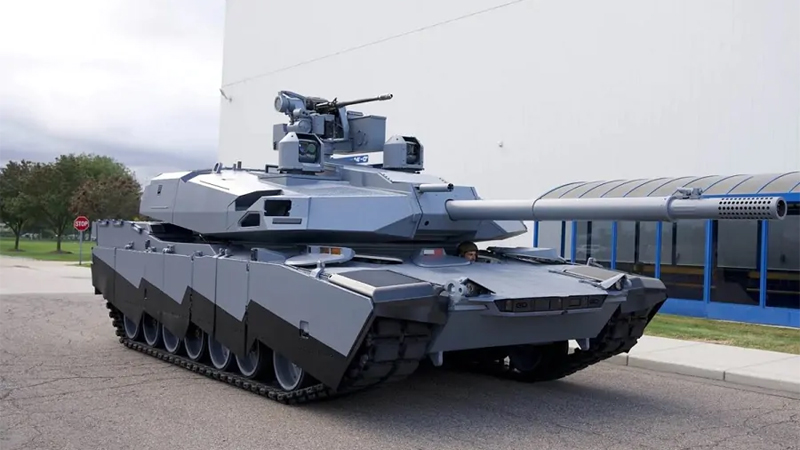
The U.S. Army selected an unconventional civilian venue – the Detroit Auto Show, traditionally focused on commercial vehicles – to showcase this military prototype. This choice underscores a deliberate strategy to bridge civilian and defense innovation, tapping into Michigan’s renowned automotive ecosystem for expertise in manufacturing, hybrid powertrains, electronics, and rapid prototyping. Collaborators like Roush Defense (which built the prototype) and components from companies such as Caterpillar highlight this approach, with General Dynamics Land Systems expected to handle eventual full-scale production.
The displayed vehicle is an early pre-prototype, not a near-final production model. It serves primarily as a physical demonstrator to validate key technological decisions, including software integration, mobility enhancements, and lethality improvements. Program officials emphasize that this is an engineering prototype incorporating lessons from risk-reduction activities. The Army plans to field four such pre-prototypes in 2026 for extensive testing within Army formations, with soldier evaluations beginning in early 2026 (potentially spring or summer). This accelerated timeline – driven by the Army’s Continuous Transformation acquisition model and the Army Transformation Initiative – advances the program significantly ahead of original projections, which targeted initial operational capability around 2030. Testing will focus on performance, safety, and integration of commercial-off-the-shelf parts to enable quicker iteration and reduced costs.
One of the most notable innovations in the M1E3 Abrams is its reduced crew size. Traditional Abrams variants, including the current M1A2 SEPv3, require a four-person crew (commander, gunner, loader, and driver). The M1E3 prototype incorporates an autoloader for the main gun, allowing operation by just three crew members. This change enhances efficiency, reduces manpower demands, and contributes to overall weight savings.
Complementing the autoloader is a major structural shift: an unmanned, remotely operated turret. Crew members are relocated to a heavily armored cockpit within the hull, improving survivability by keeping them below the turret ring and away from the most vulnerable areas during engagements. This design draws inspiration from lessons in recent conflicts, prioritizing protection against top-attack threats like drones and loitering munitions.
The M1E3 retains the proven 120mm M256 smoothbore gun as its primary armament, maintaining compatibility with existing ammunition stocks while benefiting from decades of refinement. The turret has been fully redesigned to integrate the autoloader and support remote operation. Additional firepower comes from a roof-mounted remote weapon station (RWS), which can be configured with a machine gun, automatic grenade launcher, or anti-tank guided missiles, offering modular adaptability for diverse mission requirements on dynamic, networked battlefields.
Enhanced situational awareness is achieved through an extensive array of external sensors, cameras, and likely fused systems (including infrared and LIDAR), providing a 360-degree integrated peripheral view. This replaces traditional periscopes and viewers, reducing crew exposure while boosting threat detection and response times. Other reported features include a hybrid diesel-electric drivetrain for improved fuel efficiency, silent watch capabilities (engine-off operation to reduce thermal signature), better off-road handling, and a lighter overall weight – targeting around 60 tons compared to the M1A2’s 70+ tons – for faster deployment and reduced logistical strain.
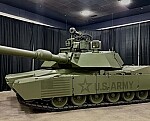
The M1E3 emphasizes modularity, open architecture for future upgrades, and integration of AI-enabled systems for threat prioritization and decision support. Its “Formula 1-style” cockpit with game-like controls aims to ease training for younger, tech-savvy soldiers.
In the broader context of contemporary Western main battle tank projects, the M1E3 stands out for its accelerated development and focus on evolutionary upgrades to an existing platform rather than a clean-sheet design. For comparison:
The British Challenger 3 (an upgrade of the Challenger 2) introduces improved armor, a new 120mm gun, and enhanced electronics, with initial operational capability targeted for around late 2026–2027. It prioritizes protection and firepower but remains a four-crew, manned-turret design without the radical weight reduction or hybridization seen in the M1E3.
Germany’s Panther KF51 (Rheinmetall’s private venture) features a 130mm gun, autoloader, three-crew configuration, and advanced active protection, weighing around 65 tons. It serves as a bridge to the Franco-German Main Ground Combat System (MGCS), a more ambitious long-term program (expected post-2040) envisioning a family of crewed and uncrewed platforms with shared lethality and networking.
The Main Ground Combat System (MGCS), a collaborative Franco-German effort launched in 2017 to replace the Leopard 2 and Leclerc tanks, represents Europe’s most forward-looking next-generation armored program. Unlike the M1E3’s focus on a single upgraded MBT platform with rapid prototyping and near-term fielding, MGCS is conceived as a broader !system of systems” – family of interconnected vehicles including a manned main battle tank, a manned missile carrier, and unmanned support platforms for sensors, non-line-of-sight weapons, drones, or electronic warfare.
Key envisioned MGCS features include advanced AI for decision support, sensor fusion for real-time situational awareness, protection against electronic warfare/cyber threats/directed energy weapons, and a modular base chassis (targeting under 50-60 tons for the core platform). Armament debates center on larger calibers like the 130mm Rh-130 or 140mm ASCALON gun, both with autoloaders to enable a reduced crew (likely three or fewer in the manned MBT variant), potentially with unmanned turret options for enhanced protection.
Initial timelines aimed for prototypes around 2030 and service entry by 2035–2040, but recent assessments push full operational capability beyond 2040 creating capability gaps and prompting interim solutions like upgraded Leopard 2 variants or Rheinmetall’s KF51. In contrast, the M1E3’s pragmatic, evolutionary path leverages existing Abrams infrastructure for faster iteration, weight reduction via hybridization and autoloader/unmanned turret integration, and deployment potentially in the early 2030s, allowing the U.S. to field modernized heavy armor sooner while addressing similar threats (drones, top-attack munitions, logistics).
The M1E3’s approach – leveraging commercial tech, hybrid power, and rapid prototyping – allows faster fielding than MGCS or even the KF51’s full adoption, while addressing similar challenges like drone threats and logistical burdens. Overall, the M1E3 represents a pragmatic step toward a more agile, survivable, and sustainable heavy tank, poised to evolve with emerging technologies and maintain U.S. armored dominance in contested environments.