
U.S. F-16s Deploy from Alaska Toward Greenland in Arctic Readiness Operation
The U.S. Air Force has moved F-16 fighter aircraft from Alaska to eastern Canada as part of a wider Arctic defense operation that will extend into Greenland, underscoring NORAD’s growing focus on rapid deployment, cold-weather operations, and allied coordination in the High North.
The deployment is being conducted under Operation ARCTIC VANGUARD 26-4.2, which runs from September 13 to September 26. According to NORAD, F-16s from Eielson Air Force Base in interior Alaska were sent to Goose Bay, located in Canada’s Newfoundland and Labrador province, before aircraft and personnel move farther forward into Greenland.
The operation is led by the Alaskan NORAD Region in close coordination with the Canadian NORAD Region. NORAD — the joint U.S.-Canadian command responsible for aerospace warning, aerospace control, and maritime warning for North America — said the deployment is designed to test the ability to move combat aircraft across vast northern distances and operate them in difficult Arctic conditions.
A key part of the exercise is proving that fighter units can be shifted quickly from Alaska, staged through northeastern Canada, and sustained in remote environments where infrastructure is limited and weather can create serious operational challenges. NORAD has not disclosed the number of F-16s or personnel involved in the mission, nor has it specified the exact location in Greenland where the aircraft will operate.
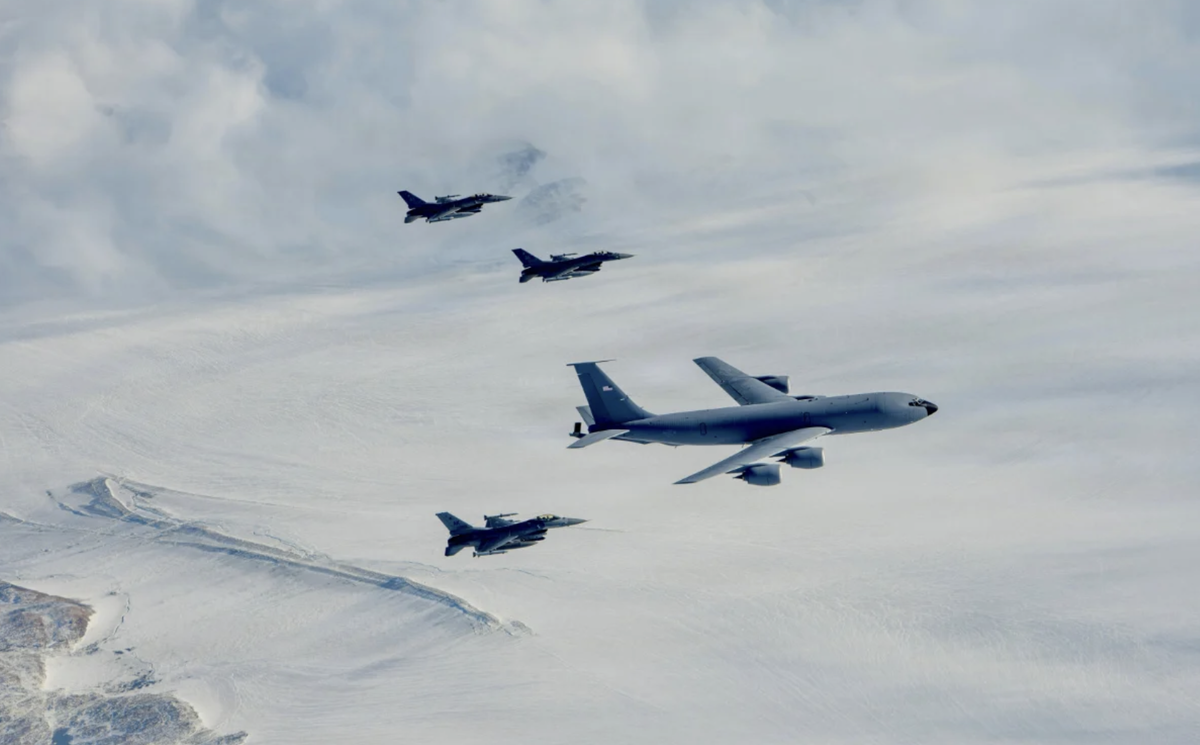
Royal Canadian Air Force strategic airlift helped support the movement. A U.S. Air Force image released earlier in September showed members of the 354th Fighter Wing loading cargo onto a Canadian CC-177 Globemaster III at Eielson Air Force Base. Another photo, dated September 16, showed U.S. Air Force F-16s flying with a KC-135 Stratotanker over Greenland, highlighting the aerial refueling support needed for long-range Arctic operations.
In Greenland, U.S. aircraft and personnel are expected to work alongside partners from the Kingdom of Denmark and NATO. Greenland, an autonomous territory within the Kingdom of Denmark, occupies a strategically important position between North America and Europe. Its geography makes it a key location for monitoring northern air approaches and supporting allied activity across the Arctic.
Lt. Gen. Robert D. Davis, commander of the Alaskan NORAD Region, said the operation shows that distance and harsh terrain do not prevent NORAD from carrying out its defense mission.
“Operation ARCTIC VANGUARD demonstrates that austere conditions and vast distances present no barrier to NORAD’s collective defense,” Davis said. He added that moving combat airpower from Alaska across Canada and into Greenland validates agile combat capabilities and demonstrates integration with Canada, Denmark, and NATO allies.
The deployment comes amid a series of U.S. and allied activities focused on improving military readiness in the Arctic. The current operation is not limited to F-16s. U.S. Northern Command also announced that F-35A fighters from the Wisconsin Air National Guard’s 115th Fighter Wing had flown missions from Pituffik Space Base in Greenland under the same ARCTIC VANGUARD framework.
Pituffik Space Base, formerly known as Thule Air Base, is the northernmost U.S. military installation in the world. Located in northwestern Greenland, it plays a long-standing role in U.S. and allied operations in the Arctic region.
NORAD has conducted similar Arctic deployments before. In February 2025, F-16s and KC-135 tankers deployed to Pituffik for Operation NOBLE DEFENDER, operating in temperatures as low as minus 34 degrees Celsius. Later that year, in October 2025, NORAD sent two F-35s, two F-16s, and three KC-135 tankers to the Arctic to test how quickly forces could be deployed to the region.
Operation ARCTIC VANGUARD is part of what NORAD and U.S. Northern Command call the Nordic Bridgeconcept. The approach is intended to align Arctic operations, exercises, training, and investments with NATO, partner nations, and other U.S. combatant commands. The goal is to create a more consistent multinational presence across the region and improve interoperability in multiple domains.
The latest F-16 movement from Alaska to Greenland reflects a broader shift in how North American defense planners view the Arctic. The region’s extreme climate, limited infrastructure, and long distances make it a demanding operating environment. For NORAD, practicing the movement of fighter aircraft, tankers, cargo, and support teams across the northern theater is central to maintaining credible deterrence and rapid-response capability.
The current iteration of Operation ARCTIC VANGUARD is scheduled to conclude on September 26. NORAD has not said when the F-16s will return to Alaska or how long they will remain forward-deployed in Greenland.