
Whoever Controls the Defense Industry Controls the War: Central Europe in the Race for Manufacturing, Data, and AI
The European defense industry is currently undergoing a turning point that is changing the rules of both production and business relations. Inventories are depleting faster than the industry can replenish them, production capacity is falling short, and manufacturers who can deliver volume, speed, and quality all at once are gaining the upper hand. “This clearly plays into the hands of manufacturers. Capacity is insufficient to meet even the basic needs of the armed forces, not only in Poland but across Europe and beyond,” said Przemysław Kowalczuk of the Polish Niewiadów Group, summarizing the current situation.
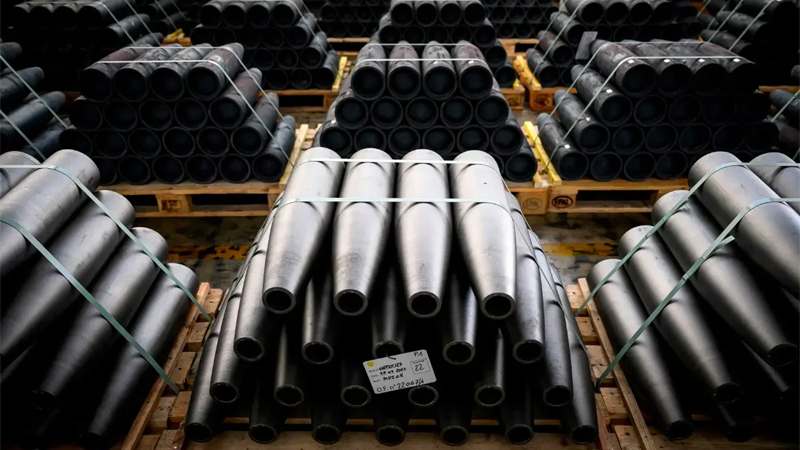
This shift did not happen overnight. For three decades, European armies had been purchasing ammunition in minimal quantities, often amounting to only a few thousand rounds of large-caliber ammunition per year. The manufacturing base adapted to this, in many cases operating at the very limit of economic viability, and some countries lost the ability to produce key types of ammunition entirely. Once the intense war between Ukraine and Russia began consuming stocks in the hundreds of thousands of rounds per year, it became clear just how fragile the entire model was. The return to mass production is therefore not happening gradually, but under pressure that is forcing the industry to skip entire stages of development.
In the current industrial landscape, Central Europe—especially Poland—is gaining extraordinary significance. The region has retained Cold War-era know-how, technology, and infrastructure in certain segments, which is precisely why it can scale up production relatively quickly. The combination of state-owned enterprises and a dynamic private sector creates a more flexible environment than traditional Western European structures. “This is a window of opportunity. The client has a need and still has the financial resources. Whoever can deliver will secure a strong position many years in advance,” said Przemysław Kowalczuk in an interview with the Polish portal Strefa Obrony.
The scale of the change is illustrated by specific figures. New or modernized plants in the region are targeting an annual production of around 150,000 to 200,000 pieces of artillery ammunition. For the Niewiadów group, this amounts to about 180,000 rounds per year, or hundreds of rounds per day under standard production conditions. Such intensity has not been common in Europe since the late 1980s. At the same time, these very figures reveal the main problem: traditional production organizations cannot handle such a volume.
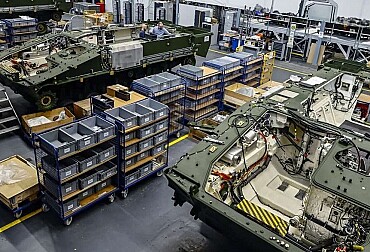
Przemysław Kowalczuk spoke openly about this: “Increasing the number of workers is not the solution. With these volumes, it doesn’t add up mathematically. The only way forward is through the automation of virtually every step of production.” The defense industry is thus moving closer to the automotive model, where a high degree of robotization and standardization maintains stable performance even at high volumes. However, this is not merely a technical change. It opens the door to a deeper transformation that will affect the very essence of product manufacturing.
The traditional concept of ammunition was based primarily on metallurgy and mechanics. Current developments are shifting the focus toward electronics, software, and data. Programmable munitions, greater precision, and integration with digital fire control systems are changing the entire manufacturing paradigm. “Steel today represents a necessary foundation. The real competitive advantage arises in the digital realm, in data integration and the ability to respond in real time,” summarized Artur Józefiak of the consulting firm Accenture, reflecting on developments in recent years.
This shift connects the product to its broader application, which extends far beyond the boundaries of manufacturing. The modern battlefield functions as a data ecosystem where every element depends on the speed and quality of information transmission. “Today, it is impossible to effectively engage a target without digital capabilities. Without data flowing between sensors, control systems, and weapon platforms, even the most advanced ammunition loses its purpose,” Artur Józefiak noted in a discussion on the Strefa Obrony portal.
This is where artificial intelligence comes into play. When data volumes grow too quickly, traditional analytical methods are no longer sufficient. AI helps optimize production, manage logistics, predict failures, and shorten decision-making cycles on the battlefield. “Today, we have enough data to develop specialized models. The question is not whether to use AI, but how to properly integrate it into processes so that it delivers real value,” added Marcin Kubec of Transition Technologies MS.
The integration of technologies is not limited to the final product. It naturally plays a crucial role in production as well. The concept of digital twins and advanced production lifecycle management enable every step to be monitored and optimized in real time. Marcin Kubec, however, pointed out new challenges: “It’s easy to collect data and fill databases. The difficult part is knowing what we want to measure and how to use that information to manage production and innovation.”
This factor is proving to be key as innovation cycles shorten. New product versions can be released within months, which puts pressure on the flexibility of the entire system. A manufacturing plant must therefore account not only for current production but also for rapid adaptation to future changes. This applies to technology, organizational structure, and decision-making processes.
At the same time, it is becoming clear that production capacity alone is not enough. Logistics—that is, how effectively to deliver products to where they are needed—is emerging as the weakest link. Industry can produce top-quality products, but if they do not reach the right place on time, they lose their purpose. This issue is of particular importance for Central Europe, where new capacity is emerging faster than long-term political strategies and infrastructure.
Another risk for regional manufacturers is posed by the standards that determine entry into global supply chains. Meeting the requirements of NATO or the U.S. Department of Defense is not merely an administrative matter. It involves a comprehensive change and the adjustment of processes that directly impact competitiveness. “These standards come at a cost; that’s a fact. On the other hand, they organize the company and open doors to markets we wouldn’t otherwise reach,” added Przemysław Kowalczuk.
For Central European countries, this implies the need to think in the long term. Investments in production capacity must take into account both domestic demand and future export opportunities. The question, therefore, is not whether local companies can supply today, but where they will be supplying in 5–10 years. This shifts the focus of business planning from short-term order fulfillment to building a long-term position in the global market.
Moreover, the IT sector plays a significant role, as it is one of the strongest segments of the Central European economy. However, its involvement in the defense industry remains limited. “We have a strong IT sector that serves global civilian clients. We lack systematic demand that would steer it toward the defense sector,” Artur Józefiak pointed out, highlighting a structural problem. The result is a situation where digital components often come from abroad as part of complex weapons systems.
This situation contrasts with that of the United States or Israel, where the military actively stimulates the domestic technology ecosystem. Demand for specific solutions emerges, partnerships develop, and companies grow based on actual defense needs. In Central Europe, a similar mechanism is still lacking, thereby limiting the region’s ability to fully realize its potential.
The overall picture reveals a transformation unfolding simultaneously on several levels. On one hand, there is an urgent need to increase production and replenish stockpiles. On the other hand, a new industrial paradigm is emerging, driven by data, software, and integration capabilities. A tension is arising between these two poles that will determine the direction of development in the coming years.
For Central Europeans, this situation presents a unique opportunity. The region can strengthen its role in Western security architecture while simultaneously building an industrial base with a global reach. Success, however, depends on the ability to integrate traditional manufacturing with digital technologies, invest in infrastructure, and create an environment for the growth of domestic technology companies.
“It’s not just about delivering a product. It’s about creating a system that will function in the long term, one that can handle both growth and change,” said Przemysław Kowalczuk, describing the challenging situation facing the Central European defense industry. It is precisely this ability to adapt and integrate that will determine whether the current window of opportunity leads to a lasting strengthening of the Central European region or remains merely an untapped opportunity in the shadow of the Western European defense industry.