
A Front Line Without Infantry? Ukraine Tests the Future of Ground Combat
The development of Ukrainian unmanned ground vehicles represents one of the most significant qualitative shifts in the current conduct of high-intensity warfare. Russian aggression has created an environment in which technological adaptation has become an existential necessity rather than the result of long-term planning in peacetime. Just as 2023 and 2024 saw a rapid expansion of air and naval drones, 2025 and early 2026 marked the systematic emergence of unmanned ground vehicles, collectively referred to as UGVs (Unmanned Ground Vehicles). Thanks to their massive combat deployment in this area, Ukraine has moved into the position of global leader.
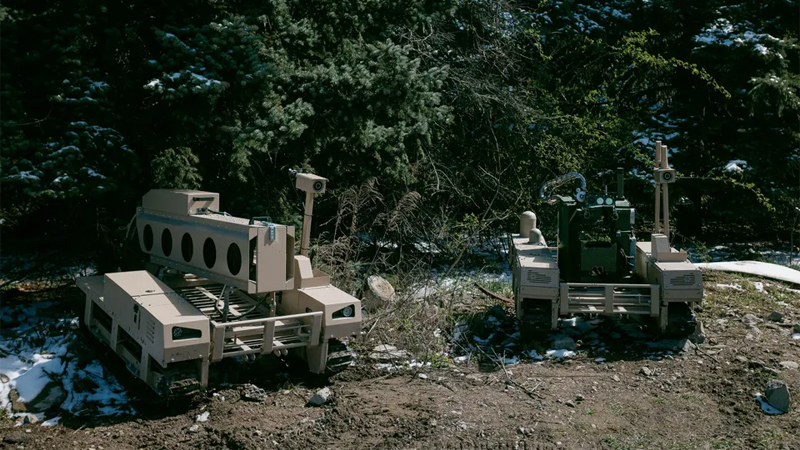
The massive deployment of UGVs has changed the nature of the battlefield. The front line has expanded to a depth of tens of kilometers and has taken the form of permanent "kill zones." Any movement of conventional vehicles or infantry is quickly detected and destroyed by a combination of reconnaissance and suicide drones, artillery, and precision munitions. In such an environment, traditional logistics and classic infantry attacks become extremely costly in terms of human casualties. Ukraine's response is to systematically remove humans from the most dangerous sections of the battlefield and replace them with machines that, while still vulnerable, are economically and morally replaceable.
The Ukrainian approach to UGVs is characterized by extremely close links between frontline units, developers, and manufacturing capacities. The vast majority of systems are developed directly in Ukraine, often in small and medium-sized companies that are able to incorporate feedback from soldiers directly from the battlefield within weeks. The result is a very wide range of platforms, from simple logistics vehicles to evacuation and engineering systems to full-fledged combat robots with remote-controlled turrets.
From a technical point of view, UGVs can be divided into wheeled and tracked platforms. Wheeled systems excel in higher speed, lower energy consumption, and easier maintenance, which makes them ideal for logistical tasks on relatively solid terrain. Typical examples are the TerMIT platforms or the lighter logistics variants of the Veprik series, capable of transporting tens to hundreds of kilograms of ammunition, water, or food. Tracked UGVs, such as the Muracha, Muracha-Mini, or the heavier Karakurt, are optimized for movement in muddy terrain, over craters and trenches. These more robust platforms have a load capacity of up to several hundred kilograms, and some variants are capable of overcoming water obstacles.
Logistics is currently the main area of deployment for UGVs. Approximately half of all missions involving these systems are aimed at supplying frontline positions and evacuating the wounded. The rationale behind this solution is obvious: while the loss of a logistics robot costing tens of thousands of US dollars may be painful but acceptable, the loss of a trained soldier represents an irreplaceable human and operational deficit. Many Ukrainian units now consider driving a conventional vehicle to the front line an unacceptable risk, and UGVs have become virtually the only way to keep supplies moving.
According to the American think tank Jamestown, in addition to logistics, the combat deployment of UGVs is developing rapidly. Ukrainian companies are integrating standard weapon systems into ground platforms, including 7.62 mm PKT machine guns, 12.7 mm Browning M2 heavy machine guns, and MK-19 automatic grenade launchers. A typical example is the Droid TW, a tracked combat robot equipped with a remote-controlled turret with a machine gun, thermal imaging, daytime cameras, and a digital fire control system. This type of UGV can take up a firing position and remain there for tens of days without the need for rotation, which fundamentally changes the dynamics of defense.
Suicide UGVs, designed to destroy fortifications, bunkers, and armored vehicles, represent a specific category. Ratel-S type platforms can carry a payload of up to 40 kilograms of explosives or a combination of TM-62 anti-tank mines. These machines function as the ground equivalent of attack FPV drones, but with significantly higher payload capacity and the ability to approach targets below ground level, for example in forest cover or in building ruins.
A turning point in their development came with coordinated operations in which UGVs were deployed alongside aerial drones in fully robotic attacks. The practical aspects of planning such operations are described by a Ukrainian officer known by the nickname Shuhaj, who was involved in preparing one of the first operations of this type. "When you plan a mission with soldiers, you have to take into account a whole range of factors: combat stress, shock, and other psychological effects," he explains. "But if the operation consists exclusively of drone operators, it's a completely different scenario. Suddenly, it's crucial to pay much more attention to communication systems and in-depth knowledge of the terrain."
Shuhaj also points out the technical limitations of ground robots. "Ground drones require extremely accurate knowledge of the terrain. Any pit, crater, or trench can be deadly for them," he says. "That's why we have to plan routes well in advance. We use high-resolution images, orthophotomaps, and detailed terrain data. Even a single heavy rain shower can dramatically change conditions, so plans sometimes need to be updated almost daily." This experience illustrates that the robotization of combat does not mean simplification, but rather a shift of complexity from the physical presence of soldiers to the areas of planning, data, and control.
Coordinated robotic operations had not only a tactical but also a significant psychological effect. Russian troops, accustomed primarily to threats from the air, sometimes found themselves under fire from ground platforms that approached without directly threatening Ukrainian soldiers. From Ukraine's perspective, however, the main goal was to verify that the combination of UGVs and UAVs is viable even in an environment of intense electronic warfare.
Communication and resistance to interference are one of the key technical problems. UGVs use a combination of radio links, repeaters, and in some cases satellite terminals. Navigation often takes place without the use of GPS, which is systematically jammed, and relies on inertial sensors, visual navigation, and pre-prepared map data. Ukrainian practice shows that even under these conditions, acceptable reliability can be achieved if systems are designed with an emphasis on redundancy and simplicity.