A Revolutionary Step in Naval Autonomy: The AIRCAT Bengal MC
The unveiling of the AIRCAT Bengal MC in April 2025 represents a significant advancement in unmanned naval technology, developed through a collaboration between U.S.-based Eureka Naval Craft and Australian autonomy specialist Greenroom Robotics. While not yet an operational vessel in the U.S. Navy fleet, this proposed design has been described by its creators as one of the most advanced autonomous naval attack platforms conceived to date. It highlights the growing role of international partnerships, particularly under frameworks like AUKUS, in pushing the boundaries of maritime warfare.
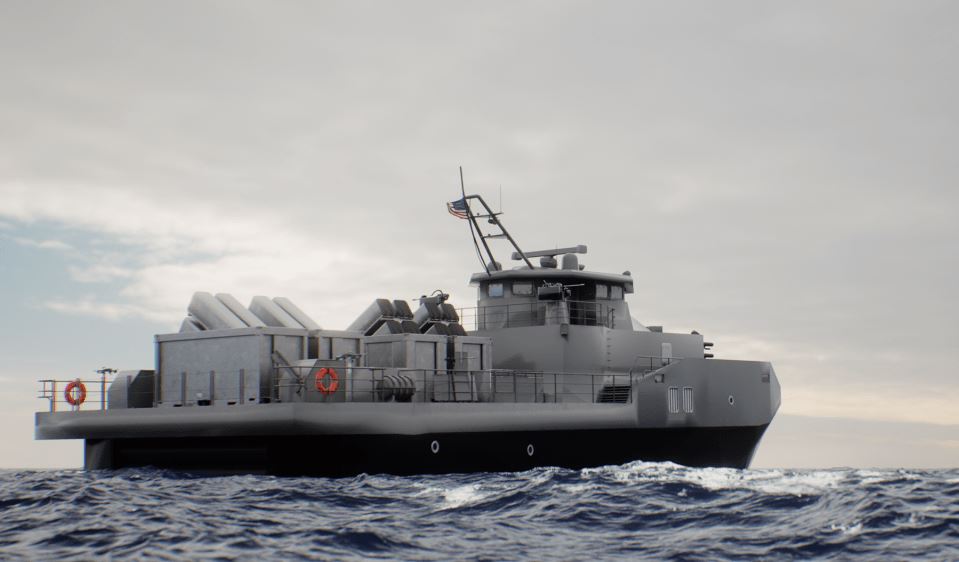
The AIRCAT Bengal MC is a 36-meter multi-mission vessel built on a Surface Effect Ship (SES) architecture, which combines catamaran-like stability with air cushion technology for reduced drag and enhanced performance in rough seas. This design allows for exceptional speed—exceeding 50 knots depending on payload—and a range of approximately 1,000 nautical miles (about 1,850 kilometers). Its standout feature is the ability to carry a payload of up to 40-44 tons, equivalent to two standard 40-foot ISO containers, making it highly modular and adaptable for various missions.
At the core of its autonomy is the Greenroom Advanced Maritime Autonomy (GAMA) system, developed by Greenroom Robotics. GAMA has been proven in real-world trials, including the Australian Navy’s Patrol Boat Autonomy Trial (PBAT) on a decommissioned 57-meter Armidale-class vessel. It enables advanced navigation, situational awareness, threat detection, and fleet coordination using AI-driven software. The vessel can operate in fully autonomous, remotely controlled, or optionally crewed modes (with space for a small crew of 5-7 personnel), providing flexibility for high-risk operations while allowing human oversight when needed.
The Bengal MC’s modular design allows it to swap payloads quickly, transforming it from a surveillance platform to a combat asset. It is proposed to integrate potent weaponry, including Tomahawk cruise missiles for long-range strikes and Naval Strike Missiles (NSM) for anti-ship engagements. This armament would enable precision attacks against land or sea targets, reducing reliance on larger, crewed warships for missile launches and minimizing risks to personnel.
Beyond combat, the vessel’s versatility extends to logistics support, drone operations (serving as a mothership for aerial or marine unmanned systems), troop transport, mine countermeasures, reconnaissance, and even search-and-rescue missions. Its high speed and endurance make it ideal for distributed maritime operations in contested environments, such as the Indo-Pacific region, where rapid response and persistence are critical.
Eureka Naval Craft positions the Bengal MC as a cost-effective alternative to traditional corvettes and frigates, leveraging modular construction to lower building and maintenance expenses while maximizing fuel efficiency. The design emphasizes affordability and scalability, with potential production across multiple shipyards. It is being marketed to the U.S. Navy, U.S. Marine Corps, AUKUS partners (Australia, UK), NATO allies, and Indo-Pacific nations like Japan, South Korea, Singapore, and others.
This project builds on broader trends in naval innovation. The U.S. Navy has been advancing unmanned surface vessels (USVs) through programs like Ghost Fleet Overlord, which has tested converted commercial vessels for long-range autonomous transits and payload integration since 2018. Meanwhile, Greenroom Robotics’ GAMA software has expanded through partnerships, including with Austal Australia and UK firms, aligning with AUKUS Pillar II goals for advanced capabilities in autonomy and AI.
In a geopolitical landscape marked by rising maritime tensions, platforms like the Bengal MC could enhance deterrence by enabling distributed, resilient forces. Autonomous systems reduce crew exposure, lower costs, and allow fleets to cover vast oceans more effectively. As prototypes transition to operational concepts, such vessels may redefine naval strategy, blending human oversight with machine precision for safer, more agile operations.
The AIRCAT Bengal MC exemplifies how private industry and international collaboration are accelerating naval evolution. Though still in the design and proposal phase, its features—high-speed autonomy, heavy modular payload, and lethal armament—signal a future where unmanned platforms play a central role in maintaining sea control and projecting power.