ACV-30 Enters Service: America’s Wheeled Amphibious Powerhouse Challenges Peers in Global 8x8 Arena
The United States Marine Corps has taken a significant step forward in modernizing its expeditionary forces with the official beginning of operational fielding for the Amphibious Combat Vehicle-30, or ACV-30. Announced by BAE Systems on May 28, 2026, this milestone delivers a protected, mobile platform armed with a stabilized 30mm cannon directly into the hands of Marine units. Designed for the demanding realities of contested littoral environments, the ACV-30 represents a leap in combining amphibious mobility, survivability, and direct-fire lethality, addressing long-standing gaps in the Corps’ ability to project power from ship to shore and inland.
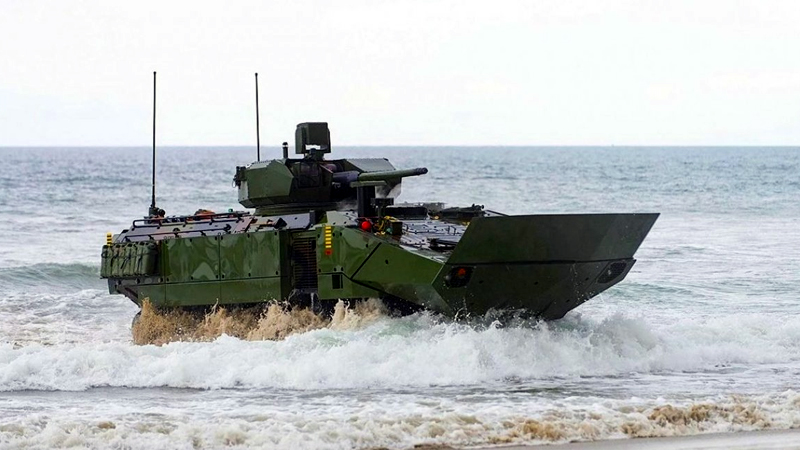
At its core, the ACV-30 is an eight-wheeled, all-terrain armored vehicle built on a proven 8x8 chassis derived from the Iveco SuperAV design, refined through collaboration between BAE Systems and the Marine Corps. Weighing around 35 tons in its combat configuration, it features a V-shaped hull for superior blast protection against mines and improvised explosive devices, energy-absorbing seats, automatic fire suppression systems, and a robust armored structure that provides MRAP-level survivability while maintaining amphibious performance. Powered by a high-output diesel engine delivering approximately 690-700 horsepower, the vehicle achieves road speeds exceeding 65 mph on paved surfaces and maintains effective mobility across rough terrain, including the ability to operate with a flat tire. Its true distinction lies in its open-ocean swimming capability, allowing it to launch from amphibious ships positioned well offshore – up to several nautical miles – and self-propel to hostile beaches using water jets at speeds around 6 knots, then seamlessly transition to land operations.
Development of the ACV family traces back to efforts to replace the aging AAV-7 tracked amphibious assault vehicle, which had served since the 1970s but faced limitations in protection, reliability, and adaptability to evolving threats. The program evolved through phases, with early focus on wheeled solutions for better strategic mobility, lower maintenance, and enhanced protection in an era of anti-access/area-denial challenges. BAE Systems secured the prime contract, leveraging the SuperAV platform. Initial personnel carrier variants (ACV-P) reached initial operational capability around 2020, proving the basic design’s worth through rigorous testing in varied conditions. The ACV-30 variant emerged as the infantry fighting vehicle iteration, incorporating a Kongsberg RT-20 remote turret armed with the Mk44 Bushmaster II 30mm chain gun and a coaxial 7.62mm M240 machine gun. This remote weapon system allows precise, stabilized fire on the move, both afloat and ashore, with capacity for up to 300 rounds of 30mm ammunition. The vehicle typically carries a crew of three – driver, commander, and gunner – plus up to eight embarked Marines, along with two days of supplies, making it a self-sustaining element in expeditionary operations. Plans call for roughly 152 ACV-30s within a total ACV fleet of about 608 vehicles across personnel, command, recovery, and cannon-armed variants.
The ACV-30’s capabilities are tailored for the Marine Corps’ Force Design 2030 emphasis on distributed littoral operations. Its 30mm cannon provides organic direct-fire support far superior to earlier .50 caliber or 40mm grenade launcher options, enabling engagement of light armored vehicles, fortifications, personnel, and low-flying threats at ranges out to several kilometers. The stabilized turret maintains accuracy while the vehicle maneuvers or swims, a critical edge in dynamic beach assaults. High ground clearance, advanced suspension, and all-wheel drive ensure strong off-road performance comparable to or exceeding tracked predecessors in many environments, while the wheeled configuration offers superior road speeds and lower logistical burden. Protection levels include resistance to small arms, artillery fragments, and significant underbelly blasts, with provisions for add-on armor and potential active protection systems against RPGs, drones, and anti-armor threats. This balance allows the ACV-30 to not only deliver Marines safely but also remain combat-effective immediately upon reaching shore, supporting dismounted maneuvers with suppressive fire.
In the broader landscape of major wheeled armored fighting vehicles, the ACV-30 stands out for its seamless integration of full amphibious operations with heavy firepower, a combination not universally matched among contemporaries. Consider the General Dynamics Stryker family, particularly the 30mm-armed Dragoon (M1296/M1304) variants used by the U.S. Army. These are highly mobile 8x8 platforms optimized for rapid deployment and inland maneuver, with excellent road performance and Double-V Hull protection against blasts. The Stryker Dragoon’s Kongsberg turret with the same Bushmaster II 30mm gun offers similar lethality, and its lighter weight – around 20-26 tons – grants superior strategic airlift compatibility. However, Strykers lack the ACV-30’s inherent open-water swimming ability and ship-to-shore self-deployment, relying instead on strategic lift for water crossings. The ACV-30’s larger troop capacity in its baseline form and dedicated amphibious focus give it an edge in Marine littoral scenarios, though Strykers may hold advantages in pure land speed and some networked C4ISR integrations within Army formations.
Europe’s Piranha V, from General Dynamics European Land Systems, serves as another close peer. This modular 8x8 offers scalable protection up to STANAG Level 5 with add-ons, including all-around 25mm resistance in maximum configuration, and can mount 30mm turrets for IFV roles. With strong mine protection via its V-hull and high payload capacity, it excels in versatility across APC, reconnaissance, and fire support missions. Yet, while amphibious kits are optional for some Piranha variants, the ACV-30’s baseline design prioritizes robust sea performance without compromises, achieving better inherent swim capability and transition handling. The Piranha V’s lighter baseline weight can aid mobility in certain terrains, but the ACV-30’s heavier, more armored build and Marine-specific optimizations provide superior protection and endurance for contested beachheads.
Germany’s Boxer, a collaborative 8x8 with a unique modular mission-pod system, emphasizes protection and adaptability, with combat weights pushing 36-38 tons in advanced configurations. Its high-end armor and options for 30mm turrets make it formidable in high-intensity European conflicts, and the separable drive and mission modules allow rapid role changes. Boxer variants deliver excellent crew comfort and survivability, often with superior internal volume. However, it is not inherently amphibious in the same self-propelled, open-ocean sense as the ACV-30, typically requiring support for water operations. The ACV-30 trades some of the Boxer’s modularity depth for proven swim performance and a more compact, expeditionary footprint suited to naval integration, while matching or approaching its firepower and blast resistance.
Other notable wheeled AFVs, such as the Patria AMV or various LAV derivatives, share the 8x8 trend toward high mobility and protection but generally prioritize land-centric roles. The ACV-30 differentiates itself through its purpose-built amphibious DNA, allowing Marines to bridge sea and land domains more fluidly than most land-focused wheeled platforms. While heavier than some peers, which could affect certain air transport options, this mass contributes to its stability in surf and resilience under fire. Ongoing enhancements, including potential counter-drone systems and active protection, will further evolve the platform.
As the ACV-30 enters operational service, it signals a maturation of Marine Corps capabilities for high-end littoral combat. No longer must amphibious forces rely solely on legacy systems or vulnerability during the ship-to-shore transition. This vehicle promises to enhance unit cohesion, provide immediate firepower, and enable more aggressive expeditionary maneuvers against peer adversaries. Its fielding comes at a pivotal time, reinforcing the Corps’ role as a agile, sea-based crisis response force while setting a benchmark among modern wheeled armored vehicles for integrated amphibious lethality.