
Airbus Unveils Dual High-Speed and Conventional Concepts to Shape NATO’s Post-2035 Helicopter Fleet
Airbus Helicopters recently unveiled two innovative rotorcraft concepts as part of NATO’s Next Generation Rotorcraft Capabilities (NGRC) program. These designs aim to equip European and allied forces with advanced platforms to replace aging fleets entering service between 2035 and 2040.
The NGRC initiative addresses the obsolescence of medium multi-role helicopters operated by NATO members. Many current models, including various NH90 variants, approach the end of their operational lives. The program seeks rotorcraft offering extended range (over 900 nautical miles), cruising speeds around 220 knots, payloads of 12-16 troops or four tonnes, and controlled costs (flyaway under €35 million per unit, operating costs €5,000-€10,000 per flight hour).
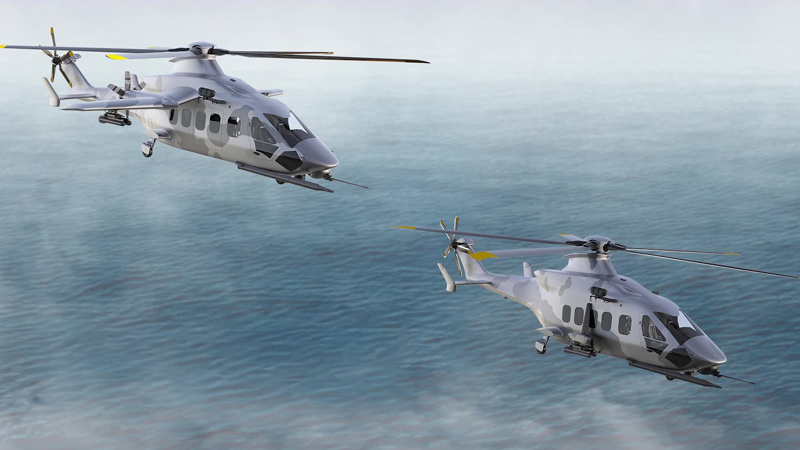
Airbus’ proposals feature two complementary approaches developed with partners Collins Aerospace, Raytheon (both RTX), and MBDA:
- A high-performance conventional helicopter, emphasizing robustness, versatility, and affordability through proven designs.
- A high-speed compound rotorcraft, incorporating fixed wings and side propellers for superior speed, range, endurance, and payload. This builds on Airbus’ X3 demonstrator and the Racer high-speed compound under the European Next Generation Rotorcraft Technologies (ENGRT) program, where military pilots validated benefits like rapid acceleration/deceleration, fast climbs/descents, and expanded flight envelopes.
Both concepts share a Modular Open System Architecture for commonalities in maintenance, training, weapons, and systems – promoting simplicity, upgradability, and long-term affordability. Features include enhanced connectivity, cybersecurity, crewed-uncrewed teaming, multi-domain combat integration, survivability, and battle damage repair.
Bruno Even, CEO of Airbus Helicopters, emphasized Europe’s need to deliver capable, cost-effective solutions: “We want to ensure that Europe is in a position to offer a platform that best meets the needs of our military partners in terms of affordability, operational efficiency, and maximum availability, both for conventional helicopters and high-speed rotorcraft.”
Airbus leads the NGRC concept study awarded by the NATO Support and Procurement Agency (NSPA) in July 2024. Competitors include Leonardo (tiltrotor) and Sikorsky (compound pusher designs based on X2 technology). The project involves nations like France, Germany, Italy, the Netherlands, the UK, Canada (Greece as participant; US and Spain as observers), transitioning to detailed concept design phases.
Airbus complements this by evolving its current military portfolio. The NH90 receives Block 1 and 2 upgrades for long-term viability, while models like the H145M, H160M, and H225M set benchmarks in affordability, connectivity, and maintenance.
Globally, similar ambitions drive next-generation rotorcraft
In the United States, the Army’s Future Vertical Lift (FVL) program advances the Future Long-Range Assault Aircraft (FLRAA), designated MV-75. Based on Bell’s V-280 Valor tiltrotor, it targets twice the speed and range of the UH-60 Black Hawk (cruising up to 280 knots). Milestone B occurred in 2024, with prototype flights planned for 2026, low-rate production in 2028, and initial fielding potentially accelerated to 2028-2030. The program replaces portions of Black Hawk fleets, including for special operations, after canceling the Future Attack Reconnaissance Aircraft (FARA) in 2024 to redirect resources toward autonomy, unmanned systems, and FLRAA.
In Europe, beyond NGRC, ENGRT II (launched 2026, co-funded by the EU) matures technologies with Airbus and Leonardo leading: compound (from Racer) and tiltrotor configurations across a 53-partner consortium from 12 nations, bolstering strategic autonomy.
China pursues high-speed rotorcraft, with recent flight tests of a coaxial compound demonstrator (S-97 Raider-like) and tiltrotor prototypes. These hint at future platforms for the People’s Liberation Army, emphasizing speed and low-altitude combat, though details remain limited and focused on domestic modernization.
These programs reflect a global shift toward faster, longer-range, more connected rotorcraft integrating advanced technologies like autonomy and modular systems to meet evolving threats.