
America’s New Air Force One Has Arrived, and the Details Are Turning Heads
The United States has taken a major step in presidential aviation with the arrival of a new Air Force One aircraft, delivered on a timeline that few in Washington expected when the effort first began. More than just a symbolic upgrade, the new jet fills a growing operational gap inside one of the country’s most sensitive missions: keeping the President mobile, protected, and connected anywhere in the world at a moment’s notice.
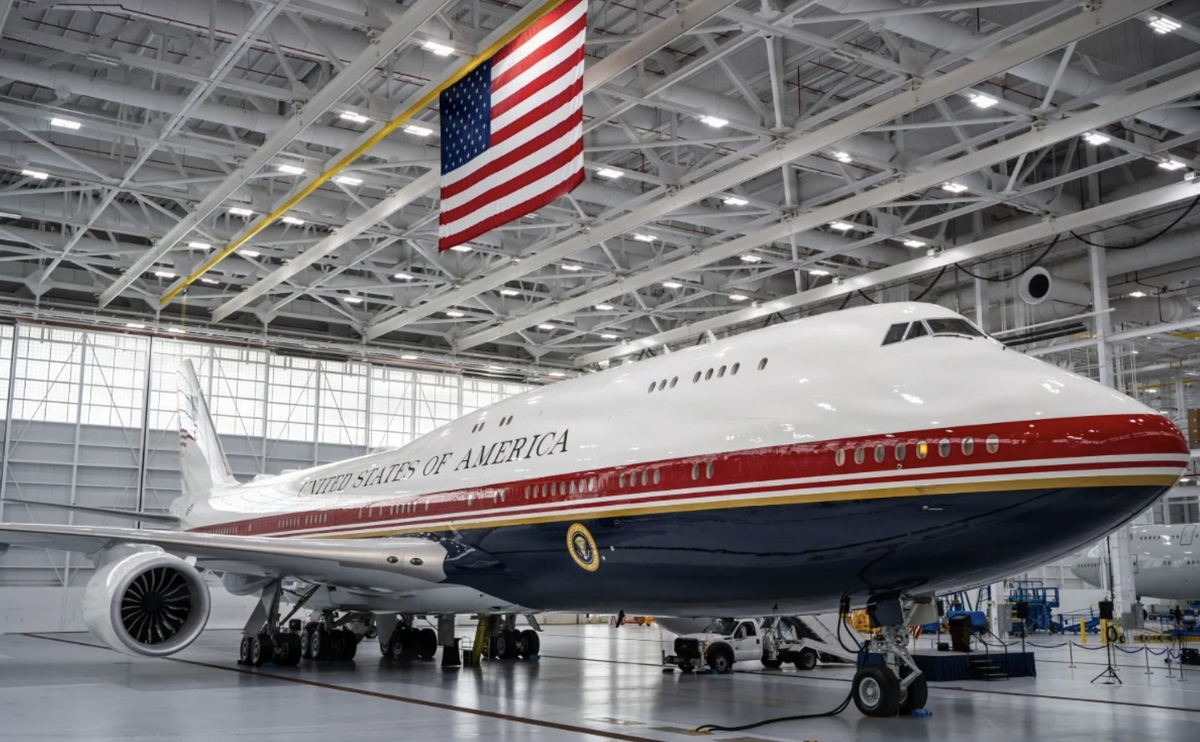
The aircraft, known as the VC-25B Bridge, has officially joined the Presidential Airlift Group at Joint Base Andrews in Maryland, the elite unit responsible for transporting the President of the United States. It has now entered commissioning flights, the final validation phase before it can be cleared for presidential service. Once approved, it will become a critical addition to the nation’s executive airlift fleet.
At first glance, the aircraft stands out for its appearance. It arrives in a new red, white, and blue livery, replacing the powder-blue design that has defined Air Force One since the Kennedy era. That alone marks a historic visual shift. But the more important transformation is inside the aircraft, where secure communications, executive transport systems, and mission-critical modifications have turned a commercial jet into a flying command platform built for the highest office in the country.
The VC-25B Bridge is based on the Boeing 747-8, the most modern and largest version of the iconic 747 family. At roughly 76 meters, or 250 feet, in length, it ranks among the longest passenger aircraft ever built. Its range of around 14,800 kilometers, or 9,200 miles, gives it the ability to fly nonstop from Washington to nearly any major destination on Earth. For a presidential aircraft, that capability is more than convenient. It is a matter of security and diplomacy, allowing the President to respond directly to global crises without depending on foreign refueling stops.
What makes the Bridge aircraft especially notable is how it came together. Rather than waiting for Boeing’s long-delayed next-generation Air Force One replacement program, the Air Force moved with unusual speed by acquiring a previously owned commercial aircraft and modifying it through a tightly managed engineering effort. That decision allowed the service to create a near-term solution to a pressing problem that had been quietly worsening for years.
The current Air Force One fleet consists of two VC-25A aircraft, both adapted from Boeing 747-200 airframes that entered presidential service in 1990. After more than three decades of operation, those aircraft remain capable but increasingly difficult to maintain. Heavy maintenance periods have become more demanding and time-consuming, and when one aircraft is unavailable, the other must shoulder the entire burden of presidential airlift. That leaves little room for scheduling flexibility and raises obvious operational concerns if the remaining aircraft develops technical issues of its own.
The VC-25B Bridge changes that equation. By adding a third executive transport aircraft to the rotation, the Air Force reduces pressure on the aging VC-25A fleet and creates more resilience in a mission where failure is not an option. It is, in effect, a strategic bridge between the current generation of presidential aircraft and the fully purpose-built VC-25B replacement Boeing is still working to deliver for long-term service.
Secretary of the Air Force Troy Meink framed the achievement in simple terms, emphasizing that speed did not come at the expense of mission standards.
“The safety and security of the commander in chief is our highest priority. From the beginning, we meticulously evaluated every requirement to accelerate delivery while maintaining the high standards expected of the presidential mission. This effort proves that the U.S. Air Force can move fast without sacrificing quality, security, or reliability.”
That accelerated pace was supported by an unusually practical training strategy. In October 2025, the Air Force leased a Boeing 747-8F freighter from Atlas Air so that pilots and maintainers could begin preparing before the actual Bridge aircraft was ready. It later purchased a Lufthansa Boeing 747-8i passenger aircraft as a dedicated full-time training platform, ensuring that crews could continue training without interrupting the modification schedule. A full three-dimensional mockup of the Bridge aircraft’s interior was also delivered in January 2026, allowing White House staff and Presidential Airlift Group personnel to begin familiarization months before the first commissioning flight.
That preparation mattered because the program was designed around discipline and restraint. Rather than pouring time and money into cosmetic redesigns, the Air Force kept much of the previous head-of-state interior layout largely intact. The focus stayed on what directly supported the mission: communications, security systems, and airworthiness. Passenger areas that play a limited role during most presidential operations were not extensively reworked. It was a focused approach that reflected the logic behind the entire program — move quickly, concentrate on essentials, and do not compromise on critical performance.
Air Force Chief of Staff General Ken Wilsbach acknowledged that many doubted the effort could succeed on an accelerated timeline.
“Many thought it could not be done, but the United States Air Force was able to execute and provide a secure, reliable airborne command post on an accelerated timeline.”
The commissioning flights now underway represent the last major hurdle. These missions are designed to test the aircraft across the full range of tasks it may be asked to perform, while giving the White House enterprise and partner agencies a chance to verify every operational requirement. Only after that process is complete will the aircraft be formally cleared to carry the President.
Once commissioned, the VC-25B Bridge will join the VC-25A and C-32 fleets in the active presidential airlift rotation. That will give the United States three executive transport options for the first time in the modern operational environment, adding flexibility and reducing the strain on legacy aircraft that have long carried the mission.
The public, however, may be just as captivated by the aircraft’s exterior as by its strategic role. The original Air Force One design — powder blue over white with “United States of America” across the fuselage — became one of the most recognizable liveries in aviation history after it was selected in 1962 with the guidance of industrial designer Raymond Loewy. The new red, white, and blue paint scheme on the VC-25B Bridge represents the first major break from that visual identity in more than sixty years.
In the end, the significance of the new aircraft goes far beyond its paint, size, or novelty. The VC-25B Bridge exists because presidential airlift is not a ceremonial function. It is a core element of national command authority. By moving faster than expected and focusing only on what truly mattered, the Air Force delivered something rare in Washington: a practical solution to an urgent problem before the old system became unsustainable.
For the United States, the arrival of the new Air Force One is not just an aviation milestone. It is a reminder that when mission urgency is clear and priorities are disciplined, even the most complex government programs can still move at speed.