Baltic Defense Divergence: Why Estonia Shelves CV90 Plans While Neighbors Push Forward with Armor
In a move that underscores the rapid evolution of modern warfare, Estonia has suspended a planned €500 million ($587 million) procurement of new CV90 MkIV Infantry Fighting Vehicles (IFVs). Instead, the Baltic nation will redirect those funds toward unmanned systems, counter-drone technologies, layered air defense, and enhanced situational awareness. The decision, announced by Defense Minister Hanno Pevkur on April 9, 2026, reflects lessons drawn directly from Russia’s ongoing invasion of Ukraine, where mass drone swarms, precision strikes, and electronic warfare have dramatically altered the utility of traditional heavy armored platforms.
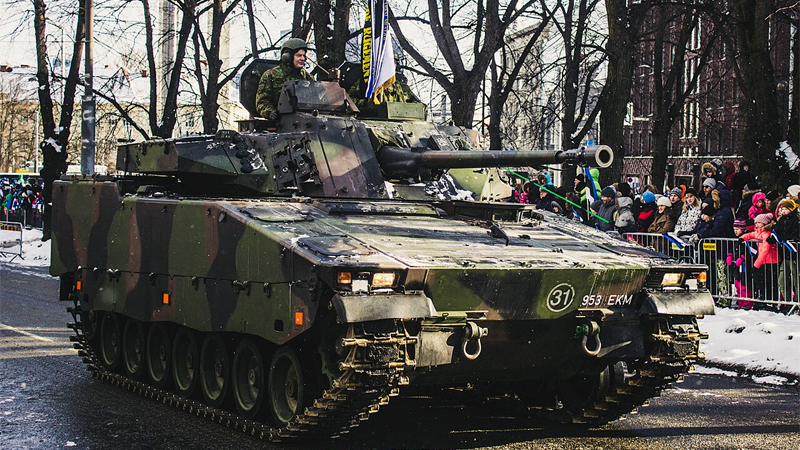
Estonia currently operates a modest fleet of 44 second-hand CV9035EE IFVs, acquired from the Netherlands in 2014, along with support variants based on older CV90 hulls. These vehicles have served reliably in a force optimized for territorial defense and rapid mobility. Rather than pursuing a full replacement scheduled for delivery around 2029–2030, Tallinn plans to invest roughly €100 million in modernizing and extending the service life of the existing fleet by up to 10 years. The bulk of the reallocated budget – hundreds of millions – will bolster capabilities in drones (including strike and reconnaissance UAVs), counter-unmanned aerial systems (C-UAS), air defense, and related surveillance tools. Estonia has also signaled interest in expanding its deep-strike options, including additional HIMARS rocket systems.
Pevkur emphasized that the choice was driven by updated military advice from the Commander of the Estonian Defence Forces. In the contemporary battlespace, heavy equipment faces diminishing returns due to high costs, vulnerability to low-cost drones and anti-armor systems, and the premium placed on flexibility and “eyes and ears” capabilities. Recent incidents of wayward Ukrainian drones drifting into Estonian airspace during attacks on Russian Baltic ports further highlighted the urgency of robust counter-drone and air defense layers. With defense spending already exceeding 5% of GDP – one of the highest rates in NATO – Estonia is prioritizing cost-effective, high-impact investments that align with the attritional and asymmetric nature of today’s conflicts. Extending the CV90s, while not free, proves far cheaper than acquiring and sustaining an entirely new fleet amid rising platform prices and supply chain pressures.
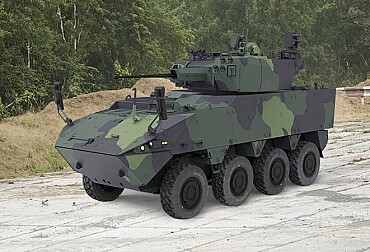
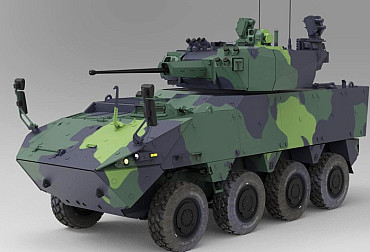
This pivot does not signal a retreat from mechanized forces but a recalibration. Estonia maintains a total defense posture, blending professional troops, conscripts, and a robust volunteer Defense League. Its existing CV90s, paired with wheeled APCs like the Turkish Otokar Arma and Finnish Patria Pasi variants, provide sufficient protected mobility for a small but agile army focused on delaying and disrupting any potential aggressor until NATO reinforcements arrive. The emphasis on drones and air defense complements this by addressing the most immediate threats: saturation attacks from loitering munitions, FPV drones, and cruise missiles that have proven devastating in Ukraine.
Regional Comparisons: Divergent Paths Among NATO’s Eastern Flank
Estonia’s decision stands in contrast to several neighbors, highlighting varied interpretations of the same Ukrainian lessons and differing national priorities, budgets, and force structures.
Latvia and Lithuania, the other Baltic states, continue pursuing new IFV acquisitions despite shared security concerns. Latvia has selected the Spanish ASCOD 2 tracked IFV to modernize its land forces, opting for a platform that offers strong protection and firepower suited to its terrain. Lithuania, with the largest defense budget among the Baltics, approved the purchase of 100 CV90 MkIV vehicles in late 2025 through a multinational Nordic-Baltic program involving Sweden, Finland, Norway, the Netherlands, and (until recently) Estonia. Deliveries are slated to begin in 2028. Lithuania’s heavier mechanized orientation aligns with its deepening ties to Germany, including the upcoming permanent deployment of a Bundeswehr Panzer brigade equipped with Leopard 2 tanks and other heavy assets. Both Latvia and Lithuania are investing in air defense and drones as well, but they view new IFVs as essential for building credible conventional deterrence and interoperability with larger allies.
Finland, a recent NATO member with a formidable conscript-based army and vast territory to defend, remains committed to the CV90 family. Finnish forces already operate CV9030 variants, and the country participates actively in the multinational MkIV program. Helsinki’s doctrine emphasizes dispersed, mobile defense across challenging terrain, where well-protected IFVs retain significant value for infantry support and rapid repositioning. Finland’s larger population and industrial base allow it to sustain both traditional armored capabilities and emerging drone technologies without the same zero-sum trade-offs Estonia faces. Joint procurement with Nordic partners further reduces costs and enhances standardization.
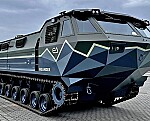
Poland, by far the most ambitious military modernizer on NATO’s eastern flank, pursues a broad and heavy buildup. Warsaw operates legacy Soviet-era equipment alongside Western systems and has invested heavily in main battle tanks (including Abrams and K2 Black Panther), self-propelled artillery, and new IFVs/APCs. Poland’s massive defense budget – bolstered by its size and economic weight – enables simultaneous pursuit of heavy armor, long-range fires (like HIMARS and Korean systems), air defense (Patriot), and a growing drone portfolio. Unlike the smaller Baltics, Poland envisions itself as a regional heavyweight capable of leading conventional defense efforts, while still integrating Ukrainian-style innovations in unmanned systems.
In summary, the other Baltics lean toward maintaining or expanding tracked IFV fleets for mechanized depth, Finland integrates CV90s into a total defense model suited to its geography, and Poland scales up across all domains. Estonia, with its tiny population (around 1.3 million) and exceptionally high defense-to-GDP ratio, has chosen asymmetric efficiency: squeezing maximum value from existing armor while doubling down on the technologies – drones, sensors, and countermeasures – that have redefined survivability and lethality in Ukraine.
Strategic Rationale and Broader Implications
Estonia’s reasoning rests on three pillars. First, empirical observation of Ukraine shows that massed low-cost drones and electronic warfare can neutralize or attrit expensive armored formations far more effectively than in past conflicts. Second, fiscal pragmatism: with limited manpower and high per-soldier equipment costs, investing in platforms that amplify situational awareness and standoff capabilities yields better returns. Third, urgency on the air domain – recent drone incursions served as a wake-up call for multilayered defense against threats ranging from small FPVs to larger munitions.
This shift aligns with Estonia’s broader defense innovation push, including closer ties between the military and its vibrant tech sector. It also supports multinational efforts like the Baltic Defence Line and European Drone initiatives. Critics might argue that abandoning new IFVs risks capability gaps in high-intensity conventional scenarios, but Estonian planners counter that the existing fleet, properly upgraded, suffices for the next decade while drones provide scalable, attritable mass.