Beyond Vulnerable Convoys: Evaluating Autonomous Heavy-Lift UAVs Across Allied Logistics Concepts
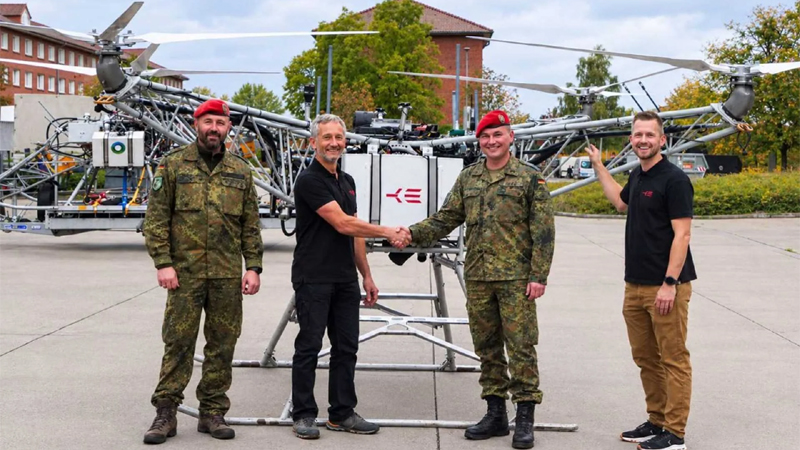
The German Army’s 131st Supply Battalion in Bad Frankenhausen took delivery of its first heavy-lift unmanned aircraft from the Portuguese manufacturer TEKEVER. The system, widely reported as belonging to the newly unveiled AR6 family, is intended for evaluation rather than immediate operational adoption. Stationed within the 37th Armored Infantry Brigade, the battalion supports more than 5,500 soldiers with supply, transport and maintenance. The trials focus on whether an autonomous vertical-take-off-and-landing platform can reliably move ammunition, spare parts and medical supplies across the last, most dangerous segment of a logistics chain – between a forward depot and positions that ground vehicles can no longer reach safely.
The context is the war in Ukraine. Intensive surveillance, artillery, loitering munitions, mines and electronic warfare have rendered conventional truck convoys costly and often impractical. Forces have dispersed, roads have been cut or watched, and the volume of urgent small-to-medium loads has grown. Both sides have experimented with unmanned systems for resupply and even casualty evacuation; one Ukrainian brigade’s reported use of a heavy-lift drone to extract a wounded soldier, though not fully independently verified, has circulated widely among Western planners. Germany’s evaluation therefore sits inside a broader NATO conversation about how to keep units fighting when the traditional logistics tail is under continuous pressure.
TEKEVER presented the AR6 at the Farnborough International Airshow in July 2026. Company statements set a performance target of roughly 200 kilograms of payload over 500 kilometres. The aircraft is a four-rotor design that needs no runway. Its distinguishing technical feature is a hydraulic transmission developed with the Scottish firm Flowcopter, which TEKEVER acquired. An internal-combustion engine drives pumps whose digitally controlled flow distributes power to the rotors. The architecture is meant to escape the payload-versus-range trade-off that has limited many purely electric multicopters. Military configurations are described as capable of operating without satellite navigation and of incorporating autonomy features for multi-platform operations and improved survivability. Production is planned to begin by the end of 2026 at the company’s site in Swindon. TEKEVER has simultaneously opened a German subsidiary in Munich to support the Bundeswehr and work with local industry, signalling that the Bad Frankenhausen delivery is part of a longer industrial engagement rather than a one-off trial.

A single aircraft cannot replace bulk road or rail movement, nor can it eliminate the need to protect ground routes. Each flight still requires a secure delivery point, coordination with other air users, and acceptance that the platform itself can be detected, jammed or destroyed. Actual endurance will vary with payload, fuel and weather. The German trials are therefore about integration – how the system fits into existing logistics procedures, how often it can fly under electronic-warfare conditions, and whether the operational benefit justifies the residual risk.
Similar questions are being asked across Western forces, though the platforms and operational concepts differ. In the United Kingdom and the United States the Malloy Aeronautics T-series, now associated with BAE Systems and Survice, has moved furthest toward routine use. The electric T-150 / TRV-150 class carries roughly 68 kilograms and has already performed ship-to-ship transfers during the Royal Navy’s Indo-Pacific carrier-strike-group deployment, including flights between HMS Prince of Wales and HMS Dauntless. HMS Trent later used the type from a River-class patrol vessel in the Caribbean. The US Marine Corps and Army have fielded the TRV-150 for tactical resupply, including medical stores, and have tested weaponised variants carrying APKWS laser-guided rockets for short-range air defence. These systems are quieter and simpler to operate than turbine platforms, but their range and payload remain modest. They illustrate a mature, lower-risk niche for the last few kilometres rather than deep contested penetration.
At the heavier end the United States has pursued medium-lift vertical-take-off designs. Kaman’s KARGO, later acquired by Piasecki, is a purpose-built turbine-powered VTOL intended to carry around 800 pounds (roughly 360 kilograms) over distances measured in hundreds of kilometres. It builds on earlier K-MAX experience in Afghanistan and has been evaluated by both the Army and Marine Corps for expeditionary logistics. The aircraft can be transported in a standard shipping container and assembled quickly, suiting distributed operations across island chains or sparse terrain. Parallel work continues with other designs; Phenix Solutions’ Ultra 2XL, a coaxial-rotor aircraft powered by a Rolls-Royce RR300 turboshaft, has demonstrated payloads above 600 pounds and ranges of several hundred nautical miles. It is among the finalists in the Army’s G-TEAD autonomous-resupply competition, whose live phase in Hawaii in late 2026 examines both air and ground systems for contested Pacific environments.
Within Europe a German industrial response is also taking shape. The Munich-area start-up ERC System has unveiled the Victor U250, a hybrid-electric lift-and-cruise aircraft targeting 250 kilograms over 300 kilometres at cruise speeds around 250 kilometres per hour. A memorandum of understanding with Rheinmetall and the state of North Rhine-Westphalia aims at local production. The design emphasises speed, the ability to airdrop rather than land in contested areas, and compatibility with existing fuel infrastructure. First deliveries are projected for 2028. It occupies a performance band close to the AR6 target and underscores that several European firms now view the 200–250 kilogram class as the practical gap between small tactical drones and manned helicopters.
Across these programmes the technical choices reflect different operational priorities. Pure-electric multicopters offer low acoustic and thermal signatures and rapid turnaround for short-range tasks, yet they struggle with range once payload grows. Turbine or hybrid solutions trade signature and complexity for endurance and lift, better matching the distances typical of brigade or island-chain resupply. Autonomy stacks that reduce dependence on satellite navigation are common requirements, given the electronic-warfare environment observed in Ukraine. Secondary roles such as casualty evacuation appear repeatedly in company literature and in Ukrainian reporting, although the medical and legal implications of uncrewed CASEVAC remain under study.
None of these systems will eliminate the need for protected ground movement or for larger manned aircraft. Their value lies in reducing the frequency and exposure of the most dangerous trips, in carrying high-value or time-critical loads when roads are denied, and in freeing helicopters for missions that still require a crew. Realising that value depends on more than airframe performance: reliable navigation under jamming, integration with logistics software and airspace control, protection against small-arms and air-defence threats, and the ability to generate enough sorties to matter at scale. Attritable or low-cost designs may prove more sustainable in high-intensity conflict than exquisite platforms that cannot be replaced quickly.
Germany’s decision to place a TEKEVER aircraft with a frontline supply battalion is therefore best read as one data point in a larger adaptation. Allied forces are collectively testing whether unmanned aerial lift can restore some of the flexibility that contested environments have taken from ground logistics. The outcomes of the Bad Frankenhausen trials, the Hawaiian G-TEAD evaluation, ongoing British and American use of the T-series, and the industrial efforts around Victor and KARGO will help determine how large a share of the last tactical mile shifts from wheels to rotors. In the meantime the fundamental problem remains unchanged: modern battlefields punish concentrated, predictable supply lines, and every Western army is looking for ways to keep its soldiers supplied without offering the adversary an easy target.