
Bruegel Warns: Europe’s Strategic Autonomy Is Giving Way to Dependence on U.S. Industry
In recent years, Europe has found itself in a strategically dangerous situation, which it itself is financially supporting. The political rhetoric of European governments and institutions operates with concepts such as strategic autonomy, defense sovereignty, and strengthening the European pillar of NATO. However, the actual flow of money, technological development, and decision-making power supports contradictory processes. Although there has been a dramatic increase in defense budgets since 2022, more resources are not leading to a strengthening of Europe's industrial and technological base. On the contrary, we are seeing the emergence of a deeper and structurally stronger dependence of Europe on the US defense industry, concentrated in areas that are decisive for the conduct of modern high-intensity warfare.
According to the Brussels-based think tank Bruegel, this dependence can be measured in billions of US dollars, specific contracts, and technical restrictions. The Foreign Military Sales (FMS) system, a US government program for intergovernmental arms sales, plays a central role. Within this framework, European countries do not conclude contracts directly with companies such as Lockheed Martin, Raytheon, or Boeing. The US government acts as the contractual partner, determining the parameters of deliveries, the pace of implementation, the form of modernization, and the scope of future capabilities. This creates a long-term political and technological commitment with a significantly asymmetrical distribution of power.
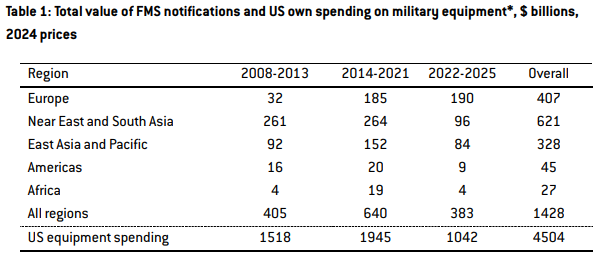
The extent of European involvement in this system recently reached historic levels. Between 2022 and 2025, European countries ordered approximately $190 billion worth of US military equipment through the FMS, based on 2024 prices. The year 2024 alone brought European orders worth around $76 billion, which is several times the long-term average. In practice, this means that in four years, Europe spent the same amount of money in the US as it did in the previous decade.
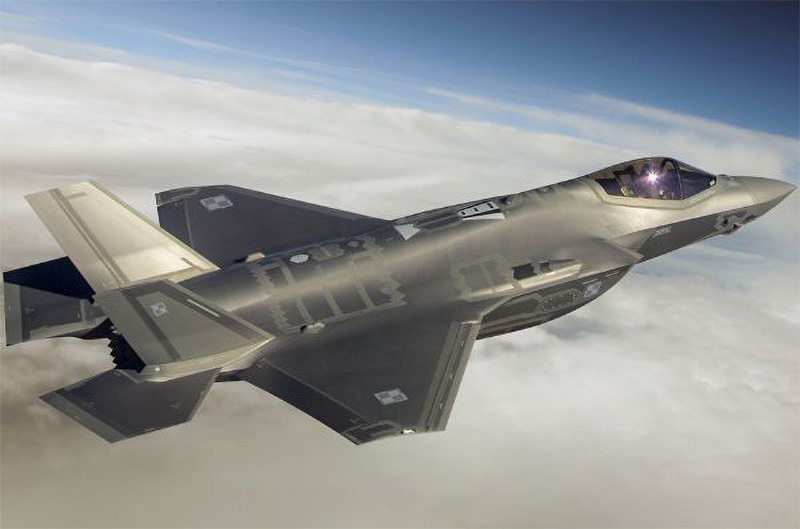
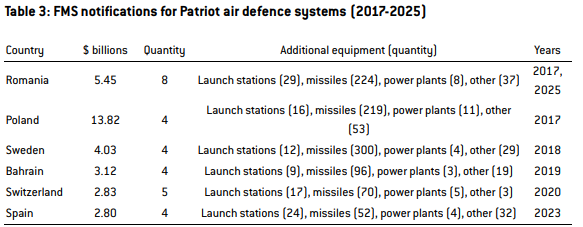
Poland is the most striking example of this trend. Between 2022 and 2024, Warsaw announced purchases of American weapons worth tens of billions of dollars under the FMS. The contracts include 32 F-35 fighter jets, Patriot systems, hundreds of PAC-3 MSE missiles, M1A2 Abrams tanks, HIMARS rocket launchers, and extensive packages of ammunition, training, and long-term logistical support. The operational support package for the Polish F-35s alone amounted to approximately $1.85 billion, not including future upgrades.
Germany is following a similar trajectory. Berlin has ordered 35 F-35 aircraft worth over $10 billion, including ammunition, infrastructure, and training. Finland and Switzerland have signed contracts worth billions of dollars, with a significant portion of the costs related to software, US weapon systems, and long-term operational support. Belgium, Denmark, the Netherlands, and Romania are in the same customer group, albeit in smaller volumes.
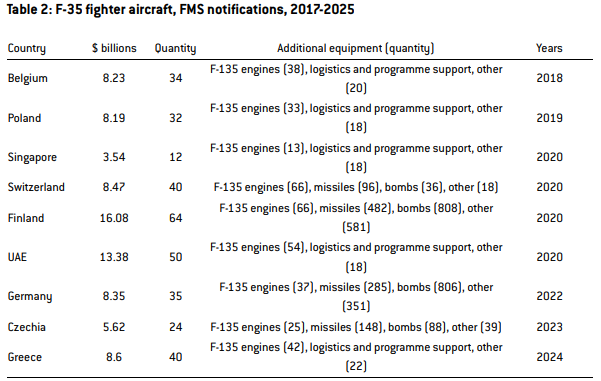
The Czech Republic is also involved in this pattern on a smaller absolute scale, but with similar structural implications. The decision to purchase 24 F-35 aircraft represents a financial commitment of approximately $5 billion (information from January this year), including training, infrastructure, and logistical support. A significant portion of this amount is not directed toward the aircraft themselves, but rather toward American software, integration packages, weapon systems, and long-term service contracts. This shifts the operational capability of the Czech tactical air force into a mode of permanent technological dependence on American decisions.
A similar principle applies in the field of air defense. The Czech Republic has purchased the Israeli SPYDER system, but further steps in the area of integrated air defense will be virtually impossible without American technology. Patriot systems, which are becoming the standard among major allies in the region, operate on American software, radars, and fire control. The price of a single PAC-3 MSE missile is in the millions of dollars, which puts long-term pressure on defense budgets.

The F-35 program and Patriot systems represent a symbol of new dependence in the European and Czech contexts. Both aircraft and air defense operate as part of a complex digital ecosystem controlled from the United States. Access to regular software updates, threat databases, and weapon integration certification remains fully under Washington's control. Without these elements, there is rapid technological degradation of capabilities. Political decision-making is thus not conveyed through explicit conditions, but through everyday operational reality.
The strategic asymmetry of this model clearly plays into the hands of the United States. The American defense industry is strengthening its production capacities, reducing unit costs for its own armed forces, and consolidating its global technological dominance. European countries are financing this process, while their own industrial base remains in the role of subcontractors with no control over key technologies. The Bruegel think tank points out that the United States has been investing more than $150 billion a year (2024) in defense research and development for a long time, while all European countries combined are spending less than a tenth of that amount (€11 billion in 2023).
Another risk factor is the capacity overload of US industry. The United States is currently supplying its own armed forces, supporting Ukraine, and preparing for a possible conflict in the Indo-Pacific region. In this system, Europe acts as a solvent customer without decision-making priority. Delivery times are lengthening, modernization is being postponed, and strategic decisions remain outside the European political sphere.
The result of this situation is structural weakness. European defense capabilities are financed by European budgets, technologically controlled by American industry, and politically governed by the priorities of the US government. This model only works if there is long-term agreement on transatlantic interests. In the context of the current global power shift, this poses a fundamental risk.
The ongoing European rearmament does not lead to autonomy. It is leading to deeper integration into the American military-industrial complex, with increasing expenditure and a declining capacity for independent strategic action. The Czech Republic is becoming part of this trend. Without a fundamental change in the structure of investment, European and Czech defense will remain dependent on strategic decisions taken outside the European area for decades to come.