Chinese J-20 Stealth Fighter Completes Key WS-15 Engine Flight – Closing Gap with U.S. F-22 Raptor?
The Chinese J-20A stealth fighter jet, known as the “Mighty Dragon,” has achieved a significant milestone in its evolution with the successful completion of a flight test powered by its fully domestic WS-15 engines. This event, which occurred on January 24, 2026, was officially confirmed through images released by the manufacturer, Chengdu Aircraft Corporation (CAC). The photographs depict a J-20A in a distinctive yellow color scheme—typically used for production testing and prototype evaluation—featuring nozzle designs characteristic of the WS-15 engines, including serrated edges for enhanced stealth and improved thrust management.
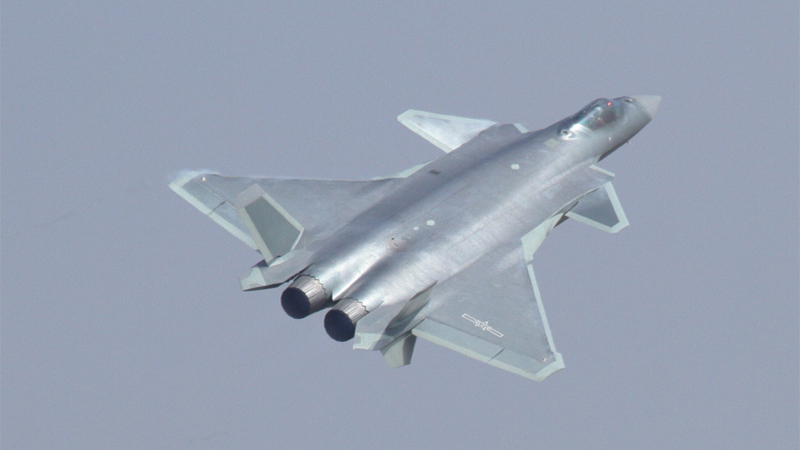
This breakthrough addresses one of the longstanding challenges in the J-20 program: the reliance on interim powerplants that limited the aircraft’s full fifth-generation potential. Early production models of the J-20 were equipped with Russian Saturn AL-31F engines (and later variants like the AL-31FN), which provided around 123–135 kN of thrust but fell short of enabling key capabilities such as reliable supercruise. From around 2019–2021, China transitioned to the domestically developed Shenyang WS-10C (an improved “Taihang” variant with thrust ratings of 142–147 kN and a thrust-to-weight ratio approaching 9.5), which allowed limited supercruise and better rear-aspect stealth via serrated nozzles. However, the WS-10C remained an interim solution, as it did not fully meet the original design goals for sustained high-performance operations.
The WS-15 “Emei,” a low-bypass afterburning turbofan developed by the Aero Engine Corporation of China (AECC) since the 1990s, represents the culmination of decades of effort to achieve engine independence and match or exceed Western fifth-generation standards. Development faced repeated hurdles, including technical bottlenecks in high-temperature materials (such as single-crystal turbine blades), thermal management, and reliability under extreme conditions. By March 2023, AECC announced that serial production had begun after overcoming these issues, with small-scale production and in-flight testing underway. Prototype flights with WS-15 engines were reported as early as 2022 (initially with one engine swapped for testing), followed by dual-engine configurations in 2023 (e.g., the notable June 29, 2023, flight of serial 2052) and clearer visual confirmations in 2024.
The January 2026 flight marks a pivotal step toward operational maturity, with the aircraft displaying modifications optimized for the new engines: refined air intakes for better airflow, updated rear fuselage sections for thermal and aerodynamic integration, and potentially enhanced avionics to handle increased power output. The yellow primer scheme indicates this is part of the production testing phase, suggesting the configuration is nearing the standard intended for frontline PLAAF units.
Key Expected Capabilities with WS-15 Engines
The WS-15 is designed to deliver dry thrust sufficient for sustained supercruise (supersonic flight without afterburners, estimated at Mach 1.3–1.5 or higher), while providing maximum afterburner thrust in the range of 180 kN (approximately 40,000 pounds) per engine—potentially surpassing the Pratt & Whitney F119 on the F-22 Raptor (around 35,000 pounds each). This upgrade dramatically improves several performance aspects:
- Supercruise: Enables prolonged supersonic dashes with reduced fuel burn and lower infrared signature, enhancing stealth during penetration missions and extending operational range.
- Thrust and Acceleration: Superior climb rates, quicker acceleration, and better high-altitude performance, allowing the J-20A to engage or disengage from threats more effectively.
- Maneuverability: Enhanced energy management and potential for future thrust-vectoring control (TVC) nozzles (demonstrated on related WS-10 variants and speculated for advanced WS-15 iterations), which could improve close-in dogfighting agility—though current visible nozzles lack TVC paddles.
- Range and Endurance: Greater internal fuel efficiency supports longer patrols over contested areas like the South China Sea or Taiwan Strait, complementing the J-20’s large internal weapons bays (capable of carrying extended-range missiles like the PL-15/PL-21).
- Other Enhancements: Increased electrical generation for advanced sensors, radars (e.g., upgraded AESA arrays), electronic warfare systems, and integration with unmanned systems via manned-unmanned teaming (MUM-T) concepts. The Pentagon’s assessments note ongoing upgrades including more internal missile carriage in low-observable mode.
These improvements position the J-20A as a more formidable air superiority platform, capable of challenging peers like the F-22 in beyond-visual-range engagements (thanks to long-range missiles and sensors) while offering advantages in range and production scalability. China is reportedly producing around 120 J-20s annually (including single-seat J-20A and twin-seat J-20S variants), accelerating fleet growth to potentially hundreds by the late 2020s.
The J-20 program, initiated in the late 1990s under China’s push to close the technological gap with the United States, achieved its first flight in 2011 and entered service in 2017. It marked China’s entry into the exclusive club of nations fielding operational fifth-generation stealth fighters. While early versions were criticized for engine limitations, the WS-15 integration resolves this “Achilles’ heel,” unlocking the aircraft’s full aerodynamic and stealth potential. Precise operational data remains classified, but the milestone underscores China’s rapid progress in indigenous aerospace propulsion and its ambition to project power in contested regions.