
Drones, L-159s and the Czech Dilemma: Why Ukraine’s Air Needs Are Not So Easy to Replace
Czechia’s debate over whether Ukraine needs L-159 light combat aircraft has exposed a larger question about modern warfare: can drones really replace manned aircraft, or are officials using the rise of unmanned systems to justify a political decision already made?
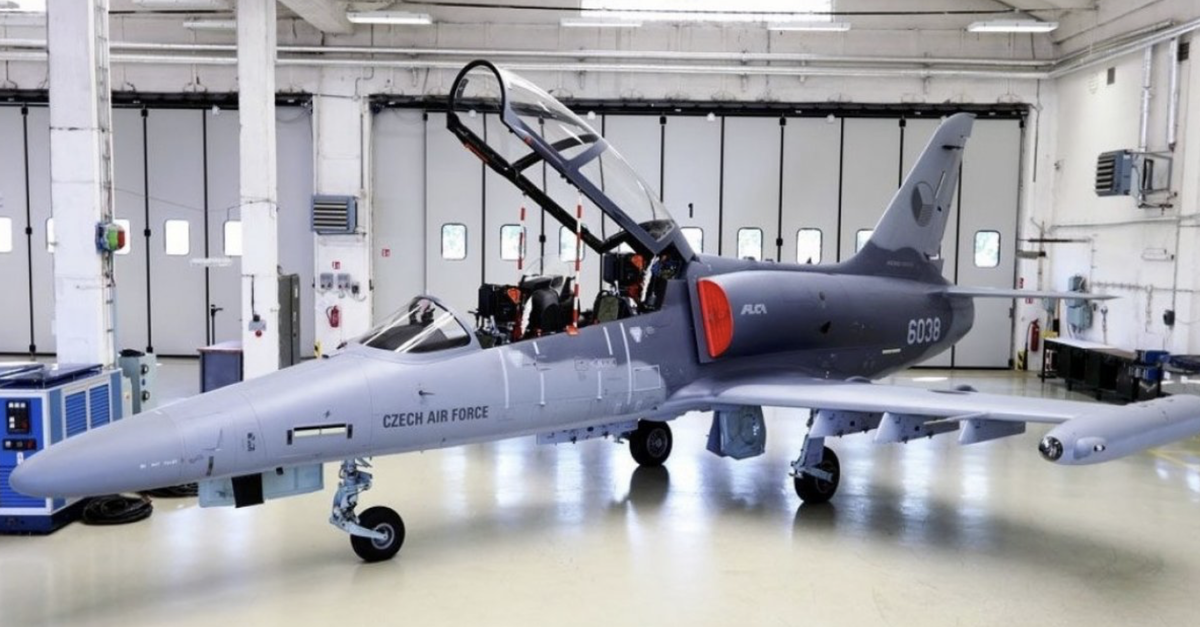
The issue returned to public attention after Czech Chief of General Staff Miroslav Hlaváč suggested in an interview with CTK that Ukraine no longer needs the L-159 aircraft it had previously sought. According to him, the capabilities Ukraine expected from the L-159 can now be delivered by “other technologies,” a phrase widely understood as a reference to drones and unmanned systems.

On the surface, the argument reflects a real trend. Ukraine has become one of the world’s most experienced drone warfare operators. Unmanned systems now perform reconnaissance, strike missions, artillery correction, battlefield surveillance and even some air-defense-related tasks. In many roles, drones are cheaper, easier to replace and less politically sensitive than crewed aircraft.
But the comparison between drones and aircraft such as the L-159 is far from straightforward.
What the L-159 Offers
The Aero L-159 ALCA is a Czech-made light combat aircraft, while the two-seat L-159T2 can be used in a trainer-combat configuration. It is not a frontline fighter like an F-16, but it still belongs to a category of aircraft that can support pilot training, limited combat missions and transition from older Soviet-designed aviation systems.
For Ukraine, such aircraft could potentially serve several purposes. One is training. Ukraine still has legacy L-39 aircraft from the Warsaw Pact era, and replacing or supplementing that training base is a real requirement. Another is the possible use of light jets for specific missions where fast reaction, onboard sensors, weapons carriage and pilot decision-making remain valuable.

This is where the “drones can do the job” argument becomes complicated. A drone can replace some missions performed by light aircraft, but it cannot replace pilot training. If the task is to train aviators for jet operations, a jet aircraft is still required. Simulators can help, but they do not remove the need for actual flight hours.
The L-39NG Question
Alongside the L-159 discussion, Czech officials have also mentioned possible Ukrainian interest in the L-39NG Skyfox, a modern trainer aircraft produced by Aero Vodochody. Hlaváč said that different proposals are appearing, but any decision would depend on Ukraine’s current requirements and whether such aircraft would be useful for building air defense.
This wording suggests that talks are still at an early stage. It also shows that Prague is trying to frame the discussion not simply around what Czechia can offer, but around whether Ukraine’s needs have changed.
That is a reasonable question. Ukraine’s military requirements are constantly shifting under wartime pressure. A system that looked attractive six months ago may become less urgent if battlefield conditions, available weapons, training pipelines or allied support change.
Still, the distinction between L-159s and L-39NGs matters. If the issue is combat employment, drones may compete with light aircraft in some missions. If the issue is pilot training and replacing old L-39Cs, only another aircraft can truly fill that gap.
Can Drones Replace Light Combat Aircraft?
Drones have clearly transformed the battlefield, but they are not a universal substitute for aviation.
Small and medium UAVs are excellent for surveillance, targeting and tactical strikes. Long-range attack drones can hit fixed infrastructure. Interceptor drones are emerging as a cheaper response to incoming UAVs. However, there is still no widespread European or Ukrainian fleet of heavy jet-powered unmanned aircraft capable of performing all the roles of a manned light combat jet, including high-speed interception with air-to-air missiles.
This is especially relevant in the context of Russian long-range attack drones, including Shahed-type systems. Ukraine has been searching for cost-effective ways to intercept them. In theory, light aircraft could be part of such a layered defense system. But whether the L-159 is the right platform for that mission depends on availability, weapons integration, training, maintenance, risk and cost.
Drones may perform some of these air-defense tasks more cheaply. But saying they make L-159s unnecessary across the board is a much stronger claim — and one that raises obvious questions.
The Question Czechia Cannot Avoid
Defense Express makes a pointed observation: if L-159 aircraft are supposedly unnecessary for Ukraine because drones can provide the same capability, why does Czechia still keep them?
That question is politically uncomfortable because it cuts both ways.
If the L-159 remains useful to the Czech Air Force, then it is difficult to argue that it has no serious value for Ukraine. If, on the other hand, drones truly make the aircraft redundant, then Czechia’s own continued use of the platform becomes harder to justify.
Of course, national requirements are not identical. Czechia is a NATO member operating in a different strategic environment. Ukraine is fighting an active large-scale war. What makes sense for one military may not automatically make sense for the other. Czechia may need L-159s for training, readiness, air policing support, pilot proficiency or national defense planning. Ukraine may prioritize systems that can be deployed faster and survive better in a dense air-defense environment.
But the basic logic still deserves scrutiny. “Ukraine does not need them anymore” is not the same as “the aircraft have no military value.” It may simply mean that Czechia is unwilling or unable to transfer them under current conditions.
A Political Decision Presented as a Technical One?
The refusal to transfer L-159s in January 2026 appears to have settled the matter for now. Hlaváč’s later remarks suggest that Czech officials do not see a reason to reopen the issue because Ukraine has allegedly found other ways to achieve the same effects.
That may be true in specific mission areas. Ukraine has repeatedly adapted faster than many expected, especially in unmanned warfare. But the broader claim should be treated carefully. Drones are not a magic replacement for aircraft, and aircraft are not automatically the best answer to every battlefield problem.
The real issue is not whether drones or L-159s are “better.” The question is which capability Ukraine needs, how quickly it can be fielded, and whether Czechia is prepared to provide it.
If Ukraine needs pilot training aircraft, drones are not a substitute. If Ukraine needs cheap mass interception of Russian drones, then unmanned or ground-based solutions may be more practical. If Ukraine needs a bridge platform between Soviet-era aviation and Western aircraft, then aircraft such as the L-159 or L-39NG may still have a role.
Conclusion
The Czech debate over L-159s shows how difficult defense decisions have become in the drone age. Unmanned systems are changing the economics and tactics of war, but they have not erased the need for manned aviation.
Czech officials may be right that Ukraine’s priorities have shifted. They may also be right that some missions once imagined for the L-159 can now be handled by drones. But the argument becomes less convincing when it is used as a blanket explanation for why the aircraft are no longer needed.
Ukraine’s airpower problem is not solved by one aircraft type, one drone model or one political statement. It requires a layered mix of trainers, fighters, interceptors, drones, air defenses and industrial support. The L-159 may or may not fit into that mix today. But dismissing it simply because “other technologies” exist risks oversimplifying a much more complex military requirement.