
Europe’s Mobile Artillery Renaissance: Italy’s VBM 155 and the Push for Automated Long-Range Fires
In the evolving landscape of European land warfare, the need for highly mobile, survivable and long-range artillery has never been more urgent. Lessons drawn from the protracted conflict in Ukraine have underscored the vulnerability of traditional self-propelled howitzers to drones, counter-battery sensors and precision strikes, while simultaneously highlighting the decisive role of accurate fires delivered from dispersed, rapidly relocating positions. Against this backdrop, the Italian Army’s advancing plans for a fleet of wheeled 155 mm self-propelled howitzers represent one of the most concrete and innovative national responses currently taking shape on the continent.
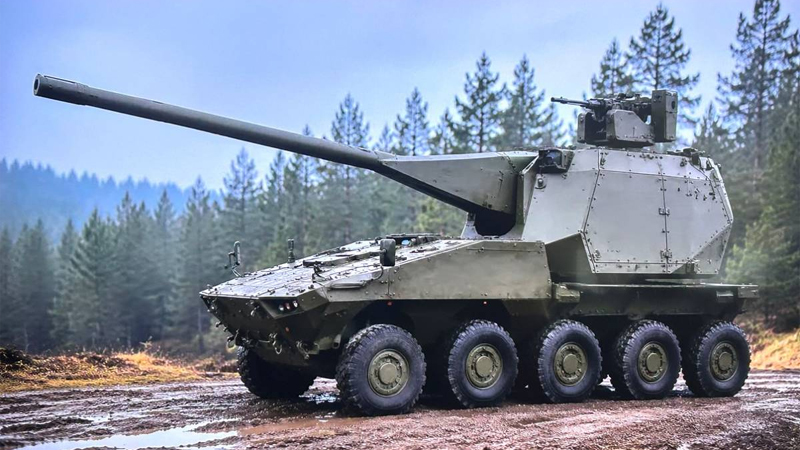
At the heart of Italy’s programme stands the VBM 155 concept, developed jointly by Iveco Defence Vehicles and Leonardo through the CIO consortium. Unveiled in model form at Eurosatory 2026 and now progressing toward prototype integration, the system is built around a purpose-designed 10×10 armoured chassis rather than a simple adaptation of the existing Freccia 8×8 family. Measuring approximately 11.1 metres in length and weighing around 40 tonnes in combat configuration, the vehicle is powered by a 720-horsepower diesel engine that promises road speeds exceeding 100 km/h and excellent strategic mobility. Its fully unmanned HITFIRE turret houses a 155 mm/52-calibre cannon capable of engaging targets at ranges of up to 70 kilometres when firing advanced rocket-assisted or guided munitions. With an automatic loader holding 30 rounds and supporting sustained rates of fire approaching ten rounds per minute, the system is designed to operate with a crew of only two soldiers, dramatically reducing exposure and manpower demands.
This combination of high road mobility, deep-strike capability and extensive automation positions the VBM 155 as a natural complement to Italy’s existing tracked artillery rather than a replacement. The Italian Army’s medium brigades, already structured around wheeled platforms such as the Centauro and Freccia families, stand to gain a fires capability that can keep pace with rapid manoeuvre while retaining the ability to deliver massed, precise effects at extended ranges. Official planning documents for the 2025–2027 period confirm a requirement for approximately 60 systems, together with dedicated ammunition resupply vehicles and logistic support packages. Prototype assembly is expected in the final quarter of 2026, with industrial qualification targeted for late 2026 or early 2027, paving the way for potential series production thereafter.

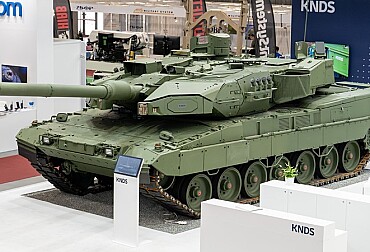
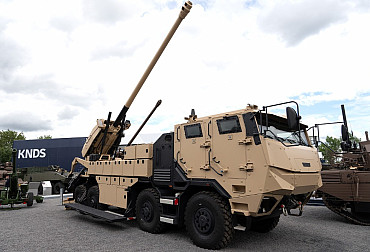
Italy’s initiative does not stand in isolation. Across Europe, manufacturers and armed forces are pursuing similar goals of greater range, automation and mobility. Rheinmetall’s L60 155 mm gun system, also presented at Eurosatory 2026, promises roughly a 30 percent increase in range over conventional L52 barrels through a longer tube and enlarged chamber, with muzzle velocities already demonstrated above 1,100 m/s. Parallel efforts by KNDS to expand production capacity at its Kassel facility for both Leopard 2A8 turrets and the RCH 155 wheeled howitzer reflect growing demand, including firm orders from Germany and the United Kingdom. Spain, meanwhile, is advancing its own dual-track artillery modernisation under Indra Land Vehicles, combining tracked systems derived from Hanwha technology to replace ageing M109s with wheeled 155 mm platforms for greater operational flexibility.
What unites these programmes is a recognition that future European land forces must balance the high-end capabilities of heavy tracked systems with the mass, deployability and sustainability offered by wheeled solutions. The Italian VBM 155, with its emphasis on reduced crew size, rapid emplacement and displacement times of around ten seconds, and native compatibility with NATO-standard and extended-range munitions, exemplifies this shift. By integrating advanced fire-control systems, automated ammunition handling and digital architecture from the outset, such platforms also prepare the ground for tighter integration with unmanned systems and networked sensor-to-shooter chains.
Challenges remain. Industrial capacity across Europe is still catching up with surging demand, while the proliferation of competing national solutions risks fragmenting logistics and training. Yet the momentum is clear. As production lines for established systems such as the RCH 155 accelerate and new designs like the VBM 155 move from concept to hardware, European armies are steadily closing the fires gap that has become so apparent in recent years. Italy’s programme, rooted in sovereign industry yet fully interoperable with Alliance standards, offers a compelling model of how medium forces can acquire potent, survivable artillery without sacrificing the mobility that defines their operational concept. In doing so, it contributes to a broader continental effort to restore credible long-range land fires as a cornerstone of collective defence.