France Fields the Jaguar R3: The SCORPION Family’s Combat Scout Comes of Age
The French Army has begun receiving the Jaguar in its R3 configuration, the first standard that the Direction générale de l’armement and the land forces have certified as fully “fit for war.” Twenty-one vehicles of this standard had been handed over by early September 2026, after qualification in April and operational clearance in July. The arrival is more than an incremental upgrade. It completes the original combat package of the Engin Blindé de Reconnaissance et de Combat and, with it, a central piece of the SCORPION programme that has been reshaping French contact forces for more than a decade.
SCORPION, launched in 2014, was conceived as a system rather than a collection of platforms. Its name—Synergie du Contact Renforcée par la Polyvalence et l’Infovalorisation—signals the intent: to replace ageing wheeled fleets, to digitise the tactical group, and to make every vehicle a node in a shared picture. Four new vehicles sit at the centre of that effort. The Griffon, a 6×6 multi-role armoured vehicle of roughly 24 tonnes, succeeds the VAB in troop-carrying, command, medical, observation and now mortar (MEPAC) roles. The Serval, a lighter 4×4 of 15 to 17 tonnes, complements it where agility and a smaller logistical footprint matter. The Jaguar occupies the combat-reconnaissance niche. A later family of systems, including the XLR logistics vehicle and the modernisation of the Leclerc tank, sits around the same information architecture, the Système d’Information du Combat SCORPION (SICS).
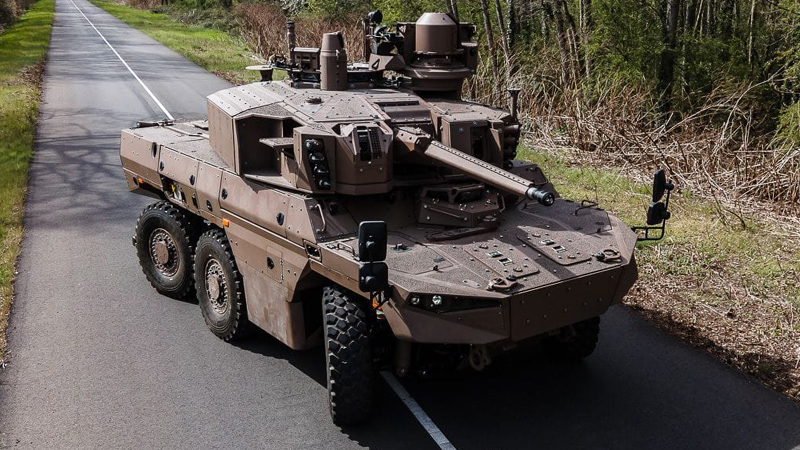
The Jaguar itself is a purpose-built 6×6 of 25 tonnes combat weight, 7.8 metres long with gun forward, 2.99 metres wide and 2.8 metres high at the turret roof. A militarised Volvo D11 diesel of 500 horsepower and a ZF automatic transmission give it a road speed of 90 km/h and an 800-kilometre range. Hydro-pneumatic suspension with variable ground clearance and all-wheel drive are intended for both high-speed road marches and broken or urban terrain. Protection is specified to STANAG 4569 Level 4 as standard, with modular add-on kits, a blast-deflecting hull and a survival-cell layout for the three-person crew. Laser and missile-approach warning, acoustic shot detection, the GALIX smoke system and radio-frequency jamming complete the self-protection suite. NBC overpressure and air-conditioning are fitted as a matter of course.
Firepower is the feature that most clearly distinguishes the Jaguar from the vehicles it replaces. The two-man T40 turret carries the 40 mm Cased Telescoped Armament System developed by CTA International. Telescoped ammunition keeps the gun compact while allowing a high rate of fire, substantial elevation (around 45 degrees) and a mix of armour-piercing fin-stabilised discarding sabot, high-explosive and programmable airburst rounds. Effective engagement of light armour and structures extends to roughly 2.5–3 kilometres; the high elevation also gives the vehicle a limited capability against slow aerial targets and upper storeys in built-up areas.
Two Akeron MP (formerly MMP) missiles sit ready in a retractable launcher on the turret, with two more stowed in the hull, for engagements out to four kilometres in fire-and-forget or man-in-the-loop modes. A remotely operated 7.62 mm Hornet station covers close-in defence. The combination is deliberately different from the 105 mm gun of the AMX-10 RC or the 90 mm of the ERC-90 Sagaie: the Jaguar is not meant to fight main battle tanks gun-to-gun. It is meant to find them, designate them, and kill them at standoff with missiles while using the 40 mm cannon against everything else.
Industrial responsibility rests with a temporary consortium of KNDS France (turret and integration), Arquus (chassis and mobility) and Thales (electronics and SICS). France plans 300 Jaguars for seven cavalry regiments, with the bulk to be in service by the early 2030s and the last deliveries around 2035. Belgium has ordered 60 and Luxembourg 38 under the CAMO cooperation framework, so the type is already a modest multinational programme. Early vehicles reached the 1er Régiment de Chasseurs d’Afrique for conversion training; the 1er Régiment Étranger de Cavalerie was among the first operational users and has already taken Jaguars on NATO deployment to Estonia.
Comparable vehicles exist, but few occupy exactly the same niche. In NATO, the closest conceptual cousins are other wheeled reconnaissance and combat platforms rather than infantry fighting vehicles. Australia’s Boxer Combat Reconnaissance Vehicle, an 8×8 of well over 30 tonnes, mounts a two-man Lance turret with a 30 mm cannon and Spike-LR2 missiles. It is heavier, more heavily protected in some configurations, and built around a modular mission-module philosophy rather than a purpose-designed 6×6 hull. Germany and the Netherlands field the much lighter Fennek for stealthy observation; it lacks the Jaguar’s organic 40 mm and missile punch. The United Kingdom’s Ajax is a tracked reconnaissance vehicle with a 40 mm CTA gun of the same family, but its programme history and weight class put it in a different category. American Stryker reconnaissance variants remain more lightly armed in standard form. Sweden’s CV90, widely used across NATO, is a tracked IFV that can be configured for reconnaissance; it offers greater off-road performance and troop-carrying capacity at the cost of strategic mobility and a different logistics footprint.
On the Russian side there is no direct analogue. The BRM-3K Rys, derived from the BMP-3, is a tracked reconnaissance vehicle with a 30 mm cannon, extensive sensors including radar, and a six-person crew. It is lighter than the Jaguar, amphibious, and built around a different tactical culture that emphasises mass and combined-arms density rather than long-range networked scouting. Standard BMP-3s and BTR-82As can perform fire-support and reconnaissance tasks, but they are not specialised 25-tonne wheeled combat scouts with a medium-calibre telescoped gun and modern ATGMs integrated from the outset. Russian doctrine still leans more heavily on dedicated recce assets such as the BRDM lineage and on artillery and aviation to prosecute targets once found.
The Jaguar’s distinctive claim is therefore less raw protection or raw gun power than the combination of mobility, a versatile medium-calibre weapon, a modern missile, and, above all, the SICS network that lets it share tracks and fires with Griffons, Servals, artillery and aviation in near real time. That architecture is what the French Army means by collaborative combat. Whether the 25-tonne wheeled formula proves more resilient than heavier 8×8s or lighter stealth scouts will be settled in the field; for now, the R3 deliveries mark the moment when the SCORPION cavalry vehicle finally carries every weapon and every sensor it was designed to carry.