M1E3 Abrams: The U.S. Army’s Hybrid Revolution in Tank Warfare for the Drone Age
The United States Army is charting a transformative path for its armored forces with the M1E3 Abrams, a next-generation main battle tank that promises to address the hard lessons of recent conflicts while maintaining the legendary Abrams lineage’s dominance on the battlefield. Revealed in greater detail at the NDIA MDEX 2026 conference and building on an early prototype displayed at the Detroit Auto Show, the M1E3 represents far more than an incremental upgrade to the M1A2 SEPv3. It embodies a fundamental redesign aimed at countering drone-saturated environments, precision-guided munitions, and the logistical strains of high-intensity peer combat through the 2040s.
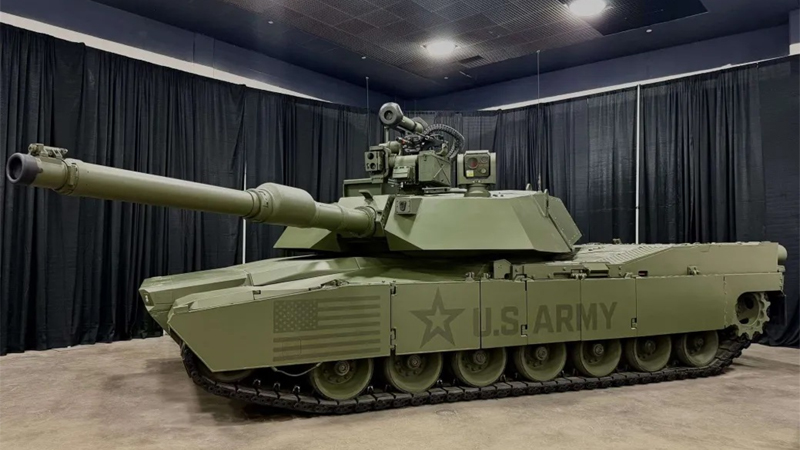
At the heart of this evolution lies a shift toward a hybrid diesel-electric powertrain coupled with a high-efficiency transmission. Current Abrams variants rely on a powerful but fuel-thirsty AGT1500 gas turbine engine, which has contributed to the tank’s growing weight – now exceeding 73 metric tons in fully equipped SEPv3 configurations – and significant logistical demands. The M1E3’s hybrid architecture is projected to deliver around 40 percent better fuel efficiency, extending operational range while reducing thermal and acoustic signatures that modern sensors and drones can easily exploit. This quieter, more efficient propulsion not only supports extended missions with less reliance on vulnerable supply convoys but also generates onboard electrical power for advanced sensors, active protection systems, directed-energy weapons, and electronic warfare suites. Army officials emphasize that this integrated power approach will make survivability and lethality "organic" to the platform rather than added as external kits.
Weight reduction forms another cornerstone of the M1E3 program. Planners target a combat weight of approximately 60–66 tons, a substantial decrease from today’s heavier models. This lighter footprint enhances strategic mobility, allowing better bridge-crossing capabilities and faster deployment, particularly vital in theaters like the Indo-Pacific where infrastructure constraints limit heavy equipment movement. By trimming the logistical tail, the Army aims to mitigate risks from enemy strikes on fuel depots and supply lines – threats vividly demonstrated in ongoing conflicts. The design philosophy prioritizes inherent survivability through modular composite armor, potential depleted uranium options, explosive reactive armor integration, and a V-hull for mine resistance, all while incorporating spall liners and advanced active protection.
One of the most striking departures is the adoption of an unmanned turret paired with an autoloader, reducing the crew from four to three – commander, gunner, and driver – all positioned deeper within the armored hull for enhanced protection. This configuration draws directly from observations in Ukraine, where top-attack munitions, loitering munitions, and cheap FPV drones have proven devastating against traditional crew layouts. Relocating personnel lower in the vehicle improves chances against overhead threats, while automation maintains or increases the rate of fire from the 120mm smoothbore cannon. The turret bustle will house the autoloader, supporting advanced munitions including potential gun-launched anti-tank guided missiles and maneuvering rounds. A remote weapon station, likely the EOS R400 Mk2 capable of mounting 40mm grenade launchers, machine guns, or Javelin missiles, provides additional flexible firepower.
The M1E3 embraces a Modular Open Systems Architecture (MOSA), enabling rapid technology insertions without major overhauls. This digital-native design facilitates integration of artificial intelligence for target recognition and threat prioritization, improved networking for multi-domain operations, and manned-unmanned teaming with robotic vehicles. Sensors, including high-definition driver vision systems, laser warning receivers, meteorological packages, and counter-drone capabilities, will form a comprehensive situational awareness suite. Prototypes already showcase redesigned hulls, external camera arrays, sensor masts, and simplified digital controls, signaling a vehicle built for continuous evolution rather than static service life.
Development timelines reflect the Army’s urgency. General Dynamics Land Systems delivered the first prototype in late 2025, with additional units slated for testing by operational units like the 1st Cavalry Division in 2026. Initial Operational Capability is eyed for around 2030, with full fielding to follow as the backbone of Armored Brigade Combat Teams. A major Requirements Contract III, valued near $3.8 billion, will sustain current fleets during transition while preparing industrial capacity. This approach balances modernization of existing M1A2s – through laser warners, digital upgrades, and counter-drone kits – with the leap to the M1E3.
Strategically, the M1E3 affirms the continued relevance of main battle tanks amid debates sparked by Ukrainian battlefield losses. Rather than discarding heavy armor, the U.S. Army is adapting it for an era of pervasive surveillance, autonomous systems, and precision fires. The tank’s reduced signature, enhanced mobility, and layered protections – active, passive, and electronic – position it to operate effectively in combined arms maneuvers against near-peer adversaries. Its design also carries implications for allied nations, potentially influencing future Western tank programs by setting new benchmarks in automation, efficiency, and adaptability.
Challenges remain, including the technical integration of hybrid propulsion at scale, ensuring the autoloader’s reliability under combat conditions, and managing costs in a constrained defense budget. Yet the program’s focus on soldier feedback from early prototypes and open architecture suggests a pragmatic path forward. As threats evolve, the M1E3 aims to deliver decisive overmatch not through sheer mass alone, but through smarter design, greater efficiency, and seamless integration into joint operations.