
Fifty-Five Years of Vertical Power: USMC Harriers Give Way to the F-35B
On June 3, 2026, at Marine Corps Air Station Cherry Point, North Carolina, the last operational AV-8B Harrier II of the United States Marine Corps touched down for the final time. Marine Attack Squadron 223, the “Bulldogs,” conducted the sundown ceremony that closed more than five decades of Harrier operations. The squadron had just returned from a deployment with the 22nd Marine Expeditionary Unit aboard USS Iwo Jima. With that flight, the Marine Corps completed its transition from the distinctive jump jet to the F-35B Lightning II for its short-takeoff and vertical-landing fixed-wing mission. The Harrier’s silhouette and the roar of its Pegasus engine passed into history.
The Marine Corps first introduced vertical and short takeoff and landing combat aircraft in 1971, when it accepted the AV-8A Harrier. It became the first American service to operate a jet that could take off and land without a conventional runway. The aircraft gave Marines the ability to place fixed-wing firepower close to ground forces, operating from amphibious assault ships or austere expeditionary strips. The original AV-8A and later AV-8C variants served through the 1970s and early 1980s. In the mid-1980s the service introduced the substantially redesigned AV-8B Harrier II, developed jointly by McDonnell Douglas and British Aerospace.
The new aircraft featured a larger composite wing, improved avionics, greater payload capacity, and better overall performance. VMA-331 became the first operational AV-8B squadron in 1985. Other units followed, including VMA-223 in 1987. At its peak the Marine Corps flew the type with eight operational attack squadrons plus a training unit. Squadrons such as VMA-211, VMA-214, VMA-231, VMA-311, VMA-513, and VMA-542 all operated the aircraft over the years, based primarily at Cherry Point and Yuma. The last production AV-8B was delivered in 2003.
The Harrier’s combat record is extensive. In Operation Desert Storm in 1991 the AV-8B was among the first Marine tactical aircraft in theater. Squadrons flew roughly 3,380 combat sorties and more than 4,000 flight hours while maintaining mission-capable rates above 90 percent. Aircraft operated from both amphibious ships and forward land bases as close as 35 nautical miles from the Kuwaiti border. Average turnaround times during surge operations ran about 23 minutes. Harriers delivered millions of pounds of ordnance in close air support, armed reconnaissance, and strike roles. Five aircraft and two pilots were lost to enemy action.
The type later flew in the Balkans, supporting operations over Kosovo. After the September 11 attacks, Harriers operated extensively in Afghanistan from ships and bases such as Kandahar, and in Iraq during the 2003 invasion and subsequent operations. They participated in strikes in Libya and against the Islamic State. Throughout its service the Marine Corps Harrier fleet logged well over a million flight hours. Units routinely deployed as part of Marine Expeditionary Units, providing organic fixed-wing air support from the decks of amphibious assault ships.
The transition to the F-35B began years earlier as part of the Marine Corps’ broader Tactical Aircraft Transition Plan. Squadrons gradually converted or deactivated. VMA-231 flew its final Harrier mission in May 2025 and later reactivated as VMFA-231, the Corps’ tenth operational F-35B squadron, in October 2026. VMA-223 remained the final Harrier unit until the June 2026 sundown. The squadron formally deactivated in early October 2026 and is scheduled to return in fiscal year 2028 as VMFA-223 equipped with F-35Bs. By the end of 2026 the Marine Corps expected to have received 205 F-35Bs. The program of record calls for 280 F-35B aircraft and a force of twelve active F-35B squadrons. Personnel from the Harrier community have been moving to the new aircraft, carrying forward decades of short-takeoff and vertical-landing expertise.
Both aircraft preserve the Marine Corps’ unique expeditionary fixed-wing capability. The AV-8B is a subsonic single-engine attack jet powered by a Rolls-Royce Pegasus turbofan with four vectoring nozzles. Its top speed is approximately Mach 0.9. Maximum external payload is roughly 9,200 pounds across multiple hardpoints, allowing a mix of bombs, rockets, missiles, and targeting pods. Combat radius typically falls in the 300-to-400-nautical-mile range depending on load and profile. The aircraft is mechanically relatively simple by modern standards, which supported high availability and rapid rearm-and-refuel cycles at forward sites. Pilots managed thrust, nozzle position, and flight controls manually, especially in the hover. The design excelled at placing responsive air support close to ground units and generating high sortie rates from austere locations or ship decks.

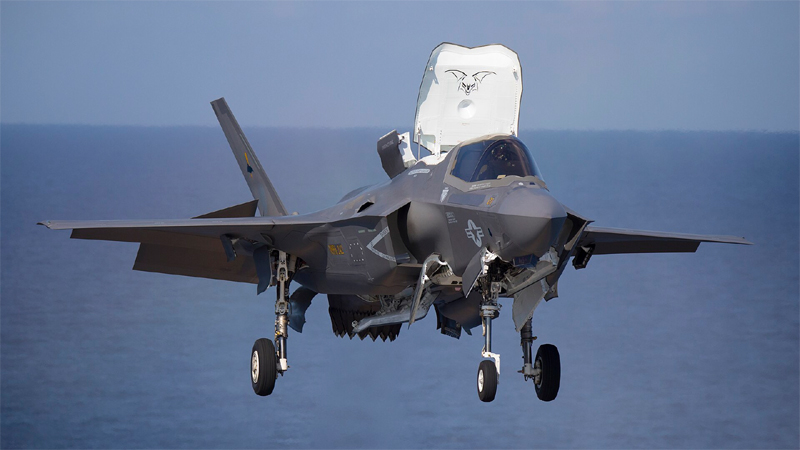
The F-35B is a fifth-generation multirole stealth fighter. It uses a Pratt & Whitney F135 engine with a shaft-driven lift fan and a three-bearing swivel nozzle for short takeoff and vertical landing. Maximum speed is Mach 1.6. Internal and external payload capacity is substantially higher, commonly cited in the range of 15,000 to 18,000 pounds. Internal weapons bays allow the aircraft to carry air-to-air missiles or precision munitions while remaining low-observable. Combat radius and loiter performance generally exceed those of the Harrier, aided by greater internal fuel capacity and more efficient high-altitude profiles.
The F-35B’s sensor suite, sensor fusion, and data-sharing capabilities give the pilot a far more complete picture of the battlespace and allow the aircraft to act as a node in a networked force. Stealth and electronic warfare features dramatically improve survivability against modern air defenses. The trade-off is greater complexity, higher maintenance demands, and a less rapid turnaround at austere forward sites compared with the Harrier’s simpler design. Former Harrier pilots have noted that muscle memory from the older jet can initially work against them in the F-35B cockpit.
The Marine Corps has therefore exchanged the Harrier’s mechanical simplicity and high-tempo responsiveness for the F-35B’s speed, range, payload, stealth, and information dominance. The jump-jet concept itself continues. Amphibious assault ships still embark fixed-wing aircraft capable of operating without catapults or arresting gear, and the specialized skills of the STOVL community remain intact. What has ended is the era of the non-stealth, subsonic Harrier as the primary means of delivering that capability. In June 2026 the distinctive sound of the Pegasus engine left Marine Corps flight lines for good, replaced by the quieter, more capable Lightning II.