
Smaller, Stealthier, Still Dual-Capable: What the B-21 Is Actually Built to Do
The B-21 Raider is no longer a single rollout photograph. By early October 2026 it is a flying test program, a low-rate production line, and a basing project at the same time, and the industrial side has just moved from funding agreements to concrete. Northrop Grumman opened a new component plant in Layton, Utah, on 9 September, and on 29 September the Air Force and the company broke ground on an additional final assembly line at Air Force Plant 42 in Palmdale, California. Imagery of that groundbreaking was released on 2 October. Both steps are meant to turn a February deal to raise annual production capacity by 25 percent into floor space, not yet into a higher delivery rate.
That choice matters because the service wants the bomber in uniform quickly. Officials have repeatedly said the first aircraft will be on the ramp at Ellsworth Air Force Base, South Dakota, in 2027. Secretary of the Air Force Troy Meink and Gen. Dale White, who oversees the program among other critical weapons, have both used that date in public. Reporting around mid-2026 indicated the first arrival may be one of the Edwards test aircraft, transferred so maintainers and aircrew can begin learning the jet while flight test continues, rather than a wait for a factory-fresh operational airframe. Ellsworth is the first main operating base and the formal training location. Whiteman Air Force Base in Missouri, already home to the B-2, and Dyess Air Force Base in Texas have been approved as later B-21 bases. Construction has followed the plan: Ellsworth rebuilt its runway and is adding maintenance and shelter space; Whiteman awarded work in 2026 on a specialized radio-frequency hangar tied to the bomber’s low-observable upkeep.
Production is the less visible half of the story, and it is the part that changed in the last month. Low-rate initial production began after a January 2024 contract. The early lots have been described as covering on the order of 21 aircraft. Final assembly remains at Plant 42, the same Palmdale complex that built the B-2. The new line broken ground there on 29 September is additional capacity, not a replacement, and it is not yet building aircraft. Reporting describes more than one million square feet of added facilities, tied to the $4.5 billion authorized in fiscal 2025 reconciliation legislation for a 25 percent rise in annual capacity. The Utah site is different in kind. East Gate 3, opened on 9 September, adds about 845,000 square feet for components and other sixth-generation work, with room for up to about 1,500 employees by 2032. It feeds the supply chain. It does not roll out finished bombers. Northrop has also said it will invest about $2.5 billion of its own capital, mostly in facilities between 2027 and 2029.
The Air Force has long planned a minimum buy of 100 Raiders to replace the B-1B and B-2, leaving an upgraded B-52 as the other half of the future bomber force. Senior officers and combatant commanders have argued in 2026 for a larger fleet, with figures around 145 and even 200 mentioned in public debate. Those are aspirations, not a revised program of record. The production rate itself remains officially unpublished. The planning baseline discussed for years was about seven aircraft a year at maturity. In May 2026, Air Force Chief of Staff Gen. Kenneth Wilsbach told Congress that Northrop was increasing the rate from 10 aircraft at a time to 12 at the service’s request. White has still spoken of a plan measured in about seven operational bombers a year. Outside estimates after the capacity deal generally land in a mature band of roughly nine to eleven a year once the line is fully ramped near the end of the decade. At those rates a 100-aircraft fleet arrives in the mid-to-late 2030s; a larger buy runs longer. Capacity and orders are not the same thing. The new Palmdale line and the Utah plant expand what the factory can build. They do not, by themselves, raise the buy above 100, and the extra assembly line will not affect deliveries until construction and tooling are finished.
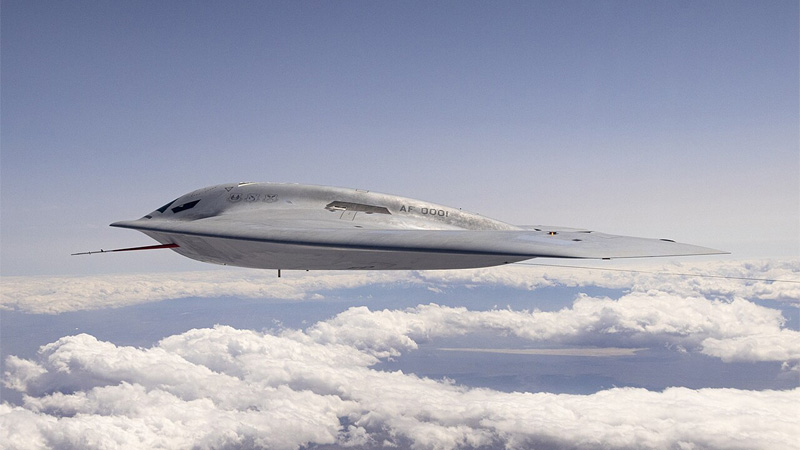
The aircraft those lots are meant to produce is a flying wing, smaller than the B-2, with a domed center section and a planform shaped for broadband low observability. Northrop and the Air Force describe it as the first sixth-generation aircraft to fly. The claim rests less on speed than on the combination of next-generation stealth, onboard sensing, networking, and an open-systems architecture meant to accept new software, sensors, and weapons without a full redesign of the airframe. Sustainment is part of the design argument. The B-2’s coatings and support tail became a constraint on how often the small fleet could fly. The Raider is supposed to use more durable low-observable processes and a digital backbone, including a digital twin, so the jet can be upgraded and maintained at a tempo closer to a normal bomber fleet.
Most performance numbers remain classified, and secondary websites that quote precise speed, range, or payload figures should be treated as estimates. What the Air Force has said is enough to place the airplane in the force. It is a penetrating bomber, intended to reach defended airspace rather than only launch from outside it. It is dual-capable: conventional precision weapons and nuclear payloads, including the Long-Range Standoff cruise missile and gravity bombs, with a mix of stand-off and direct-attack munitions. Everything is carried internally so the outer shape stays clean. Range is described as intercontinental, with fuel-efficient buried engines meant to reduce dependence on tankers relative to earlier bombers. Crew is two. Officials have also said the design leaves open a later option to fly without a crew, though the fielded aircraft is crewed. The Air Force’s older unit-cost target was $550 million in 2010 dollars, based on 100 aircraft; later public figures are higher once inflation and current-year budgeting are included, and flyaway cost is not the same as total program cost.
The operational idea is a family of systems, not a lone bomber. The Raider is meant to share data with other sensors and shooters, hold targets at risk inside heavily defended territory, and give commanders a survivable nuclear and conventional option while the B-52 remains the standoff and mass-payload platform. In that sense the 2027 date is a beginning. Ellsworth receiving an aircraft, even a test jet used for training, starts the conversion of people and bases. The September groundbreaking and the Utah opening start the conversion of the factory. Initial operational capability in the fuller sense, a squadron that can generate sorties with its own weapons, maintainers, and tactics, follows only after more airframes, more software maturity, and the slow ramp of a line the Air Force is only now building out, before it has decided how large the fleet should finally be.