Applying Lessons from the Ongoing Middle East Conflict to Central European Air Defense Systems
Since February 28, 2026, Israel has been operating in the most complex air and missile environment in its history. In the first strike alone, more than 200 fighter aircraft flew over 1,500 kilometers in each direction along carefully coordinated routes, delivering hundreds of precision weapons against selected targets. The operation required cross-national aerial refueling, close cooperation with the United States Air Force and the United States Navy, and potentially coordination with other allied forces. At the same time, all layers of Israeli and allied ballistic missile defense systems were placed on the highest level of alert in anticipation of an Iranian response. This operational cycle has repeated itself more than twice daily since February 28.
Hundreds of aircraft operating simultaneously over long distances, coordinated action with the United States, and large-scale Iranian missile retaliation created a saturated and multidomain battlefield. But they could not operate without the precise and real-time brain of the operation. Behind the visible layer of fighter aircraft and interceptors lies a less visible yet decisive layer, which can be imagined as the brain of operations. This layer consists of advanced Air Command and Control systems, commonly referred to as Air C2.
Among the companies shaping this capability for the Israeli Air Force is TSG IT Systems. Brigadier General (Ret.) Pini Yungman, President of TSG, has been at the forefront of the strategic development of these capabilities after leading the deployment of systems such as Iron Dome and David’s Sling. TSG contributes both to Air Force command and control systems for combat aircraft missions and to ballistic missile defense operations across all operational layers.
The opening phase of the campaign reportedly involved approximately 200 fighter jets striking hundreds of targets in near-simultaneous waves. In the following two days alone, more than 1,500 sorties were conducted, with thousands of additional munitions delivered. Such an operation is not simply a matter of aircraft availability. It represents detailed mission planning at all levels of the command structure, starting from the strategic level, through the operational level, to the tactical level.
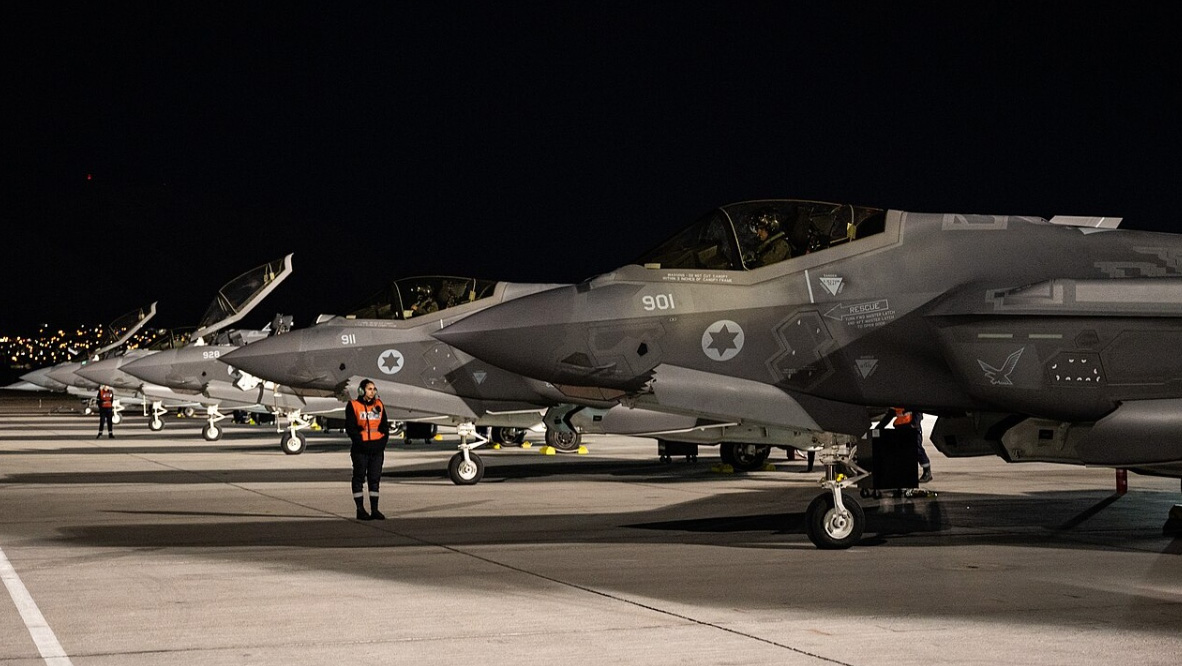
Large-scale air campaigns are built through a structured Air Command and Control process. At the strategic level, campaign objectives are translated into a coherent operational design that defines target priorities, operational phases, force allocation, penetration routes, refueling points, and timing logic.
At the operational level, Air Force headquarters constructs detailed strike packages. These packages synchronize suppression of enemy air defenses, deep strike formations, air superiority patrols, electronic warfare support, intelligence, surveillance and reconnaissance platforms, and tanker corridors into tightly sequenced operational waves.
At the tactical level, squadrons execute their missions within precise time-on-target windows while remaining dynamically controllable through the command chain. Real-time adjustments such as rerouting, retasking, or reallocating assets must remain possible without losing coherence across the wider campaign.
Even though Israel is not a NATO member, in general all processes are very similar. The principles must lead to operational success in any case. And, of course, given that the operation is not only Israeli but also involves the United States, the brain of the operation needs to understand the NATO language. The coordination includes mission planning cycles, airspace control measures, and datalink communication standards — meaning full Link 16 interoperability. The execution of coordination procedures must be aligned across national command structures, because the current battlefield is characterized by high density, rapid changes, and the unpredictability of enemy threats. The result is not parallel operations but a unified and synchronized air campaign executed as a single operational system.
Missile Defense Under Saturation: 30,000 Threats Managed
The Iranian response included large-scale ballistic missile and unmanned aerial vehicle launches toward Israeli territory. According to public operational data presented by TSG, Israel’s air defense network has successfully managed more than 30,000 aerial threats, including missiles, drones, and UAVs across seven active fronts since October 2023, achieving an overall success rate exceeding 90 percent.
Such performance does not depend solely on interceptors. It relies on a highly integrated command and control environment capable of operating under saturation conditions. Modern missile and air defense requires real-time integration of multiple sources of data including radar systems, electronic warfare inputs, ELINT feeds, identification friend-or-foe systems, electro-optical sensors, acoustic sensors, and NATO-standard data links such as Link 16.
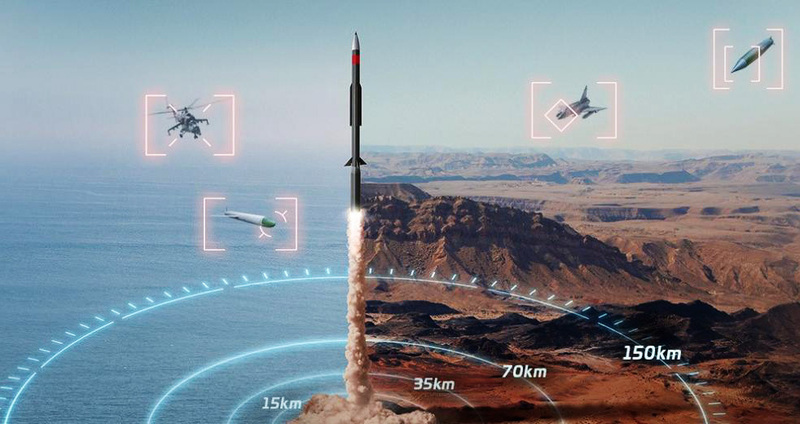
TSG’s SkyWeaver system, described as a real-time multi-sensor Air Force C4I system, is built on a data fusion engine specifically designed for this operational environment and incorporates advanced algorithms and AI capabilities. In a saturated battlespace where ballistic missiles, maneuvering threats, cruise missiles, UAV swarms, and friendly aircraft may appear simultaneously, the system analyzes the most critical threats and allocates interception tasks to the appropriate weapon systems. In Israel these systems include Arrow 3, Arrow 2, David’s Sling, deployed US assets, and Iron Dome. In the case of loitering threats, combat aircraft and helicopters may also be tasked with interception.
One of the most critical capabilities is precise impact prediction. Within seconds the system analyzes and calculates whether a ballistic missile will strike a populated area or open terrain. This calculation directly influences interceptor allocation and enables targeted civilian early warning.
The system also supports full redundancy and pre-planning capabilities. These features ensure operational continuity even under electronic countermeasures, GPS spoofing, and dense air traffic conditions that increasingly characterize modern battlefields.
An often-overlooked aspect, particularly during dense missile attacks, is coordination with civilian air traffic control. After a few days during which Ben Gurion Airport was closed for civilian traffic and used only for the military supply chain, Israel began rescue flights for its citizens stranded outside the country. This operation also required precise threat evaluation to minimize potential risks.
Civilian Early Warning: Technology That Saves Lives
One of the least discussed yet most critical layers of Israel’s defense architecture is the civilian early warning system. TSG technology supports coordination between military and civilian authorities and provides the data backbone for real-time alerts issued by Israel’s Home Front Command.
When a missile is detected, the system performs a sequence of rapid analytical steps:
- Detection and identification
- Tracking and trajectory calculation
- Threat evaluation
- Impact point prediction
- Intercept debris dispersion calculation
- Alert dissemination to affected area only
Because impact prediction is highly precise, warnings can be geographically targeted. This approach reduces unnecessary nationwide disruption while maximizing protection where it is needed most. The capability is particularly important during high-volume attacks when hundreds of simultaneous trajectories must be analyzed within seconds.
During previous escalation rounds these systems enabled both life-saving interceptions and timely civilian sheltering.
Implications of the Middle East Conflict for Middle Europe Air Defense
In modern warfare, the decisive factors are not only the number of aircraft in the sky but also the robustness of the command architecture that plans, synchronizes, controls them and assures the highest level of effectiveness. One of TSG’s strategic strengths, particularly relevant for NATO countries, is that its architecture enhances situational awareness without replacing legacy radars or interceptor systems.
The system is fully compatible with Link 16 and NATO standards. It is designed for straightforward integration and can manage both legacy and next-generation sensors. The architecture supports current and future effectors, integrates with fifth-generation fighter environments, and is built for multidomain operations. It also incorporates full fail-safe redundancy, advanced cybersecurity protections and sophisticated artificial intelligence capabilities, while allowing the customer to adapt and evolve the system independently.
The events since February 28 demonstrate that large-scale air campaigns and successful national missile defense depend on advanced Air Command and Control systems capable of real-time data fusion, predictive analytics, and intelligent resource allocation. Within this architecture, companies such as TSG are not peripheral suppliers. They are central enablers of operational advantage and civilian protection. The majority of analysts say that building totally new local Air C2 at the level already available and tested is wasteful and delays operational readiness.
On the other side, some politicians say we need to buy more fighters, more radars, more missiles, etc. But without integrating sensors and effectors into the brain capable of providing modern and flexible Air C2, we would only waste the money, and the effect would never appear. Finally, it must be said that without deep cooperation between customers and the defense industry, no new Air C2 system could ever truly be called The Brain of the Air Force.