
France and Germany Chart National Tank Futures as MGCS Shifts to Technology Focus
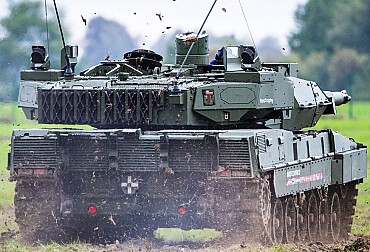
The public acknowledgment on 8 October 2026 by French Chief of the Defence Staff General Fabien Mandon that Germany had decided to leave the Main Ground Combat System (MGCS) project marked a clarifying moment for European heavy armour planning, even as defence ministers Catherine Vautrin and Boris Pistorius insisted the following day that the programme remained active and important. What has emerged is not a clean rupture but a practical reorientation: MGCS, launched in 2017 to produce a common successor to France’s Leclerc and Germany’s Leopard 2, has slipped toward service entry in the late 2040s and is increasingly framed as a vehicle for shared future technologies – connectivity, collaborative combat, automation, robotics, and artificial intelligence – rather than a single joint platform. An industrial offer submitted early in 2026 proved incompatible with France’s need to begin replacing its tanks around 2037–2038, prompting both countries to pursue national interim and longer-term solutions while retaining some cooperative technological work through the MGCS Project Company involving KNDS France, KNDS Deutschland, Rheinmetall, and Thales.
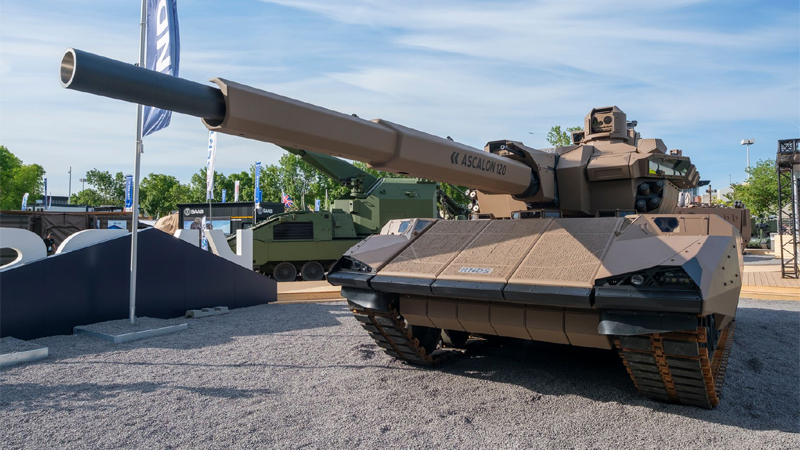
France faces a sharper capability-timing problem. The Leclerc fleet, modernised in limited numbers to the XLR standard, is scheduled for progressive withdrawal starting in 2038. General Mandon has stated that studies for a longer-term successor must begin in 2027 to avoid a gap, drawing on principles already validated in the joint work even if the common tank itself is no longer the immediate goal. In the interim, KNDS has advanced the CAPINT (Capacité Intermédiaire) concept, unveiled at Eurosatory in June 2026. It pairs a heavily modified Leopard 2A8-derived hull with an unmanned French ASCALON turret.
The ASCALON gun family is designed around a common breech that allows rapid switching between a 120 mm tube compatible with existing NATO ammunition and a 140 mm version offering substantially higher muzzle energy; the displayed configuration used the 120 mm with a 22-round autoloader, while testing has also included the larger calibre. A three-person crew sits entirely within an armoured capsule in the hull, isolated from the turret and ammunition, improving survivability. Vehicle mass is targeted around 50 tonnes in lighter configurations (rising with additional protection), powered by a 1 500 hp diesel, with active protection systems, an ARX30 remote weapon station for counter-drone work, drone integration, and open architecture for robotic “wingman” systems. French officials have described such an intermediate capability as a potential first building block of future system-of-systems concepts rather than merely an upgraded legacy tank, with ambitions for demonstrators around 2030 and initial production or service entry later in the decade.
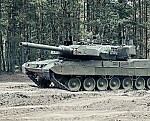
Germany’s path benefits from continuous industrial activity and less acute near-term pressure. Production and upgrades of the Leopard 2A8 continue, supporting both the Bundeswehr and export customers, while work proceeds on a national interim or bridge solution often referred to as Leopard 3 or Leopard 2AX. This effort runs through PSM Projekt System & Management, the joint venture of KNDS Deutschland and Rheinmetall originally associated with the Puma infantry fighting vehicle. The vehicle is expected to draw on the Leopard 2A8 hull and related technologies, incorporating an automatic loader, a three-person crew, enhanced 360-degree vision, short-range counter-drone measures, and potentially the Rheinmetall 130 mm Rh-130 L/51 gun (distinct from the French preference for 140 mm ASCALON in MGCS discussions).
A new engine option (including work under the OLYMP project), full digitalisation, UAV integration, and improved protection packages are under consideration. Initial deliveries are anticipated in the early 2030s – reports mention from around 2032 – to replace older Leopard 2 variants, with an early requirement on the order of about 100 vehicles and a service life potentially stretching decades. Concepts such as the Leopard 2 A-RC 3.0, with its unmanned turret, modular autoloader capable of accepting 120 mm, 130 mm or 140 mm guns, reduced weight relative to some prior designs, and crew citadel, illustrate the technological direction German industry is already exploring as a bridge toward whatever longer-term solution emerges.
Both national approaches converge on several design trends shaped by lessons from Ukraine and evolving threats: reduced crew sizes housed in protected hull capsules, unmanned or remote turrets that allow better armour distribution and lower silhouette, automatic loaders enabling larger-calibre guns, integrated active and passive protection, extensive sensor fusion, and connectivity to drones, uncrewed ground systems, and wider networked forces. Artificial intelligence for threat detection, target prioritisation, and decision support, along with cyber resilience and modular architectures, features in both French statements about the post-Leclerc future and German bridge-tank planning. France emphasises the tank as a tactical node commanding robotic assets and integrating with aerial and artillery systems; Germany leverages its established production base and the industrial capacity of Rheinmetall and KNDS Deutschland to field incremental improvements more rapidly.
The divergence carries industrial and strategic consequences. Germany retains uninterrupted production lines, a mature export ecosystem, and the ability to evolve the Leopard family while testing higher-calibre guns and automation. France must restart or accelerate studies in 2027, manage the risk of a temporary capability shortfall after 2038, and decide how far to rely on German-derived hulls (as in CAPINT) versus purely national architectures for the longer term. Work-share tensions, calibre preferences (130 mm versus 140 mm), and differing operational timelines – Germany able to modernise continuously, France facing a hard retirement date – have repeatedly complicated the original joint programme. While ministers stress that MGCS continues with a focus on shared future technologies and that years of joint staff work were not wasted, the practical effect is parallel national platforms in the 2030s, with any common system-of-systems elements arriving later, if at all, in the 2040s. Estimated programme volumes around €100 billion remain largely aspirational for a fully joint tank.
This pattern echoes the earlier collapse of the Future Combat Air System fighter effort and underscores structural challenges in major Franco-German defence projects: mismatched industrial interests, divergent threat perceptions and force structures, and the difficulty of aligning political timelines with technical reality. For NATO and European land forces, the result may be greater short-term national capability and continued interoperability through NATO standards, ammunition commonality where possible, and shared technological modules, but reduced economies of scale and the risk of fragmented future fleets. Both countries are responding to the demonstrated relevance of heavy armour in high-intensity conflict by prioritising near-term solutions – CAPINT and Leclerc XLR sustainment for France, Leopard 2A8 and Leopard 3-class vehicles for Germany – while keeping open a thinner cooperative track on robotics, AI, and networking. Whether these parallel tracks eventually reconverge around common technologies or solidify into distinct national lines will shape European armoured capability well into the middle of the century.