
French Leclerc Tanks Transform into Giant Anti-Drone Shotguns
In the United Arab Emirates, French armored forces have conducted one of the more pragmatic experiments in modern warfare adaptation. Units of the 5th Cuirassiers Regiment, permanently deployed there as part of France’s strategic presence in the Gulf, successfully tested the ability of Leclerc main battle tanks to neutralize aerial drones using their primary 120mm armament. The trials, dubbed “Tirs LAD XL,” demonstrated that an existing anti-personnel munition could be repurposed into an emergency counter-drone tool.
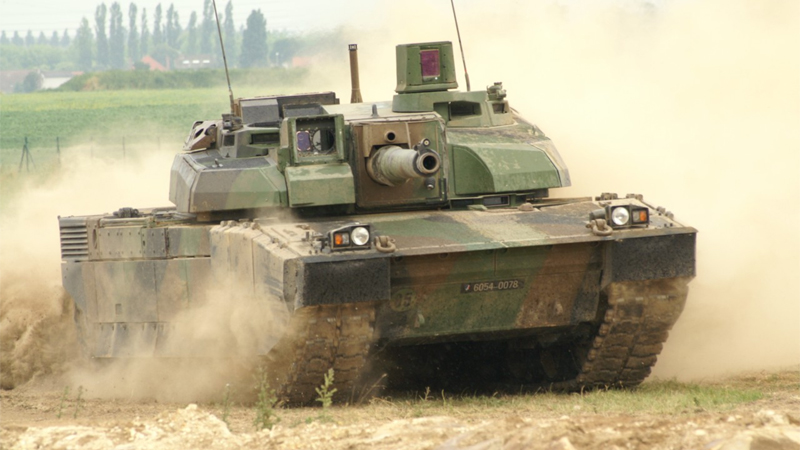
The ammunition in question is the 120 OEFC (Obus à Effet Canalisé), also known as OEFC F1, produced by KNDS France and in service since 2012. Weighing about 11.5 kilograms, this canister round ejects roughly 1,100 tungsten-carbide pellets at a muzzle velocity of around 1,140 meters per second. Originally designed for close-range defense against infantry or soft targets in urban environments – creating a wide dispersal pattern effective out to approximately 500 meters – it has now proven capable of shredding small aerial targets. During the validation firings, crews engaged drones flying erratic trajectories at higher-than-typical combat altitudes, with perpendicular approaches that simulated challenging conditions. The targets were small, lacking explosives or fuel, yet the pellets achieved decisive effects through sheer volumetric saturation.
This doctrinal innovation stems from hard-won lessons in the Middle East and observations of conflicts like the war in Ukraine, where cheap first-person-view (FPV) drones and loitering munitions have repeatedly targeted armored vehicles with devastating success. The French Army’s 2nd Armored Brigade highlighted the 5th Cuirassiers’ experience in the region as key to adapting firing procedures for the Leclerc and its OEFC rounds. Rather than waiting for dedicated hard-kill or soft-kill systems under the Leclerc’s ongoing modernization program, commanders opted for an “opportunistic” layer of defense using what is already loaded in the tank’s ammunition racks.

The approach complements other French efforts. The Army is developing the Proteus system, which repurposes a 20mm cannon with thermal cameras, fire control, and AI for anti-drone roles. Some Leclercs have also trialed protective “Cope Cages” or anti-drone grilles. Yet the OEFC trials offer a low-cost, no-modification interim solution that leverages the tank’s existing firepower. Success in these tests was monitored closely by the Commandement du Combat Futur (CCF), the French Army’s dedicated innovation body, signaling potential integration into broader anti-drone doctrines.
Specialists remain divided on the tactic’s practicality. Proponents praise the simplicity and the round’s ability to create a lethal cone of fragments that compensates for aiming difficulties against fast, maneuvering targets. A single hit on a propeller, battery, or frame is often enough to down a quadcopter or FPV drone. Critics, however, point to limitations: the short effective range, the consumption of the tank’s primary ammunition (reducing readiness for ground threats), the challenges of detection and turret slewing in real combat, and the high per-round cost relative to a disposable drone. Skeptics liken it to using a sledgehammer on a fly, noting that while effective in controlled desert conditions, massed swarms or high-speed threats could overwhelm a tank crew focused on reloading and reorienting.
Nevertheless, the experiment underscores a broader reality of contemporary warfare: main battle tanks, long optimized for engaging peer armored threats at long range, must now contend with proliferating low-cost aerial systems. The Leclerc, with its advanced fire control and autoloader, offers advantages in rapid engagement, but the core idea – repurposing canister ammunition – is not unique to France.
Comparable initiatives have emerged elsewhere, most notably in the United States. The U.S. Army has updated its tank platoon tactics manuals to explicitly train M1 Abrams crews to engage unmanned aerial systems (UAS) with their 120mm main guns, particularly using the M1028 canister round. This American equivalent disperses over 1,000 tungsten projectiles in a broad pattern, mirroring the OEFC’s design. Revised doctrine instructs crews to use “all available weaponry,” including the main cannon and coaxial machine guns, when drones threaten armored formations. Training scenarios emphasize leading moving aerial targets and integrating this capability into platoon-level maneuvers. While not yet confirmed in live combat firings like the French tests, these doctrinal shifts reflect the same urgency driven by observations from Ukraine and the Middle East.

Other nations are exploring related concepts, though often through different means. Infantry and vehicle crews worldwide have experimented with shotgun-style anti-drone ammunition for small arms, ranging from specialized 12-gauge loads to improvised solutions. Some armies are integrating remote weapon stations with high-rate machine guns or 30mm cannons optimized for aerial intercepts. In parallel, dedicated counter-drone systems – such as directed-energy weapons, electronic jammers, or missile-based SHORAD (Short-Range Air Defense) – continue to proliferate. Yet the appeal of leveraging existing tank main guns lies in their immediacy and the fact that no additional hardware is required beyond doctrinal changes and perhaps minor fire-control tweaks.
Russia and Ukraine, immersed in the most drone-intensive conflict in history, have pushed similar improvisations. Ukrainian forces have employed everything from shotgun-armed interceptor drones to ground-based machine guns and even captured equipment for anti-drone roles. Russian troops have fielded improvised anti-drone rounds for small arms and explored netting or fragmenting munitions. While specific 120mm or 125mm canister adaptations against drones are less documented in open sources for these armies, the intense pressure of FPV attacks has driven widespread innovation in layered defenses for armored columns.
The French trials in the Emirates fit into this global pattern of rapid, bottom-up adaptation. By validating the OEFC in demanding conditions, the 5th Cuirassiers have provided data that could inform not only Leclerc operations but also future main battle tank designs, such as the Franco-German Main Ground Combat System (MGCS). In an era where drones can be manufactured for a few hundred dollars while precision munitions cost hundreds of thousands, militaries are seeking asymmetric, economical responses. Using a tank’s main gun as a last-ditch “drone sweeper” represents one such stopgap – imperfect, controversial, but demonstrably workable.
As conflicts evolve, the integration of AI-assisted targeting, better sensors, and hybrid munitions may extend these capabilities. For now, the message from Abu Dhabi is clear: armored forces cannot ignore the drone threat, and creative reuse of legacy systems offers a bridge until more advanced solutions mature. This pragmatic French approach, alongside parallel American doctrinal shifts, illustrates how armies are recalibrating heavy armor for a battlefield where the sky is no longer the exclusive domain of expensive aircraft but a contested zone filled with inexpensive, lethal UAVs. The Leclerc’s new role as an opportunistic anti-drone platform may be just the beginning of a wider transformation in tank employment.