The German Leopard 3: Originally a Temporary Project, Now a Strategic One
The German program for a new-generation main battle tank is entering a phase that marks the transition from concepts to actual industrial implementation. The decision to entrust development and future production to the joint venture PSM (Projekt System & Management GmbH) represents a pivotal moment. This company, established as a joint venture between KNDS Deutschland and Rheinmetall, was originally created for the Puma infantry fighting vehicle project. However, its role is gradually expanding to include the key project for the Bundeswehr’s future main battle tank. The approval granted by the German Cartel Office last December will likely help ensure continuity of capabilities between the Leopard 2 and the future Franco-German MGCS system. That is, if the MGCS project is ever completed.
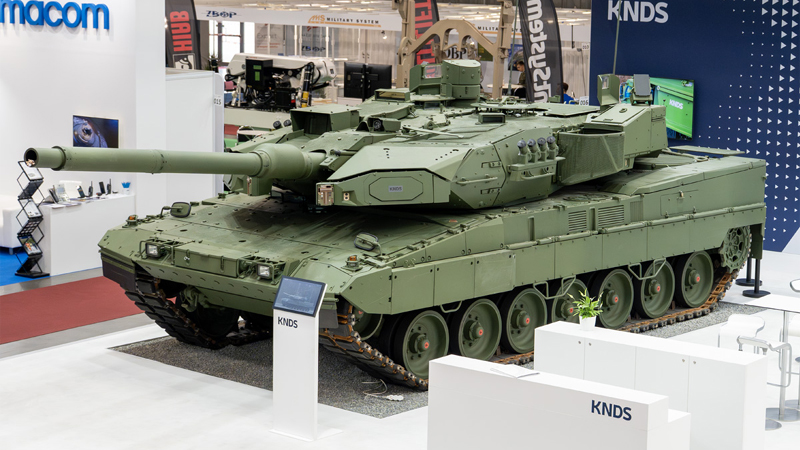
Current developments confirm Berlin’s shift from the original designation “Brückenlösung” (transitional solution) to the more ambitious concept of the “Leopard 3” tank (still an informal designation). A platform is taking shape with a planned introduction in the early 2030s and a service life of around 25 years. This timeframe changes the nature of the entire program. What was once a bridge between generations of main battle tanks is evolving into a full-fledged system capable of dominating European ground forces for a significant portion of the current century.
A major shift is represented by the agreement among industrial partners on the division of responsibilities, which was reported by the German portal Hartpunkt in March. KNDS Deutschland and Rheinmetall have divided fourteen major design projects equally between them. This model balances the influence of both players while limiting the risk of parallel development of competing solutions. Rheinmetall is taking responsibility for the main weapon system, including the 130mm cannon, optics, and a 360-degree situational awareness system. KNDS Deutschland is responsible for the automatic loading system, stabilization, fire control, and other key subsystems. Uncertainty remains regarding formal approval by the German Ministry of Defense, which has not publicly commented on the details of the contract.
The system’s technological direction is gradually becoming clearer despite the limited amount of official information. A key change is the transition to a 130-mm cannon, which is being developed by Rheinmetall. This step reflects the need for greater penetration against modern armored targets. At the same time, it necessitates fundamental design changes. The weight of the ammunition, which reaches approximately 30 kilograms, makes manual loading impossible. The automatic loading system thus shifts from an optional innovation to a necessity.
The introduction of the automatic loading system allows the crew size to be reduced from four to three. Furthermore, the vehicle’s crew is relocated to the hull, which increases its protection and alters the vehicle’s architecture. This concept aligns with trends exemplified by the Russian T-14 Armata tank, although the German solution is taking a different path. The result is expected to be a lower turret, a smaller silhouette, and a reduction in exposed surface area. The design draws inspiration, among other things, from the Leopard 2 A-RC 3.0 concept, which KNDS Deutschland unveiled in 2024 at the Eurosatory trade show.
The changes also affect the hull layout itself. Placing the entire crew inside the hull leads to a slight increase in its height. This seemingly negative factor opens up new possibilities in the area of propulsion. The OLYMP project, led by KNDS Deutschland, is exploring the integration of an alternative engine, with Liebherr emerging as a potential supplier. While Liebherr has not previously supplied engines for main battle tanks, its industrial engines offer higher power potential. The taller hull can thus compensate for the engine’s less compact design while simultaneously creating space for additional power-intensive systems.
In addition to the main structural components, a range of supporting technologies is being developed in parallel. At the turn of 2024 and 2025, the German procurement agency BAAINBw commissioned a series of studies focused on key subsystems. These include automated gun calibration, designed to compensate for the effects of temperature and mechanical stress, the development of new 130mm ammunition, including kinetic and multi-purpose variants, and the expansion of protective system capabilities.
A significant role is played by the modernization of Hensoldt’s MUSS system, which can detect laser, infrared, and acoustic threats and actively jam them. Plans now include expanding the system’s capabilities to detect optical devices. This direction of development reflects lessons learned from the conflict in Ukraine, where sensors, drones, and precision-guided munitions dominate.
The program’s timeline remains ambitious. The results of technical studies are to be completed by the end of 2026. A decision on the final configuration will follow. Introduction into the Bundeswehr’s inventory is expected in the early 2030s, with the first batch potentially comprising approximately 100 units intended to replace older versions of the Leopard 2 below the A7 standard.
This timeline must be viewed in the context of parallel programs. The Leopard 2A8, with deliveries scheduled to begin in 2027, represents a short-term solution. Among other things, this model integrates the Trophy active protection system from the Israeli company Rafael and other modernization features. Nevertheless, it remains an evolutionary step based on a platform from the 1970s.
A key factor in the “Leopard 3” program remains the uncertainty surrounding the MGCS (Main Ground Combat System) project. According to current plans, this German-French initiative is expected to achieve operational capability around 2045. However, differing requirements from Berlin and Paris are leading to repeated delays. Germany prefers a heavy tank optimized for high-intensity conflicts in Europe. France advocates for a lighter and strategically more mobile platform. This disagreement complicates both development and the industrial division of labor.
The “Leopard 3” benefits from these disagreements and is gaining broader significance. It is not merely a national solution; it is laying the groundwork for a potential future European platform. The EU’s MARTE project, in which more than ten European countries—including Germany, Italy, the Netherlands, and Sweden—have participated, demonstrates an effort to unify requirements for a future continental tank. The alignment of these requirements with the German project suggests significant export potential.
Many countries still operate older variants of the Leopard 2, such as the A4 standard. These platforms will reach the limits of their modernization capabilities in the coming years. The new German tank could therefore build on the Leopard 2’s export success and become the standard for European and NATO partners.
Overall developments show a shift from long-term visions to feasible steps. Germany is creating a platform that responds to the current security environment as well as to the structural problems of European defense cooperation. “Leopard 3” is thus gradually emerging as a key element of the future regional architecture of ground forces. Its significance extends beyond national borders and raises the question of who will set the standards for armored combat in Europe in the coming decades.