Germany and Poland Strengthen NATO’s Eastern Flank Through Defense Cooperation
On July 29, Germany published the text of the German-Polish agreement on defense cooperation, which Federal Minister of Defense Boris Pistorius and his Polish counterpart Władysław Kosiniak-Kamysz signed on June 17 in Warsaw. With this step, Berlin formalized the document, which was the result of a year of negotiations and replaced an earlier agreement dated June 21, 2011. The agreement does not contain any new security guarantees beyond the scope of Article 5 of the North Atlantic Treaty and Article 42(7) of the Treaty on European Union. It thus remains politically more modest than anticipated prior to its publication, but it sets out in detail the practical aspects of military cooperation between Berlin and Warsaw for the coming years.
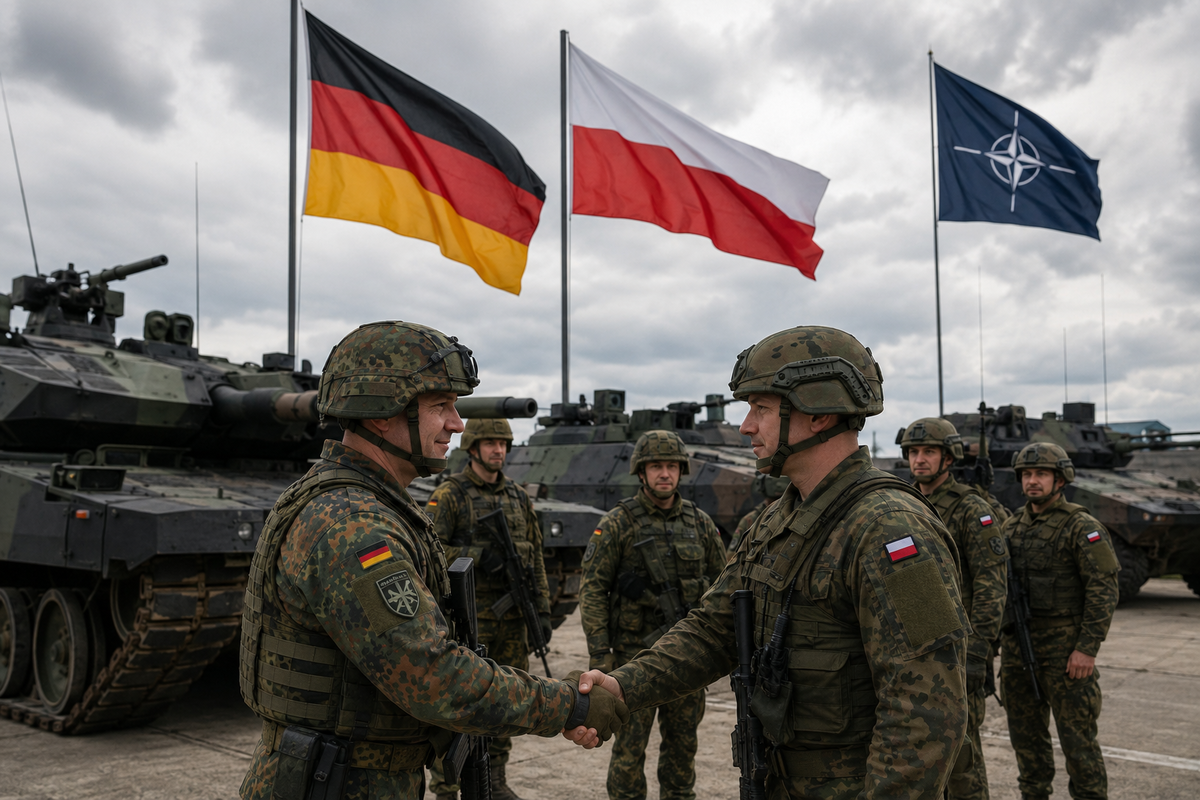
The agreement consists of 14 articles and refers, among other things, to the United Nations Charter of June 26, 1945, the North Atlantic Treaty of April 4, 1949, the 1951 NATO Agreement on the Status of Forces, the Polish-German Treaty on Good Neighborly Relations of June 17, 1991, and the Agreement on the Presence of Armed Forces on the Territory of the Other State of August 23, 2000. The preamble explicitly mentions Russian aggression against Ukraine as the key context in which both governments justify their action, along with growing great-power competition and threats to the rules-based international order.
At the heart of the document is Article 3, dedicated to building defense capabilities and operational cooperation. In it, both parties commit to a special responsibility for the security of NATO’s eastern flank and pledge to intensify joint efforts to strengthen defense and deterrence. This commitment is fleshed out in paragraphs 5 through 7: the parties grant each other the right to transit and deploy armed forces on their respective territories, harmonize administrative and customs procedures for border crossings, and develop the joint use of infrastructure. Polish territory, meanwhile, assumes the role of a supply base for the contingent of German ground forces deployed in Lithuania – specifically, the 45th Tank Brigade – whose supplies and reinforcements must pass through Polish territory in the event of a crisis. To this end, the treaty introduces the concept of the “Central Northern European Military Mobility Area,” a new framework for coordinating military mobility in Northern and Central Europe. The text emphasizes the need to harmonize EU and NATO standards to avoid duplication of capabilities.
The eighth paragraph of Article 3 goes even further and refers to joint investments in extensive infrastructure – specifically rail lines, roads, airports, bridges, and logistics centers – designed to improve NATO’s ability to conduct military operations toward the east. Both parties commit to cooperation in the area of engineering support, including defense infrastructure and technical support for combat operations. The ninth paragraph highlights the importance of developing fuel pipelines and storage facilities for allied operations on the eastern flank, which is one of the Alliance’s well-known weaknesses. Additionally, Article 4 addresses training and interoperability, listing fourteen specific commitments across the land, air, sea, cyberspace, and space domains, including opening the “European Space Component Command” to Polish participation.
Industrial cooperation is addressed specifically in Article 6. Both governments recognize that the Polish-German partnership has the potential to become a pillar of regional security and industrial cooperation in Central and Eastern Europe. They plan to engage in joint research, development, and procurement of equipment, as well as voluntary technology transfer between the supply chains of both countries and the establishment of a common approach to arms exports for joint projects. Among the priority areas mentioned are deep-precision-strike systems, unmanned and autonomous weapon systems, advanced missile and combat systems, electronic warfare, and artificial intelligence. Paragraph 10 addresses the intention to support joint production and maintenance throughout the entire life cycle of military equipment while ensuring the resilience of supply chains. This wording reflects the experiences of European armies with shortages of ammunition and spare parts in recent years.
The institutional framework for cooperation is set forth in Article 9, which establishes a multi-level governance system. Defense ministers will meet regularly for intergovernmental consultations or as needed, supplemented by additional regular meetings of deputy ministers. Cooperation between the armed forces themselves will be overseen by the “Senior Military Committee,” led by representatives of the chiefs of staff. Article 11 governs the protection of classified information with reference to the bilateral agreement of April 30, 1999, and stipulates that the treaty always makes the release and sharing of information involving intellectual property rights conditional upon the written consent of the rights holder.
Compared to the Franco-German Cass Treaty of January 22, 2019, the Polish-German document is considerably more modest in scope. The Cassis Treaty, which supplements the original Élysée Treaty of 1963, covers not only defense but also economic convergence, culture, education, cross-border cooperation, and the functioning of joint institutions such as the Franco-German Council of Economic Experts or the Council for Defense and Security. Article 4 contains a commitment to mutual assistance “by all available means, including armed forces,” going beyond a mere reference to membership in NATO and the EU (the Polish-German text, on the other hand, merely refers to Article 5 of the North Atlantic Treaty and Article 42, paragraph 7, of the Treaty on European Union).
The so-called Kensington Treaty, signed on July 17, 2025, by British Prime Minister Keir Starmer and German Chancellor Friedrich Merz, is also of a different nature, marking the first bilateral treaty between the United Kingdom and Germany since World War II. It is a broad agreement covering not only defense but also internal security, migration, economic growth, science and technology, an open society, as well as climate and energy. The text builds on the 2024 Trinity House Agreement, and in Article 7, both parties reaffirm their commitment to strengthening the defense industry and the interoperability of their armed forces. The Kensington Treaty also goes beyond a mere reaffirmation of NATO and EU membership: Article 3 contains a provision stating that, as close allies, both parties will provide assistance “including military means” in the event of an armed attack on the other party – a bilateral commitment more comparable to the Treaty of Casha than to the Polish-German text. Institutionally, the treaty establishes ministerial consultations led by the heads of government (held once every two years), at which a plan for the implementation of future projects is approved.
The new German-Polish agreement on defense cooperation confirms that Berlin continues to engage with Poland primarily through sectoral partnerships focused on defense, military mobility, infrastructure, and industrial cooperation. At the strategic level, however, the fundamental framework for bilateral relations remains the 1991 Treaty on Good Neighborliness and Friendly Cooperation, which, following German reunification, laid the foundation for political reconciliation and long-term cooperation between the two countries. Unlike its relations with Western partners, however, Berlin has not yet sought to establish a new comprehensive strategic-political treaty with Warsaw. In 2019, Germany concluded the Caen Treaty with France, which institutionally links foreign, security, economic, and cultural policies and includes an explicit commitment to mutual assistance. Similarly, in 2025, it signed the Kensington Treaty with the United Kingdom, creating a broad framework for cooperation in the areas of security, the defense industry, the economy, technology, and migration. The German-Polish agreement, by contrast, remains significantly narrower in scope and more practically oriented. This suggests that Germany continues to prefer functional and sector-specific cooperation in Eastern Europe, while building broader strategic and political architectures with its key Western European partners.