Ireland Set to Join France’s SCORPION Program: Major €1 Billion Armored Vehicle Deal on the Horizon
Ireland is poised to significantly modernize its Defence Forces by joining the French SCORPION program (Synergie du COntact Renforcé par la Polyvalence et l’Info valorisatiON or “Synergy of Contact Reinforced by Versatility and Information Enhancement”), a comprehensive initiative to transform land forces through advanced, networked armored vehicles. Recent reports from early 2026 indicate Dublin is preparing a major procurement from KNDS France, potentially exceeding €1 billion across multiple tranches, with deliveries targeted before 2030. This would replace aging fleets, including the unreliable LTAV (RG-32M) vehicles withdrawn in late 2025 after low usage and maintenance issues, and the 80 Piranha III infantry fighting vehicles from the late 1990s.
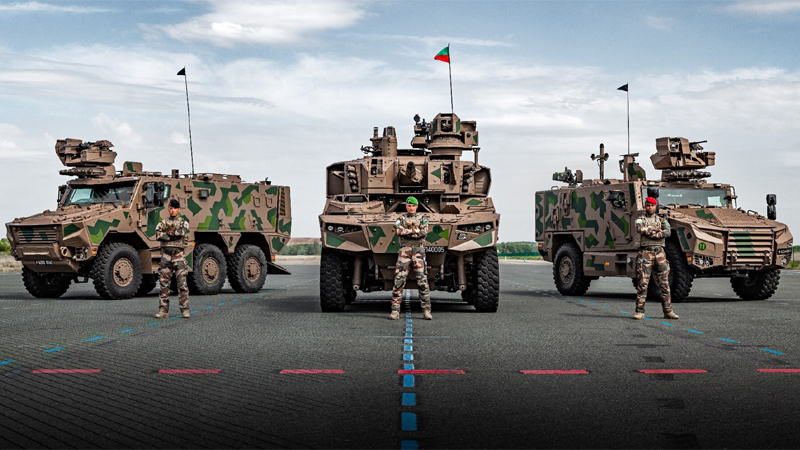
The Irish Army has historically focused on peacekeeping, with lightly equipped forces. The proposed acquisition marks a shift toward enhanced protected mobility, firepower, and interoperability – aligning with broader European rearmament amid evolving security challenges. Experts emphasize priorities like reliability, durability, operational capability, speed, mobility, and firepower, lessons from past procurement failures.
The SCORPION Program: A Modern Armored Ecosystem
Launched in 2014, SCORPION modernizes the French Army with a family of wheeled vehicles sharing vetronics, the SICS combat information system for collaborative combat, CONTACT radios, and common components (e.g., 70% shared between Griffon and Jaguar) for logistics efficiency. It integrates threat detection, networked data sharing, and infovalorization for real-time decision-making. France plans hundreds of units by 2035; partners like Belgium (via CaMo partnership) and Luxembourg have joined for interoperability. Ireland’s entry, potentially modeled on CaMo or simpler DGA framework agreements, could extend this to non-NATO “NATO-adjacent” nations.

Key Vehicles: Jaguar, Serval, and Griffon
Ireland’s interest centers on the Jaguar and Serval, with some Griffon and possibly CAESAR artillery systems.
- EBRC Jaguar (Engin Blindé de Reconnaissance et de Combat): This 6x6 armored reconnaissance and combat vehicle (25 tonnes) replaces older platforms like the AMX-10 RC. It features a 500 hp engine for 90 km/h speed and 800 km range, variable ground clearance, and exceptional maneuverability (rear steering, run-flat tires). Protection meets STANAG 4569 Level 4 (upgradable), with V-hull against mines/IEDs, GALIX multispectral countermeasures, acoustic gunfire detection (PILAR V), and optronics (ANTARES for 360° awareness). Armament includes a stabilized 40 mm CTAS autocannon (200 rpm, APFSDS-T/GPR munitions to 3 km+), 4 Akeron MP missiles (5 km range, fire-and-forget, non-line-of-sight), and a 7.62 mm remote weapon station. For Ireland, the Jaguar would restore armored cavalry lethality, lost since the FV101 Scorpion retirement in 2017, enabling reconnaissance and direct fire support in complex terrains.
- VBMR-L Serval (Véhicule Blindé Multi-Rôle Léger): A lightweight 4x4 multirole vehicle (15-17 tonnes) complementing heavier platforms, replacing parts of the VAB fleet. With a 375 hp engine, it reaches 100 km/h and 600 km range, carrying up to 10 personnel (2 crew + 8 troops). It offers STANAG Level 4 protection (modular upgrades), GALIX countermeasures, and integration into SCORPION networks. Base armament uses Hornet remote turrets (7.62/12.7 mm machine guns); variants include missile carriers (Akeron MP/Mistral), mortars (81/120 mm), electronic warfare, medical evacuation, and anti-drone roles. Cost-effective (€1.2 million/unit average), its rapid development (3 years) leverages prior SCORPION tech. For Ireland, Serval provides versatile, deployable light mobility for infantry and support tasks.
- VBMR Griffon (Véhicule Blindé Multi-Rôle): A 6x6 multirole APC (25 tonnes) replacing the VAB, with 400 hp engine for 90 km/h and 800 km range. It carries 2 crew + 8 troops, STANAG Level 4 protection (upgradable), and advanced countermeasures (GALIX, PILAR V, ANTARES, ECLIPSE jammer). Armament centers on Hornet RWS (7.62/12.7 mm MG or 40 mm grenade launcher), optional Akeron MP missiles. Variants span troop transport, command post, artillery observation, medical evacuation, 120 mm mortar carrier, and engineering. Ireland may acquire Griffons for support roles, benefiting from shared logistics with Jaguar/Serval.
- The CAESAR (Camion Équipé d’un Système d’ARtillerie, or “Truck equipped with an artillery system”) is a highly mobile, wheeled 155 mm / 52-caliber self-propelled howitzer developed by KNDS France (formerly Nexter). Renowned for its “shoot-and-scoot” capability, it combines long-range precision firepower with exceptional strategic and tactical mobility, far surpassing traditional tracked artillery in deployment speed and logistical ease. The system, combat-proven in operations including by France, Ukraine, and others, emphasizes rapid response, reduced crew exposure, and integration with modern networked systems. Ireland's potential inclusion of a “few” CAESAR units – likely in the lighter 6×6 configuration – would provide the Irish Defence Forces with their first modern indirect fire support asset, addressing the absence of self-propelled artillery since the retirement of older towed systems. This would enable precise, long-range fires in support of maneuver units equipped with SCORPION vehicles, enhancing combined-arms operations in peacekeeping or higher-intensity scenarios.
Strategic Implications and Path Forward
This deal, potentially government-to-government like CaMo, offers interoperability with France, Belgium, and Luxembourg – enhancing EU/NATO-adjacent cooperation without full NATO membership. Proximity to France aids maintenance, and French firms’ reputation appeals to Irish stakeholders. Former officer Cathal Berry notes cost matters but not dominantly; reliability trumps past fiascos. The Irish Ministry of Defence may clarify during high-level visits (e.g., French Minister in spring 2026). If finalized, this €500 million–€1 billion+ investment elevates the Irish Army from peacekeeping-focused to a more capable, networked force by 2030.