
No Warehouses, No Limits: Ukraine Rewrites the Rules of War Logistics
For centuries, the grim reality of war meant governments meticulously stockpiling vast warehouses with military hardware, preparing for conflicts they hoped would never materialize. Yet, the ongoing war in Ukraine is dismantling this age-old paradigm, at least concerning the increasingly vital domain of drone warfare. Kyiv's front-line troops are now bypassing traditional logistics, ordering crucial drones and ground robots directly from manufacturers via a blockchain-secured platform, mirroring the efficiency of modern e-commerce.
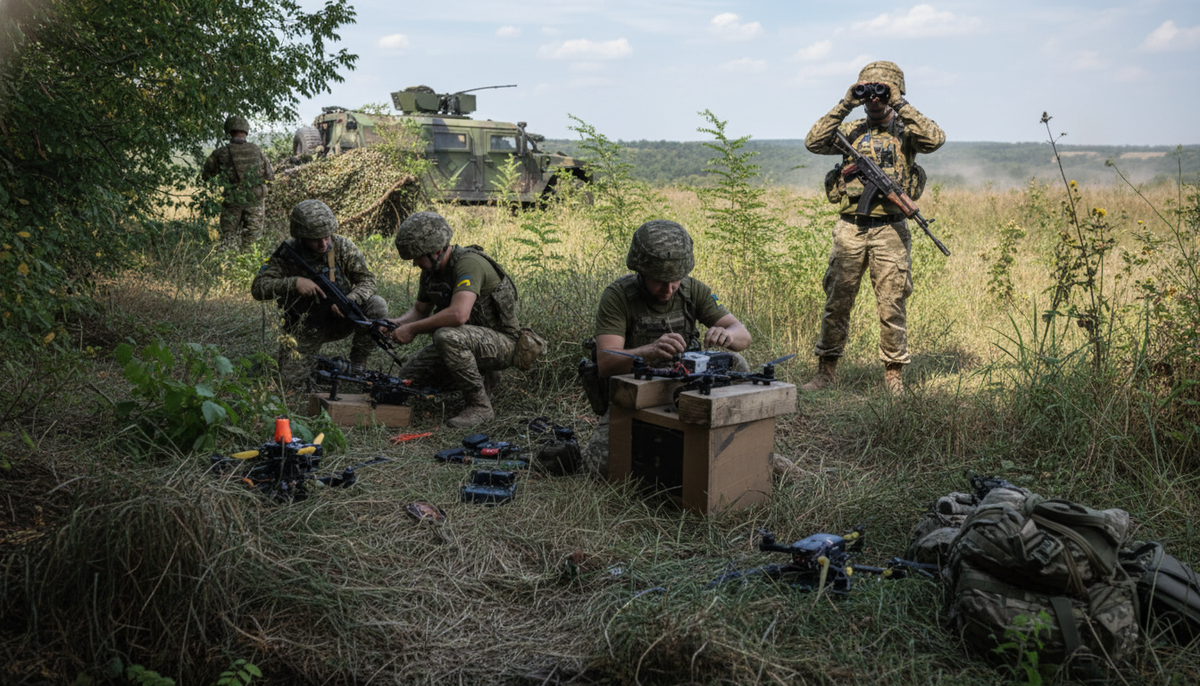
Lyuba Shipovich, head of the volunteer group Dignitas Ukraine, unveiled this revolutionary system at the Sydney Dialogue, a conference organized by the Australian Strategic Policy Institute. "There are no warehouses anymore," Shipovich declared. "Military units can order drones or ground robots on the website that is called blockchain defense. It’s similar to Amazon. They just order directly from the manufacturer, and they get delivered directly from manufacturer to the military unit to the battlefield."
The speed of this new logistical chain is staggering. Shipovich revealed that delivery from order to frontline takes a mere 24 hours. This rapid cycle not only ensures troops receive the latest technology precisely when needed but also mitigates the necessity for extensive repair facilities to modernize older equipment. This agility, she asserted, offers a crucial lesson for NATO countries, urging them to "adapt NATO procedures to new realities, to this war."
Ukraine's experience has positioned it, alongside Russia, as a primary combatant understanding the intricacies of modern warfare. Shipovich extended an open invitation: "It’s time for everyone to decide to learn from Russia or from Ukraine, and Ukraine is willing to share knowledge." This willingness includes offering training, certification programs, and procedural insights.
NATO, for its part, is acutely aware of Ukraine's pioneering efforts. Marco Criscuolo, NATO's acting head of strategy and policy, emphasized at the same conference that "the speed and quality of decision making is what really has made a difference in Ukraine." He further elaborated, "For those who believe it’s about technology, I tell you the solution is about human capital and processes. When it comes to human capital, it’s about the mindset that we adopt." This highlights a critical insight: while technology is an enabler, human ingenuity and adaptive processes are the true catalysts for innovation on the battlefield.
However, the lessons from the Ukrainian conflict extend beyond logistics and technology. Latvia’s national security advisor, Aeris Rikvellis, painted a broader picture of an "interlinked" threat. He warned the 300 attendees that "Russians, Chinese and North Koreans are learning from each other, learning from us," creating a vast, interconnected theater of conflict stretching from Europe to Asia. "They are interlinked, and we will feel events in one that will be felt in others," Rikvellis cautioned.
Even as the strategic landscape becomes global, tactical problems remain acutely local. Rikvellis cited the peculiar challenge faced by Lithuanian and Latvian border guards: how to counter air balloons laden with smuggled cigarettes consistently sent into their territory from Belarus. These seemingly trivial incidents have caused airport closures, highlighting how unconventional tactics, even those involving 50-60 kilogram (over 100 pounds) falling objects, can disrupt daily life and pose complex security dilemmas.
The war in Ukraine is not just a conflict; it is a crucible for military innovation. It is demonstrating that the future of warfare lies not in static stockpiles but in dynamic, agile supply chains, powered by human adaptability and innovative processes, all while contending with a complex, interconnected web of both high-tech and low-tech threats. The world is watching, and learning, from the battlefields of Ukraine.