
Microwave and Electromagnetic C-UAS Enter the Fight Against Swarms
The rapid proliferation of low-cost unmanned aerial systems has exposed the limits of traditional kinetic interceptors and even high-energy lasers. While lasers offer precision and a deep magazine against individual targets, they struggle with large, simultaneous swarms, adverse weather, and the need for continuous tracking of each threat. In response, defense establishments on both sides of the Atlantic and in the Indo-Pacific are accelerating the development and fielding of high-power microwave and other electromagnetic soft-kill systems that can disable multiple drones with a single engagement, often at far lower cost per effect and with reduced risk of collateral damage.
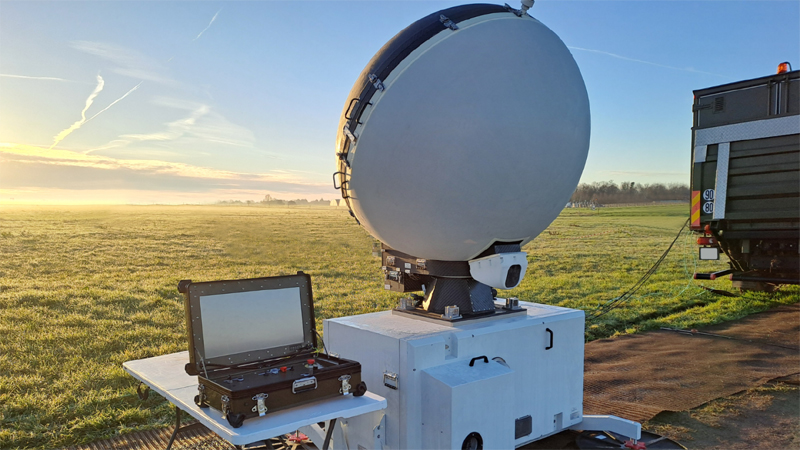
High-power microwave weapons operate by generating intense bursts of electromagnetic energy that induce destructive currents in a drone’s electronics. Flight controllers, electronic speed controllers, video processors, and power-management circuits are particularly vulnerable. Unlike radio-frequency jamming, which depends on disrupting command links, these systems attack the hardware itself and remain effective against fiber-optic-guided, autonomous, or pre-programmed platforms that have no exploitable radio signal. In live-fire demonstrations, solid-state systems using gallium-nitride semiconductors have repeatedly shown the ability to defeat dozens of drones in a single pulse, including complex swarm formations.
In the United States, the technology has moved from laboratory and experimental status into near-term operational programs. The Marine Corps awarded an $11 million contract in August 2026 for the High-power Microwave Autonomous Vehicle Operational Capability, or HAVOC, developed by Epirus. Based on the company’s Leonidas architecture, HAVOC is designed as a vehicle-mounted system that can integrate with the Marine Air Defense Integrated System and other crewed or uncrewed platforms. It features significantly higher power density than earlier prototypes, improved range and ruggedness, and autonomous target identification intended to reduce operator workload. Earlier variants of the same technology have already participated in overseas operational assessments with the Army in multiple theaters. Army contracts for the Indirect Fire Protection Capability High-Power Microwave effort have similarly advanced the Leonidas family, with Generation II systems expected to offer greater range and sustained operation.
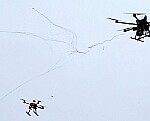
European industry is pursuing parallel paths. Thales has introduced ThunderShield, a high-power microwave effector intended for the neutralization of Class I drones and swarms. The system generates short, powerful electromagnetic waves and is described as effective against autonomous platforms, fifth-generation links, and fiber-optic controlled aircraft. It is designed for deployment at fixed sites, public events, or aboard naval vessels. In the United Kingdom, related radio-frequency directed-energy efforts under programs such as RapidDestroyer have demonstrated the ability to track, engage, and defeat large numbers of drones in controlled trials, underscoring the Alliance-wide interest in one-to-many non-kinetic effects.
Airborne applications are also emerging. Lockheed Martin has unveiled the MORFIUS X-Rotor, a reusable rotary-wing platform carrying a high-power microwave payload. The system is intended to neutralize more than fifty drones in a single flight before recovery and reuse, offering a mobile, low-cost-per-engagement option that does not require dedicated fire-control radars. Such concepts address the challenge of protecting maneuver forces or extended perimeters where fixed ground systems may be insufficient.
China has publicly disclosed advances in pulsed-power technology capable of generating extremely high peak outputs. Research published in 2026 describes systems with outputs reaching tens of gigawatts, with potential applications against both aerial threats and, in more ambitious scenarios, low-Earth-orbit satellite networks. While operational details remain limited, the scale of investment signals that electromagnetic soft-kill capabilities are becoming a global rather than purely Western priority.
Soft-kill approaches offer several operational advantages. The cost per engagement is measured in fractions of a dollar once the system is fielded, compared with expensive kinetic interceptors or the energy and dwell-time demands of lasers. A wide beam can engage multiple targets simultaneously without the need for sequential tracking, making the technology particularly suited to saturation attacks. Collateral damage is generally lower because the effect is electronic rather than explosive, an important consideration near critical infrastructure, urban areas, or friendly forces. Systems can also be integrated onto existing vehicles or uncrewed platforms, reducing the logistical burden of dedicated launchers and magazines.

Limitations persist. Effective range is typically shorter than that of high-energy lasers under clear conditions, and atmospheric attenuation, terrain masking, and the need for line-of-sight still apply. Power generation, thermal management, and the size, weight, and power constraints of mobile platforms continue to shape design trade-offs. Rules of engagement and electromagnetic spectrum management in contested environments require careful planning, and adversaries will inevitably seek hardening measures or alternative guidance methods. Nevertheless, the combination of microwave systems with lasers, traditional electronic warfare, and selective kinetic effectors is increasingly viewed as the most resilient layered approach.
As drone swarms evolve toward greater autonomy and resistance to conventional jamming, non-kinetic electromagnetic solutions are moving from experimental curiosities to essential components of short-range air defense. The contracts, demonstrations, and prototype deployments of 2025 and 2026 indicate that high-power microwave and related soft-kill technologies are now entering the force structure at a pace driven by operational necessity rather than pure research interest. Their ability to deliver one-to-many effects at low marginal cost may prove decisive in an era defined by massed, inexpensive aerial threats.