
Organic Versus Layered: What the U.S. Army’s XM30 Should Actually Match in European IFV C-UAS Design
The Congressional Research Service’s September 2026 note that the XM30 may receive an active protection system against anti-tank missiles without a clearly specified organic counter-uncrewed aerial system capability is a useful warning, but it is incomplete if treated as an American peculiarity. European infantry fighting vehicles already in production or mid-life upgrade show that the real design choice is not whether an IFV “has C-UAS,” but which parts of the detect-track-defeat chain sit on the vehicle itself and which remain with dedicated short-range air defense. That distinction should frame the XM30 debate more tightly than a binary gap narrative.
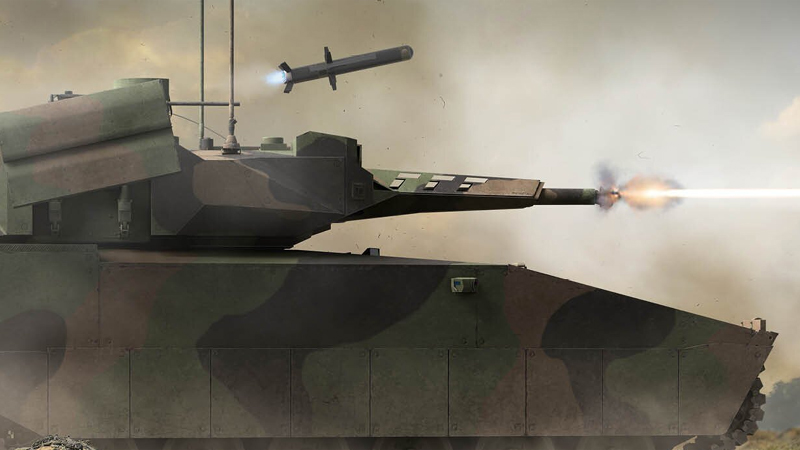
The U.S. Army wants the XM30 to replace the M2 Bradley in armored brigade combat teams as an optionally manned vehicle able to move infantry to a position of advantage and deliver fire in combined-arms maneuver. Survivability planning already includes an organic APS using kinetic and passive countermeasures against anti-tank threats. What remains unsettled is whether that suite will also detect, track and defeat small UAS, loitering munitions and one-way attack drones without depending on accompanying M-SHORAD, M-LIDS or other formation assets. The planned 50 mm XM913 Bushmaster chain gun and XM1204 high-explosive airburst-tracer ammunition give the vehicle a hard-kill option that is more serious than the Bradley’s 25 mm gun.
Programmable airburst, dual feed and first-round select are intended for infantry in cover and for aerial targets, and the Army has separately solicited work to adapt the same 50 mm gun against Group 1 to Group 3 unmanned aircraft. Duality AI’s onboard AiTDR work and the vehicle’s modular open systems architecture add software and growth paths for recognition, electronic warfare and later effectors. None of that yet equals a declared organic C-UAS requirement with sensors, elevation, magazine and rules of engagement written into the baseline. Hybrid-electric power is cited as a way to feed sensors and possible directed-energy or jamming payloads later, which is a design bet rather than a fielded kill chain.
Germany’s Puma illustrates the layered European answer. The S1 standard keeps the unmanned turret and Rheinmetall MK30-2/ABM 30×173 mm cannon with programmable airburst ammunition that can already be used against slow, low-flying aircraft and small drones inside a short envelope. Elevation to about +45 degrees is adequate for many ground-to-air snapshots but is not the geometry of a dedicated anti-aircraft turret. Soft-kill protection comes from MUSS 2.0, which uses missile warners, laser warning and a jammer head plus multi-spectral smoke rather than a hard-kill interceptor optimized for FPV trajectories.
At Eurosatory 2024 a Puma S1 appeared with a DedroneSensor RF-300 mounted on the turret to passively detect, classify and locate commercial UAVs and their control links; industry claimed the combination could cue the turret against a small swarm. That is organic detection plus an existing gun, not a full self-contained C-UAS vehicle. Berlin’s larger answer is to pair the Puma fleet with Skyranger 30 turrets and medium-range systems so the IFV is not asked to absorb saturation attacks alone. The lesson for XM30 is that a modern 30 mm IFV can own the last few hundred meters if ammunition, fire control and RF warning are integrated, while still needing a dedicated gun-missile layer for the brigade.
Sweden’s CV90 family, and specifically the Czech Army’s forthcoming CV9030 MkIV, is the closest peer to what Washington says it wants: a new-build tracked IFV entering service now, not a 1990s hull with kits. Prague ordered 246 MkIV vehicles, including 190 fighting and command configurations with a 30 mm Bushmaster II, Spike-LR missiles, next-generation sensors, the iFighting digital architecture and modular armor. Deliveries run from 2026 toward 2030. The MkIV was designed with growth weight and NATO generic vehicle architecture so sensors and protection can be added without rebuilding the hull.
Active protection is part of the Czech package. Recent reporting around the Elbit Iron Fist contract for European CV90s, including Czech vehicles, describes radar and infrared cueing with an exploding interceptor projectile intended to defeat ATGMs and, in manufacturer demonstrations, drones. Trophy has been marketed in the same NATO eastern-flank conversation and is now advertised with a drone-intercept upgrade after 2024 trials against a diving fixed-wing target. Either hard-kill family still has magazine and geometry limits against a dense FPV swarm attacking from high angles. Czech commentary is explicit that the heavy 7th Mechanized Brigade will still need a mobile C-UAS layer compatible with CV90 and Leopard 2 logistics, with Skyranger-class guns on a tracked chassis among the options under discussion. In other words, even an IFV fielded with APS, digital targeting and a 30 mm gun is not expected to be the brigade’s primary drone shield. That is the standard XM30 should be measured against: organic last-ditch and snapshot capability, plus a planned companion system, not an assumption that APS equals C-UAS.
Spain’s ASCOD lineage, known in service as Pizarro, shows the opposite end of the spectrum: a large in-service fleet whose organic counter-drone suite is still being invented around the vehicle rather than designed in from the start. Spanish VCI/C Pizarros fight with a 30 mm Mauser MK30-2 and coaxial machine gun. A €261.8 million mid-life program authorized in late 2025 will bring Phase I vehicles toward Phase II standards in fire control, vetronics, diagnostics and interoperability through 2031; published scope emphasizes electronics and availability more than a dedicated C-UAS turret. Formation-level Spanish C-UAS work sits with air-defense and electronic-warfare units using jammers, programmable remote stations and emerging hard-kill interceptors. Industry, however, is already treating ASCOD as a C-UAS testbed.
GDELS has demonstrated Microflown AVISA’s CASTLE acoustic system on ASCOD hulls to localize FPV drones in three dimensions without emitting, including while moving, so a passive cue can feed a gun or jammer. At FIDMA 2026 an ASCOD 42 demonstrator carried Valhalla’s MANGART 30 remote turret with a MK44S 30 mm cannon, airburst ammunition and elevation from −10 to +70 degrees, a geometry far more useful against diving drones than a classic IFV turret. Trophy has been shown on ASCOD at European exhibitions, and Latvian ASCOD vehicles built in Spain have been used to evaluate active and passive C-UAS packages. For XM30 planners the Spanish case is a caution: an IFV can remain relevant if its architecture accepts acoustic sensors, high-elevation turrets and APS later, but a mid-life electronics refresh alone will not close a top-attack drone problem.
Wanted XM30 C-UAS capability therefore sits above the in-service Pizarro and in the same band as upgraded Puma and new CV9030 MkIV only if three things are locked in before production. First, the 50 mm HEAB round and fire control must be qualified against the same FPV and Group 2–3 profiles European 30 mm airburst guns already practice, with elevation and sensor coverage that can see a steep dive rather than only a crossing helicopter. Second, APS must be specified against slow, small, top-attack profiles rather than treated as a missile-only hard-kill system; European marketing of Trophy and Iron Fist against drones is precisely the claim CRS says the Army has not yet made for XM30. Third, RF, acoustic and AI recognition need a place on the vehicle so the crew is not waiting for a brigade radar picture. Duality’s simulation work and MOSA make that feasible. Puma’s Dedrone fit and ASCOD’s CASTLE trials show those sensors can be turret- or hull-mounted without inventing a new chassis.
What the European vehicles do not pretend to do is replace Skyranger, M-SHORAD or a gun-missile companion. Germany is buying that layer beside Puma. Czech officers discuss it beside CV90 MkIV. Spain keeps most C-UAS at regiment and experiment level while industry upgrades the hull. The XM30 program still has prototype flexibility: both competing designs reached physical vehicles in late summer 2026, soldier evaluation with the 1st Cavalry Division is planned into 2027, and leadership has been reluctant to freeze Milestone B documentation. That window is where an organic detect-and-airburst requirement can be written without turning the IFV into a poor SHORAD substitute. The useful comparison is therefore not that Europe already solved the problem and America did not. It is that Puma, the Czech CV9030 MkIV and evolving ASCOD configurations treat counter-drone defense as a layered kill chain in which the IFV owns sensors, programmable ammunition and a limited interceptor magazine, while the brigade owns volume of fire. If XM30 fields with APS against missiles, a 50 mm gun that can theoretically airburst a drone, and no mandated organic detection or high-angle engagement standard, it will lag vehicles that are already pairing those pieces. If it copies that layered model while exploiting the larger 50 mm burst and open architecture, the CRS warning becomes a specification task rather than a structural gap.