
Poland’s F-15EX Option: Capability Gaps, Historical Interest and Official Caution
The recent inclusion of Poland among potential Foreign Military Sales customers in a major United States Department of War framework contract awarded to Boeing for the F-15 program has revived discussion of whether Warsaw might acquire the F-15EX Eagle II. The contract, valued at more than 131 billion dollars and covering aircraft, equipment and services through at least 2031 with possible extension, lists Poland alongside countries such as Japan, Israel, Saudi Arabia, South Korea, Singapore and Indonesia. This development follows years of intermittent Polish interest, including statements by former Defence Minister Mariusz Błaszczak about long-term consideration of additional F-35s or F-15s, promotional efforts by Boeing at Polish defence exhibitions, and evaluation flights by Polish Air Force officers, including then-Inspector General Ireneusz Nowak, at Boeing facilities in the United States in 2025.
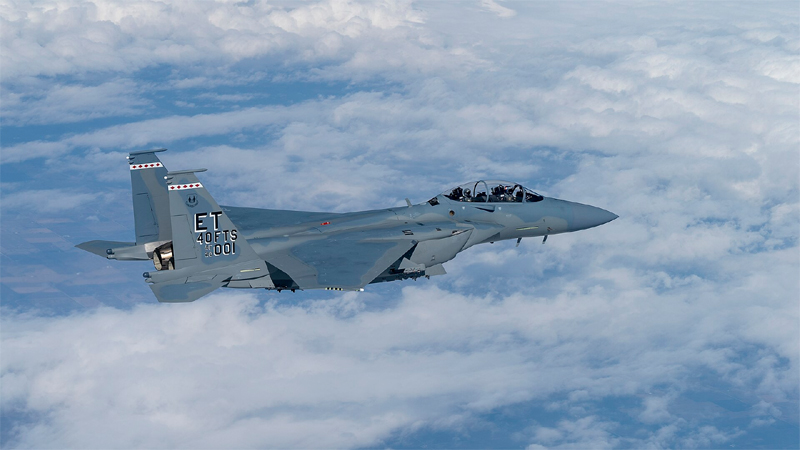
However, the Polish Ministry of National Defence has stated clearly that the Armed Forces do not plan to acquire F-15EX aircraft and that inclusion in the American framework does not constitute a procurement decision or the start of any acquisition process. Official signalling in 2026 has instead pointed toward expanding the F-35A fleet with two additional squadrons by around 2039, building on the existing order of 32 aircraft. The F-15EX therefore remains a subject of historical interest, industrial promotion and hypothetical analysis rather than an active programme.
Poland’s air force modernisation is driven by the need to replace ageing Soviet-era platforms, increase overall combat mass, improve interoperability with NATO partners, and field capabilities suited to the threat environment on NATO’s eastern flank. Key requirements include greater payload capacity for air-to-air and air-to-ground munitions, extended range and endurance for operations over large areas, high speed for rapid response and interception, and the ability to complement fifth-generation stealth aircraft. The F-15EX is positioned by its manufacturer as a “missile truck” and high-endurance platform that can carry a substantially heavier weapons load than most contemporary fighters, operate with advanced sensors and electronic warfare systems, and work in tandem with stealth aircraft that detect threats while the larger jet delivers massed effects from standoff ranges.
The F-15EX features twin engines providing strong thrust, a maximum speed of approximately Mach 2.5, a service ceiling around 50,000 to 60,000 feet, and a weapons payload capacity in the region of 29,500 pounds (about 13,400 kilograms). It can carry up to twelve air-to-air missiles such as the AIM-120 AMRAAM in demonstrated configurations, or mixes of air-to-ground weapons including cruise missiles such as the AGM-158 JASSM, precision-guided bombs, and potentially larger future munitions including hypersonic systems. Modern systems include an AESA radar, the EPAWSS electronic warfare suite, digital fly-by-wire controls, an open mission systems architecture, and a long service-life airframe. These attributes address Polish desires for greater striking power, persistence and the ability to saturate defences or engage multiple targets, areas where lighter single-engine fighters face limitations. Boeing has also highlighted industrial cooperation opportunities in Poland and potential pairing with collaborative combat aircraft concepts such as the MQ-28 Ghost Bat.
Discussions of possible fleet size have centred on figures sufficient for two or three squadrons. Public commentary has repeatedly floated numbers in the range of 32 aircraft, with some references extending to 48. These would align with Polish squadron structures often organised around roughly 16 aircraft and would help close the numerical gap toward broader goals of fielding a larger overall combat aircraft inventory. Such quantities remain speculative; no formal request or letter of offer and acceptance has been confirmed, and current planning prioritises additional F-35As.
The current Polish Air Force combat strength reflects a transition still in progress. The backbone consists of approximately 48 F-16C/D Block 52+ aircraft (around 36 single-seat C models and 12 two-seat D models), which are undergoing a mid-life upgrade to the F-16V Block 72 standard featuring improved radar, electronic warfare and mission systems, with work expected to continue into the late 2030s. Twelve FA-50GF light combat aircraft from South Korea are in service as a gap-filler, with 36 more advanced FA-50PL variants on order, though deliveries have faced delays related to systems integration and are now projected into the later 2020s. The first F-35A Lightning IIs, known in Polish service as Husarz, began arriving in 2026, with an initial order of 32 aircraft scheduled for completion by about 2030; early operational aircraft are based at Łask. A limited number of remaining MiG-29s, reduced after transfers to Ukraine and progressive withdrawals, are expected to leave service around the end of 2026.
Supporting elements include trainer and light-attack types such as the M-346, transport aircraft including C-130s and C-295s, and various helicopters, but the tactical combat fleet is the focus of expansion. Once current orders are fulfilled the combat inventory is projected to comprise the upgraded F-16s, the full FA-50 contingent and the initial F-35As, providing a mixed force of roughly 120-plus combat jets before any further acquisitions. Officials have discussed aspirations for still larger numbers of tactical aircraft in the longer term.

In this context the F-15EX has been examined as a potential heavy, high-payload complement that could free F-35s for penetrating missions while providing volume of fire, long-range strike and air superiority presence. Its non-stealthy design, higher operating costs relative to some alternatives, and the complexity of introducing a fourth major combat type have been noted as drawbacks compared with simply expanding the F-35 fleet or considering European options such as the Eurofighter Typhoon. As of late August 2026 the official position remains that no F-15EX acquisition is planned, even as the aircraft stays visible in American contracting frameworks and industry outreach. The discussion itself illustrates Poland’s determination to build one of Europe’s more capable air forces through successive waves of modernisation.