SPINE’s Transformation of the AH-1Z for Maritime Deterrence in the Indo-Pacific
The recent multi-million-dollar contract advancing Structural and Power Improvements for Next-Generation Effects, or SPINE, marks a decisive shift in how the Marine Corps views its light-attack helicopter fleet. Rather than treating the AH-1Z Viper mainly as a close air support platform, the program supplies the structural reinforcement, electrical capacity, and digital architecture needed to integrate longer-range precision weapons, sensors, and data links. In doing so it converts a capable shipborne attack helicopter into a mobile node within a larger networked kill web that can deliver effects from unexpected locations.
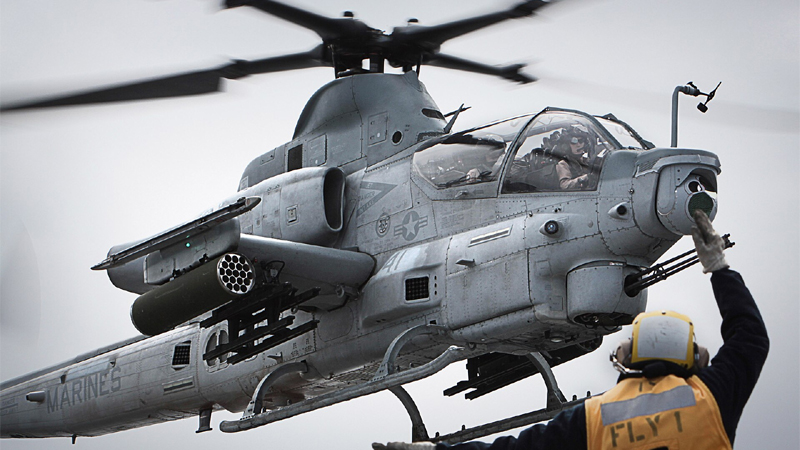
Future conflict in the Western Pacific will reward forces able to disperse, relocate rapidly, and strike from positions an adversary cannot easily catalog. Amphibious assault ships remain important, yet Marine aviation must also operate from expeditionary sea bases, austere island airstrips, and temporary forward arming and refueling points. In this environment the traditional need for an attack helicopter to close within visual or electro-optical range becomes a liability. SPINE addresses that liability by giving the airframe the margin required to carry and employ munitions whose reach can extend hundreds of nautical miles when guided by off-board sensors.
The contract, valued at more than thirty-three million dollars and awarded to Bell Textron, funds kits that reach deep into the aircraft’s power and control systems. Higher-capacity alternating-current generators, upgraded control units, reinforced assemblies, and additional gearboxes determine how many radios, processors, electronic-warfare suites, and weapon interfaces can function simultaneously. Earlier configurations sometimes forced crews to power down one system to employ another. The new architecture removes that constraint, allowing continuous operation of Link 16 terminals, advanced networking waveforms, encrypted communications, and the mission computers that will manage future launched effects. Structural reinforcement prepares the airframe for different load paths associated with heavier external stores.
These changes follow Bell’s completion of the first fully modified AH-1Z and UH-1Y aircraft, now undergoing further testing at Naval Air Station Patuxent River. The work is deliberately incremental. It does not itself purchase new weapons; instead it creates the foundation for integrating them without a complete redesign. Existing armament remains fully usable. The twenty-millimeter cannon provides immediate close-range firepower, Advanced Precision Kill Weapon System rockets offer an economical precision option, and the AGM-179 Joint Air-to-Ground Missile has already demonstrated engagement of moving surface vessels. SPINE enables addition of a new capability tier represented most prominently by the L3Harris Red Wolf launched effect.
Red Wolf has completed dozens of flight tests, including low-altitude releases from the AH-1Z. Manufacturer data indicate ranges approaching two hundred nautical miles under favorable conditions, supported by beyond-line-of-sight communications and autonomous terminal guidance. Effective combat range will vary with launch conditions, yet even a reduced figure places the weapon well beyond the traditional engagement envelope. Critically, the munition can receive target coordinates from any sensor in the network – an F-35B, MQ-9A, surface combatant, Marine littoral unit, or allied platform. The helicopter need not radiate its own sensors or expose itself; it can remain masked by terrain, weather, or the radar horizon while functioning as a mobile magazine of long-range effects.
This separation of sensor from shooter alters the operational calculus. High-value surveillance assets no longer need to stay near the target until the weapon arrives. The Viper, with its lower signature and ability to operate from small decks or improvised pads, can loiter or displace as required. Demonstrated two-way Link 16 connectivity provides the digital pathways, while future growth in mission computers will expand the information the crew can process.
Logistical advantages reinforce the operational ones. The AH-1Z and UH-1Y share approximately eighty-five percent of their components, simplifying spare parts, maintenance training, and support equipment for mixed detachments at sea or ashore. SPINE preserves this efficiency while enhancing both variants.
None of these improvements eliminates the vulnerabilities of rotary-wing aircraft in a high-threat environment. Fuel, ammunition, and maintenance must still reach dispersed sites, and fighters, surface-to-air systems, electronic attack, and precision fires will continue to threaten any helicopter that remains static. The strategic contribution of SPINE lies in multiplying potential launch points and allowing those points to shift rapidly, thereby complicating an adversary’s targeting process. An island outpost or temporary site capable of hosting even a small H-1 detachment becomes a possible source of precision fires.
In the broader context of Marine Corps force design emphasizing distributed maritime and expeditionary advanced base operations, the modernized Viper fits naturally. Its marinized design pairs well with greater-range effects generation. Low-altitude profiles remain available when needed, yet primary employment can shift toward receiving external cues and launching from relative sanctuary. The result is not an invulnerable platform but one harder to locate, classify, and neutralize in time.
Contract completion is projected for mid-2028, after which fleet incorporation will proceed according to airframe availability. Specific weapon integrations will follow their own schedules. Yet the foundational work of increasing structural margins, electrical power, and digital capacity is already under way, positioning the AH-1Z to remain relevant in peer conflict. Against the geography of the Indo-Pacific – vast distances and numerous small islands suitable for temporary basing – platforms that generate uncertainty prove especially valuable. A Viper detachment that can relocate overnight, receive targeting data from a distant sensor, and launch a difficult-to-intercept munition imposes accumulating costs on an adversary’s planning cycle. When combined with fixed-wing aircraft, surface combatants, submarines, and ground-based fires, the effect is a more resilient and less predictable American posture.
SPINE therefore represents more than an incremental upgrade. It is an architectural decision that aligns Marine light-attack aviation with the demands of networked, long-range, and distributed warfare, converting a close-support workhorse into a flexible contributor to the larger kill web.