
The Contest for the Arctic: The Militarization and Dual-Use Infrastructure
The Arctic is no longer a distant periphery of great-power competition. Melting ice has opened new shipping routes, exposed vast mineral and energy resources, and shortened the geographic distance between Russia’s Northern Fleet and the North American homeland. What was once treated as a secondary theatre has become a central concern for NATO planners, driven by Russia’s icebreaking superiority, expanding base network, and growing cooperation with China. In response, the Alliance haslaunched coordinated efforts to restore presence, improve undersea surveillance, and build dual-use infrastructure capable of operating year-round in extreme conditions.
Russia maintains by far the world’s largest icebreaker fleet, estimated at more than forty vessels, including multiple nuclear-powered ships of the Arktika class. These platforms allow Moscow to keep the Northern Sea Route open for commercial traffic even in heavy ice and to support military movements across its vast Arctic coastline. Satellite imagery and open-source reporting show continued modernization of airfields and bases on the Kola Peninsula and further east, locations that host a significant portion of Russia’s sea-based nuclear deterrent. While some air-defence systems appear to have been redistributed in 2026, construction of barracks, depots, and logistics facilities near the borders with Finland and Norway continues, underscoring Moscow’s determination to maintain a durable military footprint.
China’s role, though secondary, is steadily expanding. Beijing operates a small but growing fleet of icebreakers and has conducted joint exercises with Russian forces in northern waters. Chinese scientific and commercial vessels contribute to seabed mapping and sensor data that can serve dual purposes, feeding into a broader network that challenges the traditional undersea advantage long held by NATO submarines. Analysts note that Russia and China are jointly developing elements of a seabed-to-space monitoring architecture that could complicate Allied operations in the High North.
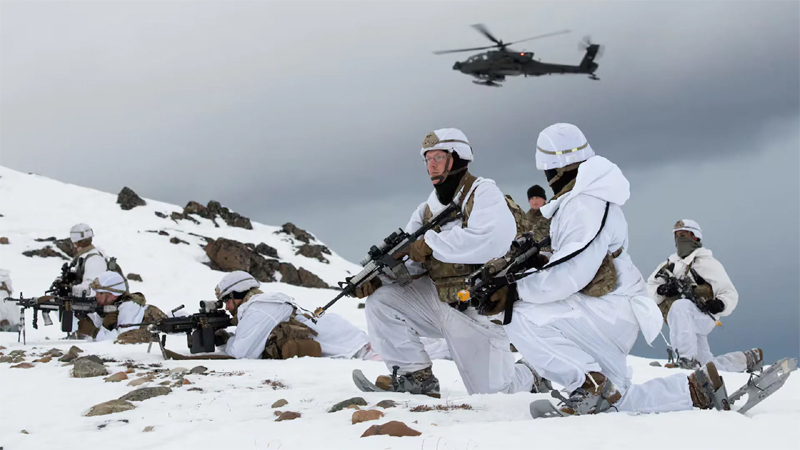
NATO’s response accelerated in early 2026 with the launch of Arctic Sentry, a multi-domain vigilance activity led by Joint Force Command Norfolk. The framework integrates national activities by the seven Arctic Allies into a coherent operational approach, increasing maritime patrols, intelligence sharing, and force presence. Exercises such as Dynamic Mongoose in the Norwegian Sea have focused on anti-submarine warfare, while Task Force X-Arctic tests networked uncrewed systems for persistent situational awareness under harsh polar conditions. Nordic Allies, already among the Alliance’s highest defence spenders, are expanding ground forces in the region and investing in cold-weather capabilities.
A critical shortfall remains surface mobility. The United States entered 2026 with only two operational icebreakers, a stark contrast to Russia’s fleet. To address this, Washington has advanced the Icebreaker Collaboration Effort, known as ICE Pact, with Canada and Finland. Contracts finalized in mid-2026 cover the construction of multiple Arctic Security Cutters, with deliveries expected to begin in 2028 and continue into the early 2030s. Several of these vessels will be homeported in Alaska, strengthening the U.S. Coast Guard’s ability to maintain presence, protect critical shipping lanes, and support dual-use missions ranging from search and rescue to sovereignty enforcement. Finland’s shipbuilding expertise and Canada’s Arctic experience are central to accelerating production while revitalizing domestic industrial capacity.
Equally important is the undersea domain. Climate-driven changes in salinity and ocean currents are altering acoustic conditions, making traditional submarine detection more difficult. NATO and individual Allies are therefore expanding fixed and mobile sensor networks, deploying unmanned underwater vehicles, and modernizing systems that can track submarines exiting the Barents Sea or approaching the Greenland-Iceland-United Kingdom gap. Programs such as the United Kingdom’s Atlantic Bastion concept aim to create layered, scalable surveillance using autonomous platforms. These efforts also address the growing vulnerability of undersea cables and energy infrastructure, which have already been subject to suspicious incidents in northern European waters.
Dual-use infrastructure is emerging as a pragmatic solution to the high costs and limited budgets associated with polar operations. Ice-hardened vessels, long-endurance drones capable of functioning in extreme cold, satellite communications optimized for high latitudes, and modular sensor packages can serve both civilian monitoring and military requirements. Experts emphasize that adversaries already exploit dual-use platforms, and Allies must do the same to close gaps in situational awareness and persistence. Investments in polar-capable uncrewed systems, improved radar coverage, and shared data architectures linking North American and Nordic partners are therefore priorities.
Challenges remain substantial. Building icebreakers and deploying reliable sensors in the High North takes years and requires sustained political commitment. Sanctions and industrial constraints have slowed some Russian projects, yet Moscow still holds a decisive advantage in icebreaking capacity for the near term. China’s growing technical and financial involvement further complicates the picture. For NATO, the task is not simply to match numbers of platforms but to create an integrated architecture that combines icebreakers for surface access, undersea sensors for domain awareness, and resilient infrastructure that can support both deterrence and crisis response.
The northern approaches to Europe and North America can no longer be treated as a secondary concern. As ice continues to recede and strategic competition intensifies, the ability to operate effectively across the full spectrum of Arctic conditions will determine whether the Alliance can maintain credible deterrence and protect critical interests in one of the world’s most demanding environments. The initiatives launched in 2026 represent a necessary first step; their success will depend on sustained investment, closer industrial cooperation among Allies, and the recognition that presence and awareness in the High North are now indispensable elements of collective defence.