
The U.S.M.C. Is Adapting Standard 5.56mm Weapons for Close-Range Drone Defense
In an era where small unmanned aerial systems have transformed modern battlefields from Ukraine to the Middle East, the U.S. Marine Corps is taking a pragmatic step to equip its frontline troops with an immediate, rifle-based countermeasure. According to a Notice of Intent published on SAM.gov on June 3, 2026, the service intends to acquire 5.56x45mm L Variant anti-drone ammunition compatible with its standard-issue M4, M4A1, and M27 rifles. This move signals a deliberate effort to integrate hard-kill capabilities directly into the weapons already slung across every Marine’s chest, offering a last-ditch defense against fast-approaching FPV kamikaze drones and other small threats that have proven devastating in recent conflicts.
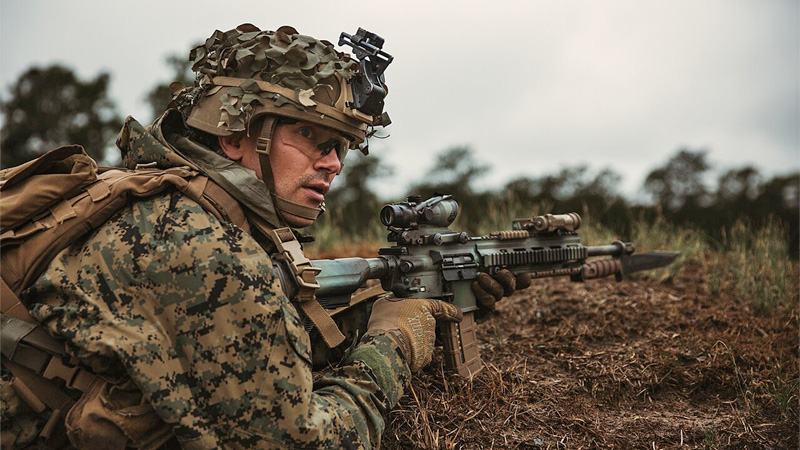
The L Variant, produced by Drone Round LLC, features a specialized projectile designed to fragment into multiple segments upon firing – reportedly five in the L version – dramatically increasing the hit probability against small, agile targets compared to conventional ball ammunition. Unlike dedicated anti-drone systems that require vehicle mounting, specialized launchers, or electronic jamming, this cartridge requires no modifications to existing weapons. Marines can simply load it when drone activity is detected, maintaining their primary rifle functionality for ground engagements while gaining an organic air-defense option. The Notice of Intent points toward a sole-source contract award projected for December 2026, underscoring the urgency felt within the Corps for near-term solutions rather than waiting for longer-term programs.
This development reflects broader lessons from contemporary warfare. FPV drones, often inexpensive and difficult to detect until the final moments, have forced militaries worldwide to rethink layered defenses. Traditional air-defense systems excel at longer ranges but can be overwhelmed or unavailable at the squad level during dispersed operations. By empowering individual Marines with this capability, the Corps aims to close that critical gap in the final protective layer, where seconds determine survival. In littoral and expeditionary environments – precisely where Marines are most likely to operate – this could enhance unit resilience without adding significant logistical burden beyond standard 5.56mm ammunition resupply.
The initiative aligns with ongoing Marine Corps efforts to make every rifleman a potential drone defender. It builds on training and doctrinal shifts that emphasize decentralized counter-UAS tactics, turning infantry squads into more self-sufficient elements capable of operating in contested airspace dominated by low-cost threats. While details on quantities remain unspecified in the public notice, the language emphasizes immediate integration into current-issue weapons, highlighting a focus on rapid fielding rather than extensive procurement timelines or new platforms.
Parallel innovations are emerging internationally, demonstrating that the challenge of countering small drones with accessible kinetic solutions is a global priority. Czech defense group CSG, through its Italian subsidiary Fiocchi, has developed similar anti-drone ammunition for standard assault rifles, primarily in 5.56x45mm caliber. Unveiled at the Enforce Tac 2026 exhibition in Nuremberg, this munition disperses tungsten pellets after leaving the barrel, boosting interception chances against fast-moving UAVs while controlling fragmentation to limit collateral damage – particularly useful in urban or infrastructure-protection scenarios.
Fiocchi’s product, tested extensively with Italian special forces, requires no weapon modifications or additional training beyond standard rifle handling. It targets short-range threats during patrols, convoys, or static defense, addressing the same operational voids identified by U.S. forces. CSG executives have framed the development as a direct response to lessons from Ukraine and other conflicts, where mass drone employment exposed vulnerabilities in traditional air defense. The company is expanding the concept to other calibers, including 5.45x39mm and 7.62x51mm, to appeal to a wider array of NATO and partner militaries. This European effort underscores a shared recognition that counter-drone capabilities must reach the individual soldier level to be truly effective.
For the U.S. Marine Corps, adopting the L Variant represents more than a technical upgrade; it embodies an adaptive philosophy suited to peer or near-peer competition. In potential future scenarios against adversaries like China in the Indo-Pacific, Marines could face swarms of low-cost drones alongside sophisticated electronic warfare. Having a reliable, drop-in kinetic option allows small units to maintain offensive momentum even when jammed or isolated from higher-echelon support. It also promises favorable cost-exchange ratios: expending a few specialized cartridges to neutralize a cheap quadcopter is far more sustainable than relying solely on expensive missiles.
Challenges remain, of course. Fragmenting projectiles must balance lethality against drones with safety for friendly forces and civilians nearby. Training will be essential to teach Marines when to switch ammunition types and how to lead fast-moving aerial targets effectively. Logistical integration, while simplified by caliber compatibility, will still require clear protocols for mixed loads and resupply. Moreover, the sole-source nature of the initial acquisition invites scrutiny regarding long-term competition and scalability, though the Marine Corps has justified it by citing the L Variant as the only currently available solution meeting strict minimum capability requirements for immediate counter-small UAS defense.
Looking ahead, this procurement could pave the way for further evolution in small-arms ammunition. As drone threats evolve – potentially incorporating fiber-optic guidance or greater autonomy – ammunition designers may iterate on fragmentation patterns, materials, and fuzing. The Marine Corps’ decision also highlights a divergence from Army paths, as the USMC continues emphasizing the 5.56mm platform with the M27 while the Army transitions toward larger calibers. Retaining legacy rifles while enhancing their versatility against emerging threats demonstrates a balanced approach prioritizing mobility, interoperability, and rapid adaptation.
Ultimately, the push for 5.56mm L Variant rounds illustrates how warfare’s accelerating pace demands creative integration of new technologies into time-tested systems. By turning standard infantry rifles into multi-domain tools, the Marines are not only addressing today’s FPV menace but also preparing for a battlefield where the line between air and ground threats continues to blur. As similar solutions like CSG’s Fiocchi offering gain traction globally, the infantry drone-defense revolution appears well underway, promising greater survivability for soldiers and Marines confronting one of the defining challenges of 21st-century conflict.