
Ukraine Opens a New Front in Air Defense by Downing a Shahed Drone From a Maritime Platform
Ukraine has added a striking new chapter to modern drone warfare. In what appears to be the first documented case of its kind, Ukraine’s Unmanned Systems Forces have successfully shot down a russian Shahed attack drone using an interceptor drone launched from a maritime surface platform.
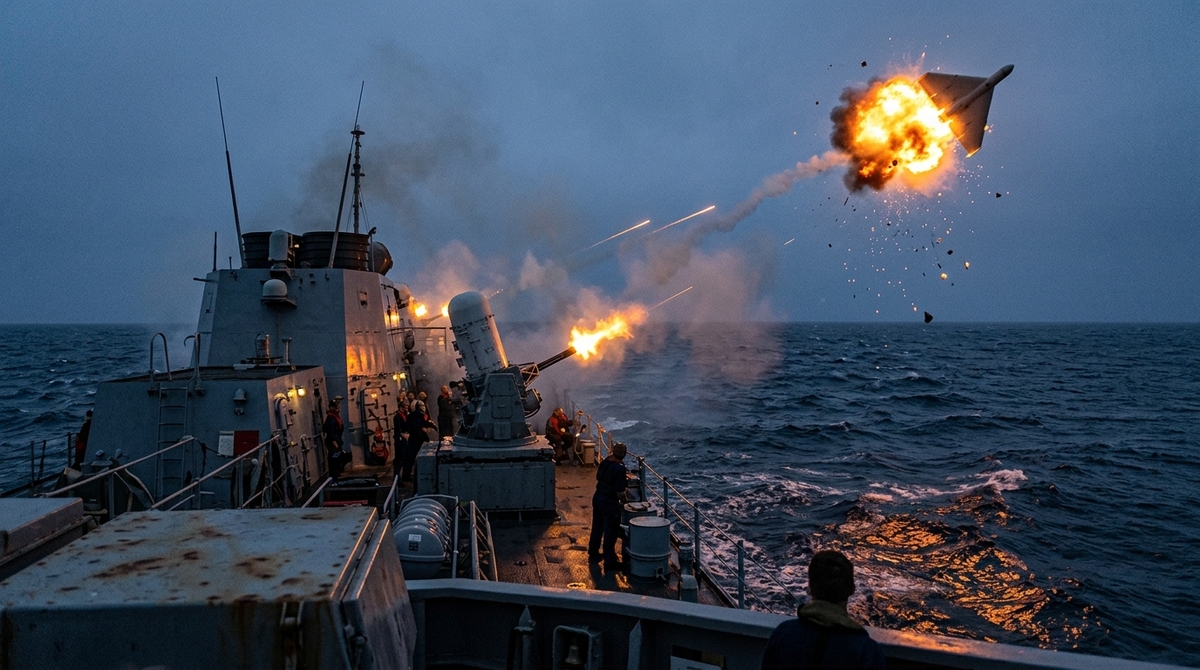
The operation marks more than just a tactical success. It signals the emergence of a new air defense concept — one in which the sea itself becomes a launch zone for counter-drone operations.
Video released by the Ukrainian military shows the moment an interceptor drone is launched directly from a surface-based platform and successfully destroys an enemy UAV in mid-air. While officials have not disclosed the type of interceptor drone used or the exact location of the engagement, the footage confirms that the interception took place and that the tactic is already being used in combat conditions.
That matters because Shahed drones have become one of the most persistent threats in russia’s strike campaign against Ukraine. They are relatively cheap, difficult to track in large waves, and often approach along routes that complicate interception by traditional ground-based air defense systems. Over water, this challenge becomes even more severe. Large maritime areas can create gaps in coverage, giving attack drones a corridor that is harder to defend.
This is where Ukraine’s new method changes the equation.
By using an unmanned surface platform as a launch base for interceptor drones, Ukrainian forces can extend the area where they are able to engage hostile UAVs. Instead of waiting for a target to move closer to shore or into the envelope of land-based defenses, they can push the interception line outward. In practical terms, that means more time to react, more space to engage, and a better chance of stopping drones before they reach critical infrastructure or urban targets.
It also shows how rapidly Ukraine is adapting its battlefield innovations across domains. Maritime drones were initially known for their role in striking naval targets and disrupting russian activity at sea. Now, the same operational ecosystem is evolving into something broader: a flexible, multi-role platform capable not only of sea denial, but also of contributing to air defense.
No official confirmation has been given on which maritime drone served as the carrier in this mission. However, reports in March suggested that a new modification of Ukraine’s Magura-series maritime drone had been developed to launch interceptor drones. If that capability was used here, it would represent an important step toward turning maritime unmanned systems into mobile anti-aircraft assets.
The significance of this development goes beyond one drone shootdown. It reflects a systematic approach to building layered, adaptive air defense with the tools Ukraine can produce, deploy, and modify quickly. Rather than relying only on expensive missile systems, Ukraine is increasingly building a more distributed defense architecture — one that uses unmanned systems not just for reconnaissance or strike missions, but also for active aerial interception.
That shift is especially relevant in a war where cost, speed of innovation, and tactical flexibility often determine battlefield advantage. Using a maritime drone as a floating launch platform for interceptor UAVs could offer a cheaper and more scalable answer to one of the war’s most common aerial threats.
The unit behind the operation is already experienced in maritime drone warfare, making this evolution a natural one. A force trained to operate unmanned systems in contested maritime environments is well positioned to experiment with ways those same platforms can support air defense missions. In that sense, the interception of a Shahed from a surface platform is not a one-off stunt. It looks more like the next phase of a broader doctrine.
Ukraine’s own statement underscores that point clearly: this was not the end of a development cycle, but part of an ongoing process. The forces involved say they are continuing to test and refine tactics for maritime drone operations.
That may be the most important takeaway. Ukraine is not simply reacting to the drone threat. It is actively reshaping the battlespace around it.
By destroying a Shahed from a maritime platform, Ukraine has demonstrated that the line between naval warfare and air defense is becoming increasingly blurred. In modern conflict, the most effective weapons are often not the most powerful in isolation, but the most adaptable. This latest interception shows that Ukraine understands that reality well — and is turning innovation into operational advantage.