
Ukrainian Drones Hit Russia’s Makhachkala Port in First Strike on Caspian Sea Hub
Ukrainian forces have carried out their first known drone strike on the port infrastructure of Makhachkala, a key Russian commercial seaport on the Caspian Sea, marking a new stage in Kyiv’s campaign against Moscow’s military logistics and energy transport routes.
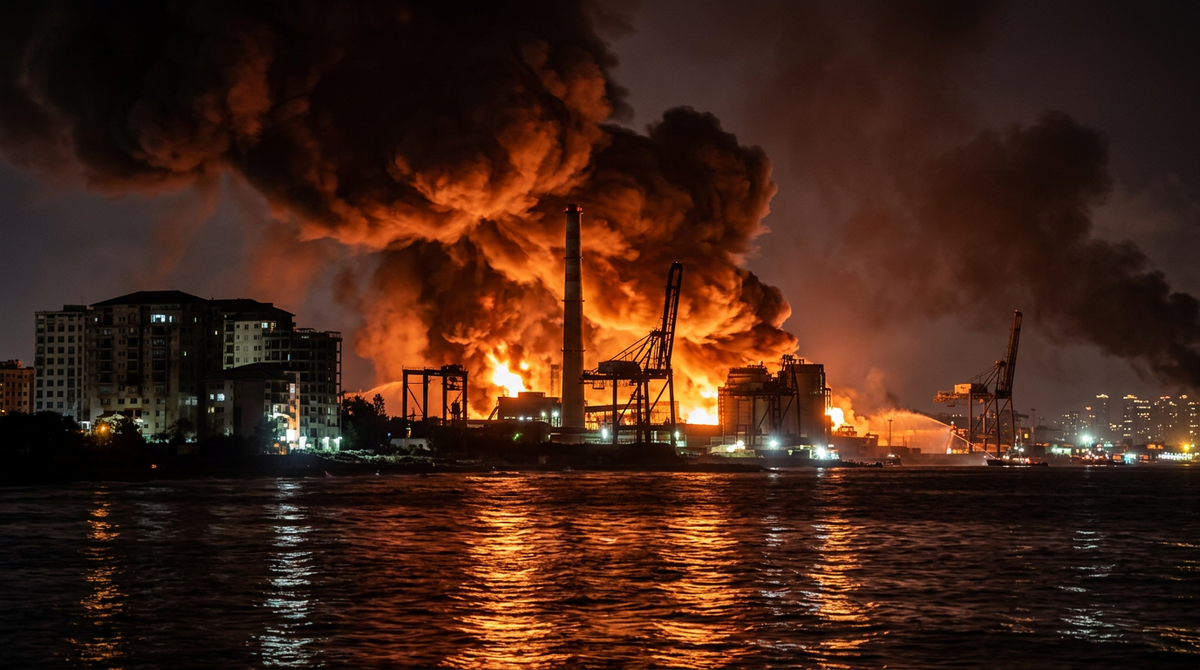
The attack took place overnight on September 10, 2026. Videos published online showed explosions in the port area, while local residents reported blasts across the city. Makhachkala, the capital of Russia’s Republic of Dagestan, lies roughly 1,000 kilometers from Ukraine’s border, making the strike a significant demonstration of Ukraine’s long-range drone capability.
Fyodor Shchukin, acting head of Dagestan, confirmed that fires had broken out at port facilities. According to his statement, the damage was caused by falling drone debris. However, footage from the area indicated that the port itself had been directly affected by the attack.
Why Makhachkala Matters
Makhachkala International Commercial Seaport is not just another regional cargo terminal. It is Russia’s only ice-free deep-water port on the Caspian Sea, allowing year-round operations for both dry and liquid cargo.
Its location gives it strategic value. The port sits close to Iran and serves as an important node in maritime traffic across the Caspian Sea. Since the start of Russia’s full-scale war against Ukraine, this route has gained additional importance as Moscow has deepened its military and logistical cooperation with Tehran.
According to Militarnyi, the port has been used to receive Iranian vessels carrying weapons and drones intended for Russia. This makes Makhachkala part of a broader supply chain connecting Iran’s defense industry with Russia’s war effort.

Part of a Wider Campaign Against Caspian Logistics
The Makhachkala strike follows a series of Ukrainian attacks on Russian and Iran-linked assets in the Caspian region.
In August 2025, Ukrainian forces targeted Port Olya-4, a vessel reportedly transporting Shahed drone components and ammunition from Iran. In January 2026, the Iranian ship Caspian Shiva was damaged in the Caspian Sea under unclear circumstances. Other vessels connected to Russian logistics have also reportedly come under attack.
In July 2026, Ukraine’s Security Service struck several targets in the Caspian Sea, including the cargo vessel Port Olya-2, owned by the sanctioned Russian company MG-FLOT LLC. That ship was allegedly used to transport military cargo between Iran and Russia. The dry cargo vessel Begey and a Russian Navy Project 12418 Molniya-class missile boat were also targeted.
The latest strike on Makhachkala suggests that Ukraine is no longer limiting its pressure to individual ships. Instead, it appears to be expanding the campaign to port infrastructure itself.
A Growing Cargo Hub Under Pressure
The importance of Makhachkala has increased sharply in recent years. In 2025, the port handled 3.5 million tonnes of cargo, a rise of 6.5–8% compared with the previous year.
Growth accelerated further in 2026. In the first four months alone, cargo throughput reached 1.4 million tonnes, more than 48% higher than during the same period in 2025. By the end of the first half of 2026, the port had handled 2.11 million tonnes of cargo, up 50% year-on-year. Over the first eight months of the year, throughput exceeded 2.9 million tonnes, a 42.5% increase compared with the same period in 2025.
Much of that growth came from liquid cargo, particularly crude oil and petroleum products. In the first half of 2026, liquid cargo throughput reached 1.5689 million tonnes, almost double the previous year’s level.
That expansion reflects a broader shift in Russian logistics. Ukrainian attacks on Russia’s shadow fleet and fuel transport networks in the Black Sea and Azov Sea have forced Moscow to look for alternative routes. The Caspian corridor has become one of those alternatives.
Strategic Signal From Ukraine
The strike on Makhachkala carries both practical and symbolic significance.
Practically, it threatens a port that Russia relies on for energy shipments, commercial cargo, and potential military imports from Iran. Even limited damage can disrupt schedules, raise insurance and security costs, and force Moscow to divert resources to protect infrastructure far from the Ukrainian front.
Symbolically, the attack shows that distance is becoming less of a shield for Russian military logistics. Makhachkala is far from Ukraine, but it is now within reach of Ukrainian drones. That forces Russia to spread air defenses across a much wider geography, from the Black Sea to the Caspian Sea and beyond.
The strike also fits Ukraine’s broader strategy: instead of only targeting battlefield positions, Kyiv is increasingly hitting the supply chains, fuel systems, ports, refineries, and transport networks that sustain Russia’s war machine.
Pressure on Russia’s Energy and Military Routes
Makhachkala’s role as a fuel and cargo hub makes it especially vulnerable in the current phase of the war. Russia has already faced pressure from Ukrainian strikes on refineries, storage facilities, and maritime transport routes. Attacks on ports add another layer of disruption.
In October 2025, drones hit the Dagnefteprodukt oil refinery in Makhachkala, showing that Dagestan’s energy infrastructure had already entered Ukraine’s target set. The September 2026 port strike widens that focus from refining to maritime logistics.
If Ukraine continues to target Caspian routes, Russia may face growing difficulty maintaining reliable transport links with Iran while also managing domestic fuel shortages and export restrictions.
The first strike on Makhachkala’s port may therefore be more than an isolated attack. It could signal the opening of a new pressure point in Ukraine’s long-range campaign against Russia’s war economy.