
Ukrainian Ground Robot Held Key Position Against Russian Assaults for 45 Days
A single Ukrainian ground robot held off Russian assaults on a key battlefield position for 45 days last summer, marking what Ukrainian military officials describe as the country’s first fully robotic defensive operation. The episode offers a striking glimpse into the future of warfare — one in which unmanned ground vehicles are no longer just support tools, but active defenders on the front line.
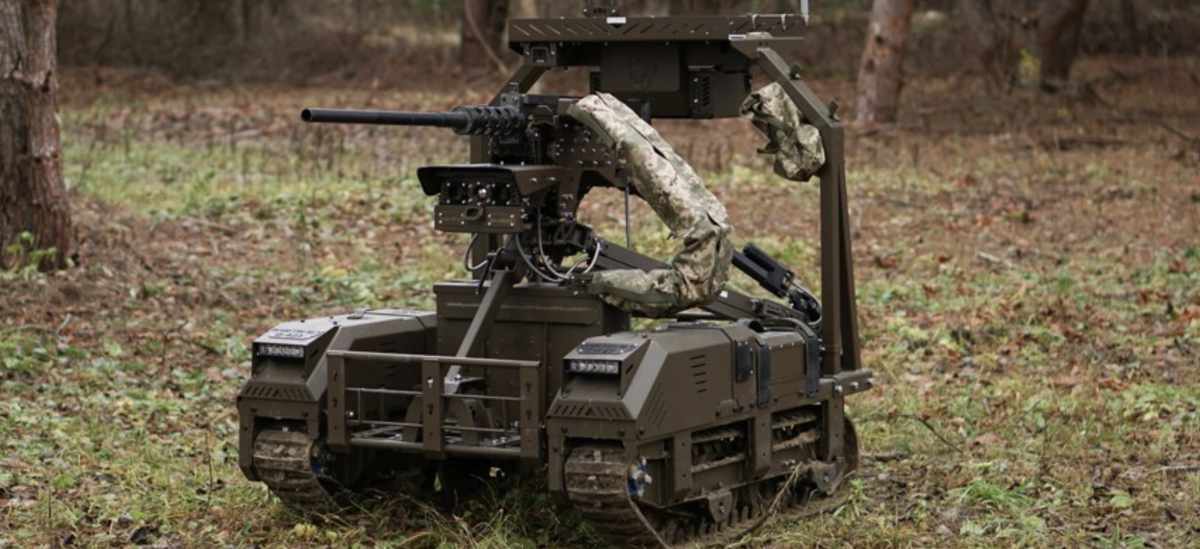
According to a spokesperson for Ukraine’s 3rd Army Corps, the remote-controlled vehicle — a Droid TW 12.7 armed with a machine gun — defended a critical intersection under constant Russian attack while its operator remained roughly 10 kilometers away. Over the course of six weeks, the robot reportedly disrupted every attempted breakthrough and prevented enemy infiltration, all without any Ukrainian loss of life.
That alone would make the operation remarkable. But it also points to something larger: Ukraine is beginning to move beyond using robots only for logistics and reconnaissance, and toward assigning them direct combat roles in sustained frontline defense.
The robot did not operate alone. During the mission, aerial drones provided continuous surveillance, detecting Russian movement and feeding real-time information to the operator. Once a threat was identified, the human controller received the signal and engaged the target with the vehicle’s machine gun. The result was a tightly linked human-machine defensive system that combined airborne observation with ground-based firepower.
It is the kind of battlefield integration many militaries are still only testing in exercises. Ukraine, by contrast, is doing it under live combat conditions.
Defense analyst Olena Kryzhanivska, who first reported on the operation, says unmanned ground vehicles are already carrying out 80 percent of logistics tasks on Ukraine’s front lines. These missions include transporting explosives to enemy positions, delivering supplies, and evacuating wounded soldiers. The Ukrainian Ministry of Defense wants that figure to rise to 100 percent, suggesting a long-term push to remove soldiers from some of the most dangerous routine tasks in combat zones.
The implications are significant. Ground robots costing between $10,000 and $30,000 are far cheaper than many conventional military systems and, unlike human troops, can be sent repeatedly into high-risk areas without adding to casualty figures. That cost-effectiveness, combined with their growing utility, is one reason analysts expect them to take on a larger combat role soon.
Kryzhanivska argues that the next phase may even include direct clashes between Ukrainian and Russian ground drones. If that happens, it would represent another major shift in modern warfare: robot-versus-robot combat on active front lines.
Still, the path to a fully roboticized battlefield remains complicated. Ukrainian military officials point to basic but serious technical constraints, especially battery capacity and ammunition load. There is rarely enough of either. One solution is to fit larger batteries, while another is to equip each platform with multiple battery packs. The same problem applies to ammunition — every extra round matters, but payload limits remain real.
Training is another major bottleneck. Operating a ground robot in combat is not as simple as transferring skills from drone piloting in the air. Ukrainian officials stress that controlling a UGV is significantly more difficult than operating a UAV because the ground environment contains far more obstacles, terrain complications, and navigation challenges. It requires a more advanced understanding of movement, cover, route planning, and battlefield geometry — problems that resemble, and in some ways exceed, the difficulties faced by self-driving vehicles.
In other words, not every drone operator can become a ground-robot operator overnight.
Even as autonomy improves, Ukraine is drawing clear ethical and operational boundaries around lethal robotics. Ukrainian officials say humans will remain in the decision-making loop, especially because combat is still taking place in areas where civilians may be present. According to Kryzhanivska, handing robots the power to decide independently when to strike would be too dangerous in such an environment, and Ukraine is firmly opposed to that step.
Military officials echo that view. They insist that every battlefield action performed by these systems must remain under the control and coordination of a soldier. In their view, the responsibility attached to lethal force is too serious to delegate fully to a machine.
That does not mean autonomy will stand still. New ideas built around predictive intelligence could allow ground robots to make more limited decisions within a controlled framework. Rather than independently choosing whether to kill, future systems may be able to anticipate enemy movement, reposition themselves more effectively, or support human operators with better tactical forecasts. In practice, that could mean a robot identifying the most likely route of an assault and moving into position before the enemy arrives.
This is where developments in artificial intelligence may become especially important. Lt. Col. Eric Sturzinger, who leads research and engagements at the U.S. Army’s Artificial Intelligence Integration Center, is working on a concept called the Tactical Joint Embedding Predictive Architecture, or JEPA. The idea is to help drones and autonomous systems better predict how adversaries are likely to act, potentially making them far more effective in future combat operations.
Ukraine’s 45-day robotic defense suggests that this future is no longer theoretical. What was once seen as experimental military technology is now proving its value in one of the most intense wars of the modern era.
The significance of the operation goes beyond one robot and one position. It shows that unmanned ground vehicles are beginning to replace infantry not only in supply and evacuation roles, but in the defense of frontline territory itself. If Ukraine can solve the problems of endurance, payload, and operator training, robotic systems may take on an even larger share of the battlefield burden.
And if that happens, last summer’s six-week stand by a machine gun-armed robot may be remembered not as an anomaly, but as the beginning of a new phase in war.