U.S. Army Eyes Czech Morana: Wheeled 155mm Howitzer to Challenge CAESAR and Archer in SPH-M Race
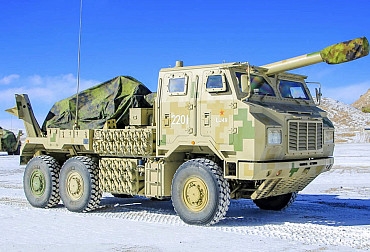
Recently a high-level US Army delegation visited the grounds of Excalibur Army’s production complex in Sternberk as part of a broader tour of Czechoslovak Group (CSG) facilities. The centerpiece of their visit was not a static display but a dynamic live-fire demonstration of the Morana 155 mm / 52-caliber wheeled self-propelled howitzer. What began as an exploratory mission to assess potential industrial cooperation quickly crystallized into a tangible evaluation of one of Europe’s most advanced truck-mounted artillery systems.
This event occured against a backdrop of urgent doctrinal and operational shifts within the U.S. Army. The cancellation of the Extended Range Cannon Artillery (ERCA) program in 2024 left a critical gap in long-range fires modernization. Towed M777 howitzers, while lightweight and air-transportable, have proven increasingly vulnerable in drone-saturated battlefields, as evidenced by heavy attrition rates in Ukraine. The Army’s Self-Propelled Howitzer Modernization (SPH-M) program – also referred to as MTC in some planning documents – now seeks mature, off-the-shelf wheeled platforms capable of rapid shoot-and-scoot tactics, enhanced crew protection, and seamless integration into brigade combat teams. Officials have indicated a target contract award by July 2026 and an initial fielding goal of up to 500 systems by fiscal year 2028. Excalibur Army’s Morana, with its fully automated loading, high ammunition capacity, and proven Tatra 8×8 mobility, has emerged as a serious contender.
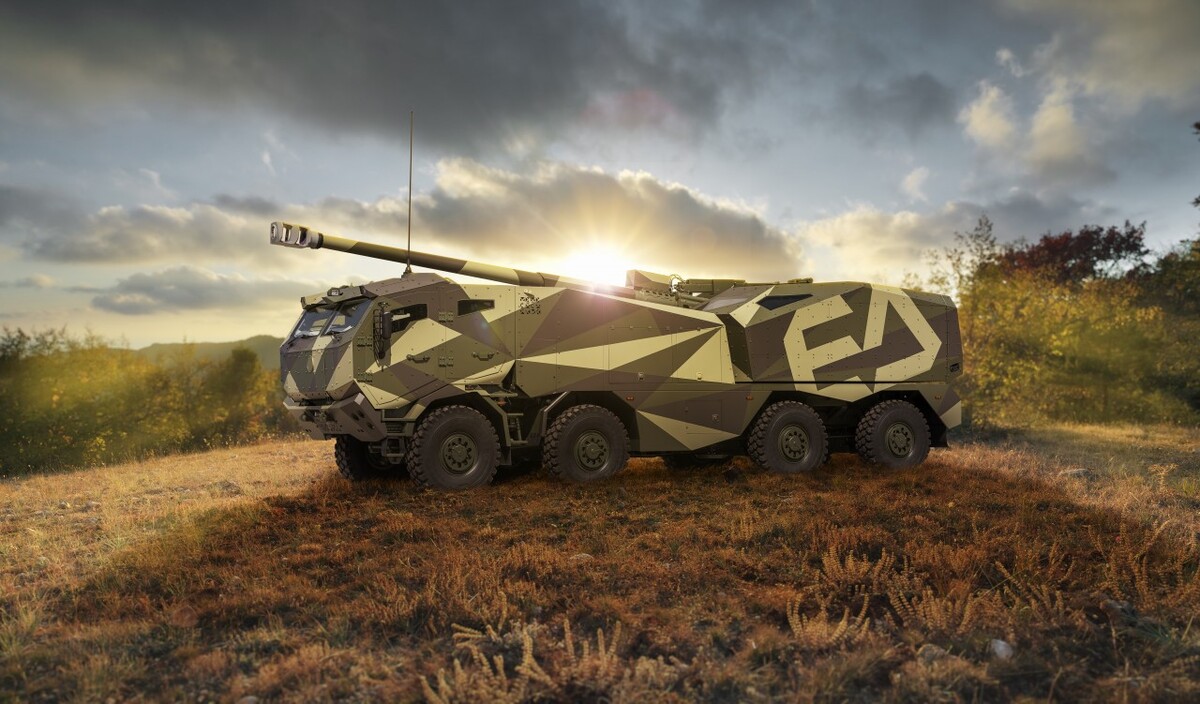
The Morana represents a sophisticated evolution of the classic “gun-on-truck” concept pioneered by systems like the Czech DANA family. Built on a modified Tatra Force 8×8 chassis (derived from the T815-7), the vehicle combines the off-road prowess of a military truck with the firepower and protection of a turreted self-propelled howitzer. At approximately 32,500–36,000 kg combat weight, it is heavier than early 6×6 CAESAR variants but comparable to modern 8×8 configurations, striking a balance between strategic airlift (C-17/IL-76 compatible) and tactical mobility.
Core Specifications and Capabilities
The Morana’s primary armament is a 155 mm L52 gun-howitzer capable of firing the full spectrum of NATO-standard ammunition, including precision-guided rounds. Maximum range with standard High-Explosive Extended-Range Base-Bleed (HE ERFB-BB) projectiles reaches 41.5 km. The system excels in Multiple Round Simultaneous Impact (MRSI) mode, delivering up to five rounds on target simultaneously at ranges around 20 km through sophisticated ballistic computation and automated gun laying.
Automation is the Morana’s defining strength. A fully robotic autoloader handles both projectiles and modular charges, enabling a burst rate of six rounds in the first minute and a sustained rate of five rounds per minute. The turret stows 40 ready rounds plus charges, with an additional five held for manual replenishment during lulls – totaling 45 projectiles without exposing the crew. A 12.7 mm remote-controlled weapon station (RCWS) provides self-defense. Crew requirements are minimal: just three soldiers (driver, commander/gunner, and operator), though the armored cab seats four. This low manpower footprint reduces logistical burden and risk in high-intensity operations.
Mobility is exceptional. Powered by a Cummins 600 hp engine mated to an automatic transmission and equipped with a central tire inflation system (CTIS) and all-wheel steering capability in some configurations, the Morana achieves a top road speed of 90 km/h and an operational range of 600 km. Off-road performance benefits from the Tatra chassis’s independent suspension and high ground clearance. Transition from march order to firing position is rapid – reportedly allowing the first round downrange in under 40 seconds – followed by immediate displacement to evade counter-battery fire. Protection meets STANAG 4569 Level 2 ballistic (7.62 mm AP) and Level 2a/2b mine resistance, with an NBC filtration system and overpressure capability.
Comparative Analysis: Morana Against Major Wheeled Competitors
To assess Morana’s viability, direct comparison with the two most prominent Western wheeled 155 mm / 52-caliber platforms – France’s CAESAR (particularly the 8×8 variant) and Sweden’s BAE Systems Archer – is essential. All three prioritize shoot-and-scoot survivability over traditional tracked howitzers, but they diverge in design philosophy, automation depth, and operational trade-offs.
Versus CAESAR 8×8 (KNDS France / Nexter)
The CAESAR family, combat-proven in multiple theaters including Ukraine, offers a lighter and more mature logistics footprint in its 6×6 form (18 tons), though the newer 8×8 Tatra-based version aligns closely with Morana at roughly 30–32 tons. Both achieve 90 km/h road speed and 600 km range. However, CAESAR’s loading remains semi-automatic in most configurations, requiring more crew intervention (typically 5–6 personnel) compared to Morana’s three-soldier full automation. Ammunition stowage on CAESAR 8×8 is around 36 rounds – nine fewer than Morana – potentially limiting sustained fire missions without resupply.
CAESAR benefits from a broader installed base and proven integration with Western fire-control networks. Its maximum range with advanced VLAP or LU munitions can exceed 50 km, offering a slight edge in reach depending on projectile choice. Yet Morana’s superior MRSI capacity (five rounds vs. CAESAR’s typical three-to-four) and higher onboard ammo load provide a clear advantage in volume-of-fire scenarios. Protection levels are comparable, but Morana’s enclosed turret and rear-mounted gun layout offer marginally better crew shielding during prolonged engagements. In a US context, Morana’s Tatra chassis shares components with some CAESAR 8×8 variants, potentially easing dual-fleet maintenance if both were selected.
Versus Archer (BAE Systems)
Archer, mounted on Volvo 6×6 or Rheinmetall HX2 8×8 chassis, is the automation benchmark. Its fully robotic system delivers exceptional burst rates – reportedly up to 21 rounds in 3.5 minutes in intensive mode – and sophisticated MRSI. Crew size mirrors Morana at three to four. However, Archer’s ammunition capacity is typically lower (around 20–30 rounds depending on variant), trading magazine depth for rapid initial salvoes. Weight and dimensions are broadly similar, though Archer’s articulated chassis excels in extreme snow or soft terrain.
Morana counters with higher sustained ammunition endurance (45 rounds) and a more conventional turreted design that supports direct-fire capability out to 5 km – useful for urban or close-support missions where Archer’s open-topped or semi-exposed layout may be less flexible. Both systems emphasize digital fire control and network-centric integration, but Morana’s Czech industrial base offers potential cost advantages and faster European production scaling. Archer benefits from BAE’s established US industrial presence, a key factor in SPH-M’s domestic manufacturing requirements.
In aggregate, Morana is more automated and ammo-rich than CAESAR 8×8, yet potentially more cost-effective and logistically robust than Archer for high-volume fire support. Its 41.5 km standard range is competitive with base munitions across the board, while automation reduces crew exposure – a critical lesson from recent conflicts.
Conclusion: A Credible Contender in a Crowded Field
The March 2026 demonstration was a practical stress test of a system designed for the very battles the U.S. Army anticipates. With its blend of high mobility, deep automation, substantial ammunition reserves, and crew protection, the Morana offers a compelling package that directly addresses the vulnerabilities of towed artillery while matching or exceeding key performance metrics of established competitors like CAESAR and Archer.
Whether Morana ultimately secures a US contract will depend on forthcoming shoot-off evaluations, cost analysis, and industrial offset negotiations. Yet its inclusion in the SPH-M shortlist already validates Excalibur Army’s engineering vision. In an era where artillery dominance hinges on survivability and tempo rather than sheer numbers, the Morana – named after the Slavic goddess of death and winter – may yet prove a lethal addition to America’s long-range fires arsenal.