
U.S. Considers Seizing Iran’s Kharg Island and the Clock Is Already Running
A war plan doesn’t always announce itself with speeches. Sometimes it shows up as a wake—long, sharp, and moving faster than a ship normally needs to.
That’s the signal many observers see in the urgent redeployment of the USS Tripoli (LHA‑7), an America-class amphibious assault ship assigned to the 31st Marine Expeditionary Unit, now pushing west from the Philippine Sea toward the Persian Gulf. Satellite imagery shared by OSINT analyst MT Anderson placed the ship in the South China Sea as of Sunday, March 15, sailing with two Arleigh Burke-class guided-missile destroyers. The detail that stands out isn’t just the formation—it’s the speed implied by the visible wake.
Arleigh Burke-class destroyers can reach around 30 knots, while America-class amphibious assault ships top out at about 22 knots. But top speed is an “emergency rating,” not a cruising habit—especially for a group that needs to arrive ready to fight. That’s why the more realistic estimate is still striking: roughly 18–20 knots. At that pace, and assuming no stops, the group could reach the Persian Gulf in about 9–10 days.
In that sense, the USS Tripoli is being read as a countdown: not merely a ship underway, but a moving indicator of how quickly Washington could be ready to execute an amphibious operation.
Why Kharg Island matters
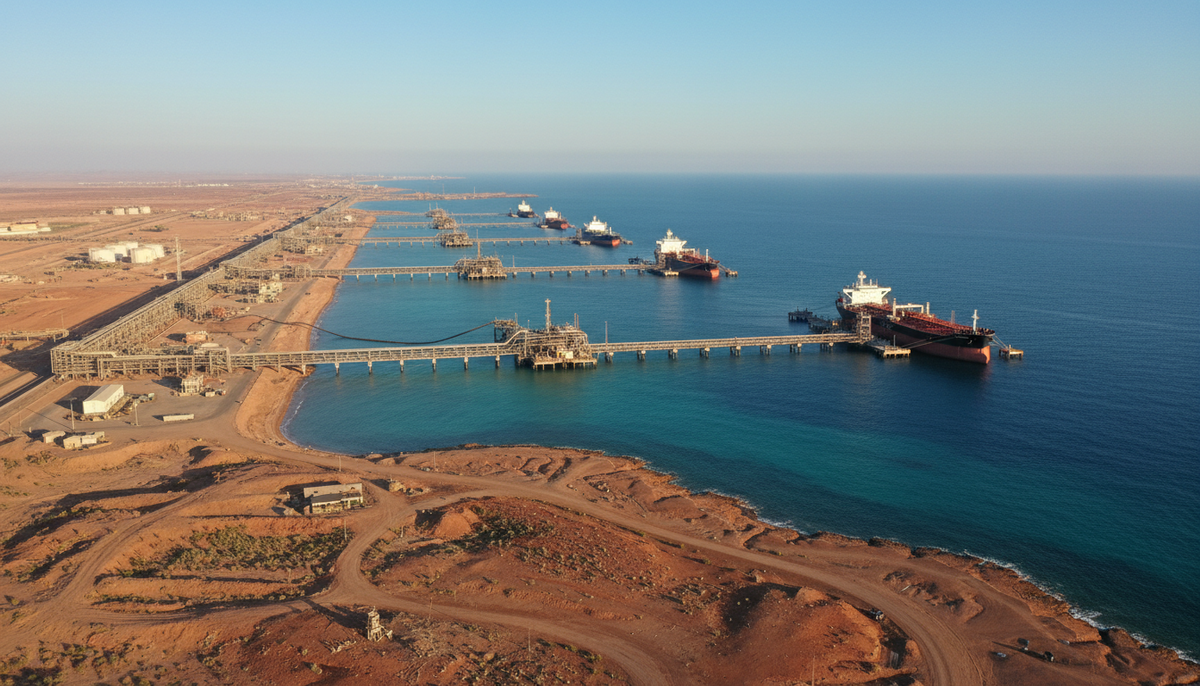
The rumored focal point—Kharg Island—would be an unusually consequential target for an amphibious operation. Nearly 90% of Iran’s oil exports flow through it. That statistic alone explains why Kharg is more than a dot on the map: it’s a lever. Control of the island would mean control over a critical artery of Iran’s export economy, and it would reshape the pressure dynamics of any wider conflict.
But even if Kharg is the headline, it may not be the first move.
The “first island” might not be Kharg
One plausible sequencing described in the facts is that the initial phase could focus instead on islands in the Strait of Hormuz. The logic is straightforward: before you attempt to seize or neutralize a major export hub deeper in the northern Persian Gulf, you may first want to lock down the chokepoint that governs navigation and maritime safety.
If decision-makers conclude that secure passage through the strait is a prerequisite, then controlling key islands there becomes less a side mission and more the door you have to unlock before entering the next room.
What the USS Tripoli can do—and what it can’t
America-class amphibious assault ships are built to put Marines ashore fast and support them immediately from the air. The USS Tripoli displaces over 45,000 tons, stretches 257 meters, and can carry nearly 1,700 Marines. Its aviation package is the real muscle behind the concept: MV‑22B Osprey tiltrotors for rapid lift, plus—specifically in Tripoli’s case—F‑35B fighter jets and AH‑1Z attack helicopters to protect the landing force and strike targets inland.
That combination points to a particular style of operation: speed, vertical envelopment, and heavy reliance on airpower to suppress defenses.
There’s also a critical limitation. The first two ships of the class—the USS America and the USS Tripoli—were built as Flight 0 variants and do not have the landing craft well found on other amphibious ships. That well deck capability is scheduled to appear starting with the Flight I variant, beginning with the USS Bougainville (LHA‑8), which is currently undergoing trials.
In practical terms, if the USS Tripoli is the centerpiece of an amphibious action, the Marine Corps would be unable to land armored vehicles from it in the traditional way. That sounds like a constraint—until you consider the operating assumption embedded in the same set of facts: in a war against Iran, that gap could be offset by total air superiority and precision strikes. In other words, instead of landing heavy armor, you attempt to make armor unnecessary by dominating the air, blinding defenses, and carving safe lanes for lighter forces to move.
The “countdown” pattern has precedent in this narrative
The facts also point to a recent example of how these deployments are interpreted: the nuclear-powered aircraft carrier USS Gerald R. Ford (CVN‑78) previously served as a similar readiness marker. Though it was slightly delayed by a stop in Cyprus, its arrival off Israel on February 27 was described as the final sign that a strike the following day was inevitable.
Whether or not one accepts that framing, the pattern is clear: large-deck ships don’t just bring combat power—they broadcast intent, timing, and readiness in a way that analysts can track day by day.
How soon could it happen?
If you treat the USS Tripoli’s movement as the “timer,” the near-term window implied by the transit estimate is simple: roughly 9–10 days to arrive in the Persian Gulf if the group maintains 18–20 knots and makes no stops. That doesn’t guarantee an operation begins immediately upon arrival—but it does define the earliest plausible moment when the option becomes operationally “on the table” in a serious way.
And that’s why the wake matters. It turns geopolitics into logistics, and logistics into a schedule.