
USAF Accelerates Collaborative Combat Aircraft Procurement
The United States Air Force is embarking on one of the most transformative initiatives in modern aerial warfare with its plan to procure more than 150 Collaborative Combat Aircraft (CCAs) by the end of fiscal year 2031. This ambitious timeline, revealed in recent budget testimony and planning documents, signals a decisive shift toward scalable, affordable, and highly autonomous unmanned systems that will operate seamlessly alongside crewed fighters. Far from mere experimental drones, these CCAs represent a new pillar of American air power, designed to address pilot shortages, mitigate risks in contested environments, and overwhelm adversaries through sheer mass and intelligent coordination. As the service invests billions in development and transitions rapidly from prototypes to production, the program underscores a broader doctrinal evolution: human pilots as orchestrators of mixed fleets rather than solitary warriors in the sky.
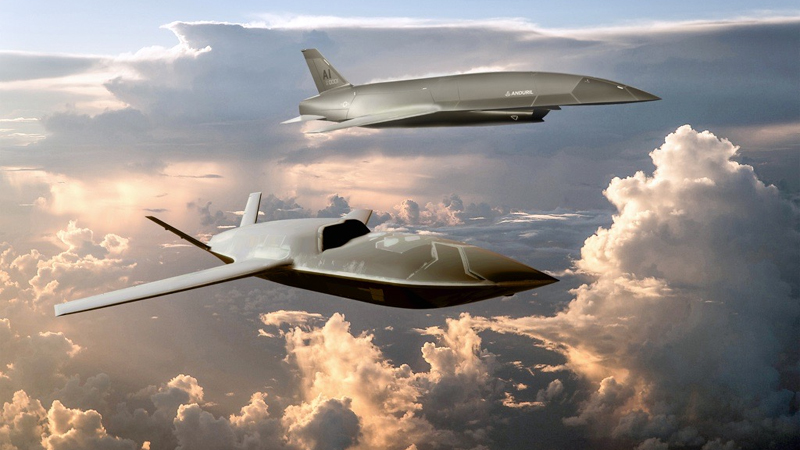
At its core, the CCA concept embodies manned-unmanned teaming, often referred to as “loyal wingman” operations but elevated through advanced artificial intelligence and collaborative autonomy. These are not simple remote-controlled vehicles or basic attritable munitions. CCAs are jet-powered, large uncrewed aircraft capable of independent decision-making within mission parameters set by human operators. They leverage AI-driven software to interpret complex battlefield data, adapt to threats in real time, and execute a wide array of roles including air-to-air combat, precision strikes, electronic warfare, intelligence, surveillance, reconnaissance (ISR), targeting support, and even decoy operations to draw enemy fire away from manned assets. The goal is to create a system of systems where a single pilot can direct multiple CCAs, extending sensor reach, weapons capacity, and operational endurance while reducing the exposure of high-value crewed platforms.
The aims of the CCA program are multifaceted and strategically urgent. In an era of great-power competition, particularly against peer adversaries with sophisticated anti-access/area-denial (A2/AD) networks, the USAF faces challenges including a shrinking pilot pool, escalating costs of crewed fighters, and the need for overwhelming combat mass. By fielding CCAs at roughly one-third the cost of an F-35 – targeting around $20-40 million per unit – the service can rapidly expand its effective fighter inventory without proportionally increasing training demands or sustainment burdens. Virtual training environments further lower lifecycle costs. Long-term visions include acquiring up to 1,000 CCAs to pair two with each advanced crewed fighter, enabling agile combat employment (ACE) concepts where forces disperse across forward locations and overwhelm defenses through coordinated swarms. This approach enhances survivability, multiplies firepower, confuses enemy sensors, and allows pilots to focus on high-level command rather than micromanaging every asset. Operational capability is targeted by the end of the decade, with Increment 1 laying the foundation for more advanced variants.
Compatibility is a central strength of the program. CCAs are engineered to integrate with existing and future platforms, creating a networked ecosystem. Primary partners include the F-35 Lightning II, the USAF’s premier fifth-generation stealth fighter. Lockheed Martin has already developed pod-based systems and tablet interfaces allowing F-35 pilots to control up to four to eight CCAs simultaneously, facilitating real-time data sharing, mission tasking, and sensor fusion. This extends the F-35’s already formidable capabilities in contested airspace. Looking ahead, CCAs will team closely with the Next Generation Air Dominance (NGAD) program’s crewed fighter, now often designated as the F-47, which serves as the command node in a broader family of systems encompassing sensors, weapons, and unmanned elements. Integration efforts also extend to potential Navy applications and even legacy platforms through modular upgrades. Testing at facilities like Nellis Air Force Base’s Experimental Operations Unit emphasizes safe human-machine teaming in realistic scenarios, with international partners such as the Netherlands joining for prototyping and interoperability development.
The procurement push to over 150 aircraft by 2031 builds on substantial prior investment. The FY2027 budget requests nearly $1 billion for initial production alongside continued R&D funding exceeding $1.3 billion, following years of development that have already seen contracts awarded to Anduril (YFQ-44A) and General Atomics (YFQ-42A) for production-representative test articles. This rapid scaling reflects lessons from simulations and exercises demonstrating how CCAs can enhance mission effectiveness in high-threat Pacific scenarios or against advanced integrated air defenses. By the end of the Future Years Defense Program, this initial tranche will provide critical mass for experimentation and early operational deployment, paving the way for Increment 2 with broader industry and potentially allied involvement.
In the global context, the USAF’s CCA initiative stands out for its scale, speed, and integration focus, but it is not without competitors. European efforts, while ambitious, remain fragmented and more oriented toward sixth-generation crewed platforms with supporting unmanned elements. The United Kingdom, in partnership with Italy and Japan under the Global Combat Air Programme (GCAP), is advancing the Tempest fighter, slated for service around 2035. Tempest envisions a sophisticated system of systems including uncrewed remote carriers or loyal wingmen for collaborative combat, emphasizing stealth, advanced sensors, and AI. However, production timelines lag behind the US push, with demonstrator flights targeted later in the decade and full operational capability further out. Budgetary and industrial challenges have slowed momentum, though the program benefits from strong industry collaboration involving BAE Systems, Rolls-Royce, Leonardo, and MBDA.
Parallel to this, the Franco-German-Spanish Future Combat Air System (FCAS), also known as SCAF or NGWS, aims for a next-generation fighter by 2040, supported by remote carriers and a “Combat Cloud” for data sharing. Airbus and Dassault lead efforts to integrate piloted platforms with uncrewed systems for electronic warfare, ISR, and strike missions. Like Tempest, FCAS prioritizes sovereignty and interoperability within Europe, but delays from political differences, differing national requirements, and industrial rivalries have pushed timelines. Both European programs focus heavily on crewed-next-gen fighters as the core, with CCAs or equivalent drones playing supporting roles rather than driving mass procurement in the near term. This contrasts with the USAF’s emphasis on rapid, affordable CCA acquisition to augment current fleets immediately. European initiatives may eventually converge or collaborate more deeply, but current duplication risks slower progress compared to America’s focused execution.
China, by contrast, presents a more direct and accelerated parallel, leveraging state-driven resources for rapid prototyping and potential mass production. Beijing has unveiled multiple loyal wingman designs, including the Hongdu GJ-11 Sharp Sword (a stealthy flying-wing UCAV), the Feihong FH-97A, and others showcased in military parades and air shows. These systems are designed explicitly for teaming with the J-20 stealth fighter, with two-seat J-20S variants optimized for drone control. Chinese CCAs emphasize long-range strike, electronic attack, reconnaissance, and swarm tactics, often with carrier-compatible variants for naval operations. Satellite imagery and public displays indicate at least several distinct designs advancing toward operational testing, supported by investment in AI autonomy and hypersonic technologies. While exact procurement numbers remain opaque, China’s industrial capacity suggests potential for hundreds of units faster than Western timelines, integrated into a broader PLA strategy for A2/AD dominance in the Indo-Pacific.
Key differences emerge in philosophy and execution. The US program stresses attritable, cost-effective designs with rigorous human oversight and iterative increments, prioritizing safety, interoperability with allies, and ethical AI boundaries. European projects embed unmanned elements within multinational sovereignty frameworks, potentially enhancing technological depth but risking delays from consensus-building. China’s approach appears more opaque and risk-tolerant, focusing on quantity, speed, and integration with existing platforms like the J-20, though questions persist around maturity of full autonomy and reliability in contested electromagnetic environments. The USAF’s 150+ by 2031 goal positions America as a leader in fielding operational capability soonest, but sustained funding, technological hurdles in autonomy, and adversarial countermeasures will test this edge. Allies like the Netherlands signal growing international interest, potentially expanding the program.
Looking forward, the CCA program could redefine not just USAF tactics but the very nature of air combat. By pairing human judgment with machine scale and precision, it addresses the realities of modern warfare where numbers matter as much as technology. Challenges remain – cyber vulnerabilities, rules of engagement for autonomous systems, sustainment in austere environments, and ensuring pilots retain meaningful command. Yet the momentum is clear: from concept to contract to combat mass in under a decade.