
USAF Achieves Breakthrough: F-22 Controls Autonomous MQ-20 Drone in Mid-Air Exercise
The US Air Force has achieved a significant milestone in aerial warfare by demonstrating, for the first time, mid-flight control of an autonomous drone by the iconic F-22 Raptor fifth-generation fighter jet. This groundbreaking test occurred over Edwards Air Force Base in the Mojave Desert, California, under clear skies, as detailed in a press release from General Atomics Aeronautical Systems, Inc. (GA-ASI) on February 23, 2026.
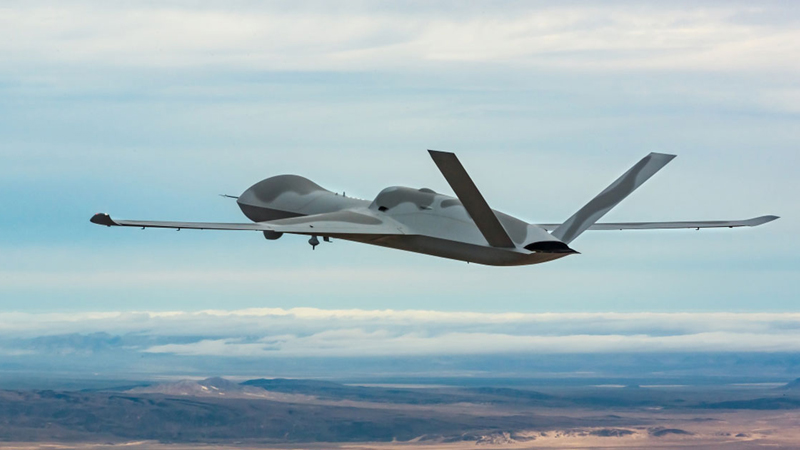
The demonstration highlighted Manned-Unmanned Teaming (MUM-T), a concept where a human-piloted aircraft collaborates seamlessly with unmanned systems to enhance mission effectiveness, survivability, and lethality. In this exercise, the F-22 served as the command aircraft, issuing real-time directives to the MQ-20 Avenger unmanned jet via advanced government reference autonomy software and a tactical data link. The MQ-20 responded by executing complex tasks, including changing course, adjusting waypoints, conducting Combat Air Patrol (CAP) patterns, and simulating engagements against airborne threats – all while leveraging its onboard sensors for independent decision-making when needed.
This integration represents a major advancement toward operationalizing Collaborative Combat Aircraft (CCA) concepts, where affordable, attritable unmanned platforms act as force multipliers for high-value manned fighters like the F-22. The MQ-20 has served as a surrogate CCA testbed for over five years, paving the way for future systems such as the XQ-67A and YFQ-42A.
The F-22 Raptor, developed by Lockheed Martin, remains the U.S. Air Force’s premier air superiority fighter. Introduced in the early 2000s as the world’s first operational fifth-generation aircraft, it combines stealth (with an exceptionally low radar cross-section), supercruise capability (sustained supersonic flight without afterburners), extreme maneuverability via thrust-vectoring nozzles, and integrated avionics for superior situational awareness. Powered by two Pratt & Whitney F119 engines, each delivering around 35,000 lb of thrust with afterburners, the F-22 achieves speeds over Mach 2, a service ceiling above 50,000 feet, and carries weapons internally to preserve its low-observable profile – including AIM-120 AMRAAMs for air-to-air and precision-guided munitions for air-to-ground roles. Its advanced AESA radar, electronic warfare systems, and sensor fusion provide “first-look, first-shot, first-kill” advantages, making it unmatched against current and projected threats.
The MQ-20 Avenger, designed and built by GA-ASI, is a jet-powered unmanned combat aerial vehicle (UCAV) that advances beyond propeller-driven predecessors like the MQ-9 Reaper. Measuring about 44 feet long with a 66-foot wingspan, it is powered by a Pratt & Whitney Canada PW545B turbofan engine, enabling speeds up to 460 mph (740 km/h), endurance exceeding 20 hours, and operations above 50,000 feet. With a maximum takeoff weight of around 18,200 lb and payload capacity up to 3,500 lb internally (plus external hardpoints), the Avenger supports weapons like Hellfire missiles, JDAMs, and various sensors including EO/IR, Lynx multi-mode radar, and SIGINT systems. Its low-observable design, high speed, and autonomy core make it ideal for high-threat environments, where it can perform reconnaissance, strike, or electronic warfare roles while reducing risk to human pilots.
The MUM-T concept, often termed “loyal wingman” operations in broader military contexts, synchronizes manned and unmanned assets through shared data links, autonomy software, and standardized interfaces. This allows a single pilot to command multiple drones, extending sensor reach, sharing targeting data, and enabling cooperative engagements without exposing the manned platform. In high-intensity conflicts – particularly against peer adversaries with advanced air defenses – MUM-T enhances force projection by distributing tasks: the manned aircraft acts as a decision-maker and “quarterback,” while unmanned teammates handle riskier scouting, decoy, or strike missions. The U.S. Air Force views this as essential for future operations, integrating with visions like Combined Joint All-Domain Command and Control (CJADC2) to maintain dominance in contested airspace.
The February 2026 test’s success stemmed from rapid software integration, including the Autonodyne Bashi Pilot Vehicle Interface (PVI), which facilitated command transmission and autonomous execution. David R. Alexander, president of GA-ASI, commended the flawless mission: “We appreciate the flawless execution of this mission using the government’s advanced autonomous systems. This demo featured the integration of mission elements and the ability of autonomy to utilize onboard sensors to make independent decisions and execute commands from the F-22.”
This demonstration underscores the accelerating pace of autonomy in U.S. military aviation, bridging current platforms like the F-22 with emerging CCA programs. As threats evolve, such teaming promises to redefine combat readiness, blending human judgment with machine precision for overwhelming tactical advantages.