
Warhound’s Genetically Edited Dogs: A Bid to Modernize America’s Military Canines
A Texas-based startup named Warhound emerged from stealth with $200 million in seed funding and a valuation of $1.2 billion. Conceived by Ben Lamm, the entrepreneur behind Colossal Biosciences, and Palmer Luckey, founder of the defense technology firm Anduril Industries, the company intends to rebuild the domestic supply of elite working dogs for the U.S. armed forces, law-enforcement agencies, and emergency responders. Led by chief executive David Spirk, a former Marine and the Pentagon’s first chief data officer, Warhound combines Colossal’s cloning and gene-editing capabilities with Anduril’s protective hardware and software. The effort targets a long-standing vulnerability: more than 80 percent of the military’s working dogs are currently acquired from European breeders, and after a multi-year acquisition and training pipeline fewer than half ultimately qualify for service. The Pentagon’s program fields more than 2,200 dog-handler teams whose roles range from explosives and narcotics detection to patrol and specialized search operations; the company argues that continued dependence on a foreign pipeline is neither reliable nor efficient.
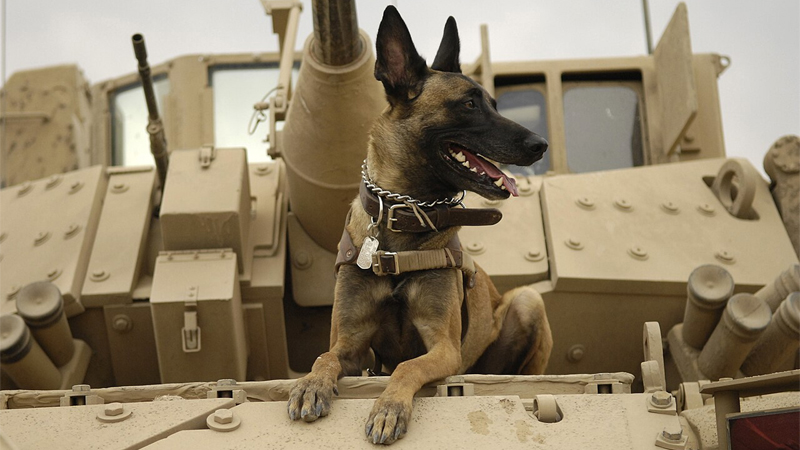
Warhound’s stated aims center on producing healthier animals better suited to demanding work while reducing the number of dogs that enter intensive training only to wash out. The company has already biobanked cell lines from top-performing service dogs, principally Belgian Malinois and German Shepherds, with Labrador Retrievers also under consideration. These cells will be cloned – through the Colossal-owned firm Viagen – and the resulting embryos will undergo targeted gene editing. The initial priority is subtractive: screening out or correcting genetic markers associated with hip dysplasia, certain cancers, muscle degeneration, and vision problems that commonly end careers early.
Later stages may address longevity and performance-related traits such as speed, agility, or olfactory sensitivity, though company leaders emphasize that any enhancements must be scientifically and ethically actionable. First litters are projected for early 2027, with the hope that animals could enter service within roughly two years. Parallel to the genetic work, Anduril will equip the dogs and their handlers with protective vests, eye and ear protection, sensors, and situational-awareness tools – described as “cybernetic Augments” – that sit on the animals rather than inside them. The company has engaged the American Humane Society to help certify training programs and support reunification or adoption of retired dogs.

The intended capabilities remain those already performed by conventional military working dogs: detecting explosives and other threats, securing perimeters, tracking, and supporting search-and-rescue or specialized operations in environments too hazardous or constrained for humans or current robotic systems. Proponents argue that genetically screened, cloned animals drawn from proven working lines should exhibit more consistent desirable traits, while the added protective gear and data links could improve both the dogs’ survival and the handlers’ decision-making.
Advantages claimed for the project include greater national-security resilience by ending reliance on overseas suppliers who face their own capacity constraints and geopolitical pressures; higher training success rates that would mean fewer animals are subjected to the long pipeline only to be rejected; and potentially longer, healthier working lives and retirements for the dogs themselves. In this framing, biotechnology becomes a tool for reducing waste and improving welfare within an existing operational requirement rather than inventing an entirely new category of animal. Commercial pathways could eventually extend beyond government customers to first responders and, company statements suggest, even civilian veterinary applications that address common breed-related diseases.
The announcement has drawn sharp criticism from animal-protection organizations and bioethicists. PETA characterized the project as an outdated idea at a moment when robotics and artificial intelligence can perform many of the same dangerous tasks without placing living animals at risk of gunfire, explosives, heat stress, or long-term trauma; the group has long advocated replacing military and police dogs with robotic alternatives. Representatives of In Defense of Animals called the effort obsolete and a cruel waste of lives, noting that robot dogs have already demonstrated useful capabilities in real-world scenarios. The Animal Legal Defense Fund described genetically engineering dogs for warfare as a profound betrayal of the human-canine bond forged over millennia of selective breeding for companionship and trust.
Independent experts have raised parallel concerns: Harvard veterinarian and bioethicist Lisa Moses noted that canine cloning remains inefficient, often requiring many invasive procedures and resulting in low rates of live offspring while placing surrogate mothers at risk. Pioneer cloning researcher Robert Lanza observed that while the scientific goals appear achievable, they are unlikely to succeed without numerous failures and defects. Broader commentary has questioned whether complex behavioral or performance traits can be reliably engineered without unintended consequences, and whether the project risks treating dogs primarily as optimized instruments rather than sentient partners.
Warhound’s founders and the American Humane Society counter that the focus on health, protective equipment, and structured retirement pathways constitutes an improvement over the status quo. The debate therefore turns on whether targeted genetic intervention and better gear meaningfully advance animal welfare within military service, or whether the very premise of engineering dogs for conflict zones is ethically untenable when non-animal alternatives continue to advance.