
The Laser Revolution in Counter-UAS: Israel Leads, America Scales, Europe Accelerates
The long-promised era of operational high-energy laser weapons has finally arrived on the battlefield, driven by the relentless pressure of cheap, massed unmanned aerial systems and the unsustainable cost of traditional missile interceptors. Israel’s Iron Beam, officially designated Or Eitan or Laser Dome, stands as the clearest demonstration that directed-energy technology has crossed the threshold from laboratory curiosity to combat-relevant capability. Developed by Rafael Advanced Defense Systems with key contributions from Elbit Systems, the 100-kilowatt-class system was formally delivered to the Israel Defense Forces in late December 2025. It is designed to engage rockets, mortar rounds, cruise missiles and drones at ranges of up to approximately ten kilometers by focusing adaptive-optics laser energy on a target until structural failure or warhead detonation occurs. The decisive advantage is economic: each engagement costs only a few dollars in electricity rather than the tens or hundreds of thousands of dollars required for an Iron Dome Tamir interceptor.
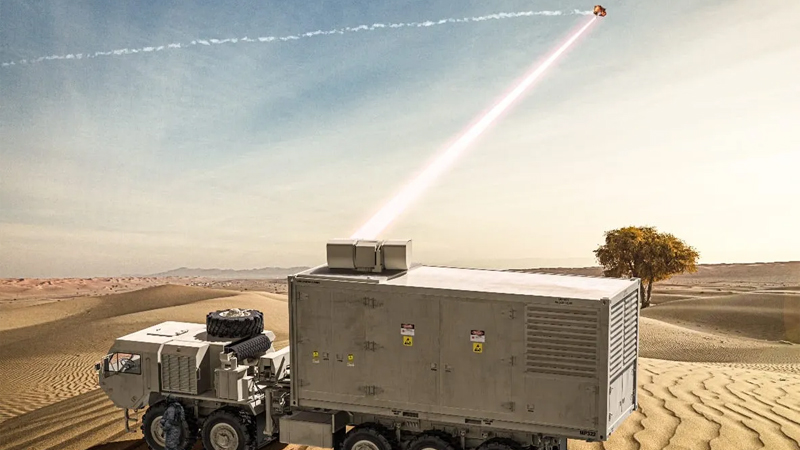
By mid-2026 Iron Beam has been integrated into the Iron Dome command-and-control architecture and has undergone extensive joint testing against multi-threat scenarios that include rockets, cruise missiles and unmanned aerial vehicles. While only a limited number of batteries have so far been fielded – officials have indicated that roughly fourteen systems would be needed for meaningful national coverage – the system has already demonstrated the ability to operate alongside kinetic layers, allowing expensive missiles to be reserved for higher-end threats while the laser handles the mass of lower-cost drones and short-range projectiles. Earlier scaled laser systems had already claimed dozens of Hezbollah drones in 2024, providing valuable combat data that accelerated the final Iron Beam configuration. Rafael continues to speak of future power growth that could eventually address larger ballistic threats, though that remains a longer-term aspiration.
Across the Atlantic the United States has pursued a more distributed and multi-service approach. The Navy’s High Energy Laser with Integrated Optical Dazzler and Surveillance, or HELIOS, a roughly 60-kilowatt system installed on the destroyer USS Preble and fully integrated with the Aegis combat system, has successfully engaged drones in fleet exercises and operational deployments. HELIOS represents the first true high-energy laser permanently fitted to an active combatant and has proven the feasibility of shipboard power management and beam control in a maritime environment. Yet the program’s limited scale – one ship so far – and mixed reports about sustained full-power performance have prompted a broader shift toward modular, containerized architectures.
The Joint Laser Weapon System effort, awarded in 2026 to teams led by Lockheed Martin and nLIGHT, aims to deliver initial 150-kilowatt prototypes that can later scale to 300–500 kilowatts for cruise-missile defense. These systems are designed to be transportable and platform-agnostic, suitable for ships, bases or forward operating locations. Parallel Army programs, including the Enduring High Energy Laser initiative and vehicle-mounted systems derived from AeroVironment’s LOCUST family, are moving toward formal programs of record. The Army is preparing contracts for compact lasers that can protect bases against one-way attack drones of the Shahed class, with power levels in the 20-to-50-kilowatt range already demonstrating reliable counter-UAS performance and costs measured in single-digit dollars per shot. The United States therefore emphasizes scalability, multi-domain integration and industrial capacity over the immediate fielding of a single iconic system.
Europe is advancing on a similar timeline but with a stronger naval and hybrid focus. The United Kingdom’s DragonFire program is scheduled for integration on Type 45 destroyers beginning in 2027, building on successful land- and sea-based trials. Germany has awarded a major contract to the MBDA–Rheinmetall consortium for a complete naval laser weapon system expected by 2029, drawing on more than a year of sea trials aboard the frigate Sachsen that included over a thousand successful engagements in varied weather conditions. At the same time European industry is developing hybrid solutions that pair high-energy lasers with short-range kinetic interceptors on a single turret, offering overlapping engagement envelopes against drone swarms. Systems such as MBDA’s Combined DefendAir–DEWS-L illustrate the continent’s preference for layered, cost-effective protection of bases, ports and critical infrastructure.
When the three approaches are compared, several clear distinctions emerge. Israel has achieved the earliest operational status and the most mature integration with an existing layered air-defense network, giving it an immediate tactical advantage in high-threat environments where rocket and drone saturation is routine. The United States leads in power-scaling ambition and in the diversity of platforms under development, from shipboard systems to containerized and vehicle-mounted lasers intended for global basing. Europe is concentrating on naval applications and hybrid laser-plus-missile architectures that reflect the particular vulnerabilities of its maritime flanks and the need for rapid industrial catch-up. All three share the same fundamental economic logic: once the capital cost of the laser is amortized, the marginal cost of each engagement collapses, reversing the unfavorable exchange ratio that has characterized recent conflicts in which a few-thousand-dollar drone forces the expenditure of a multi-million-dollar interceptor.
Challenges remain universal. Atmospheric conditions, especially dust, rain and turbulence, still degrade beam quality and effective range. Power generation and thermal management constrain continuous fire rates, particularly on smaller platforms. Rules of engagement and safety protocols for high-energy lasers operating near civilian airspace require careful refinement. Nevertheless, the trajectory is unmistakable. Directed-energy weapons are no longer experimental novelties; they are becoming essential components of layered air and missile defense. Israel’s Iron Beam has shown that the technology works in operational conditions. American programs are scaling it for mass production and multi-domain use. European initiatives are ensuring that the continent will not remain dependent solely on kinetic solutions. Together they mark the beginning of a genuine shift in the economics and tactics of defending against the most pervasive aerial threat of the present era.