Warsaw Weighs American Chinooks to Transform Polish Army Logistics on NATO’s Eastern Flank
Poland has reaffirmed its interest in acquiring the Boeing CH-47 Chinook heavy-lift transport helicopter, with Deputy Defence Minister Paweł Bejda indicating that part of a recent four-billion-dollar U.S. Foreign Military Financing loan could be directed toward the purchase. The move, discussed publicly in mid-November 2026, builds on earlier signals from Defence Minister Władysław Kosiniak-Kamysz and aligns with Warsaw’s broader effort to modernize its armed forces in response to the security environment on NATO’s eastern flank. No final contract has been signed, and officials emphasize that allocation of the funds remains under analysis, yet the Chinook has emerged as a leading candidate alongside alternatives such as the Sikorsky CH-53K King Stallion and the Leonardo AW101.
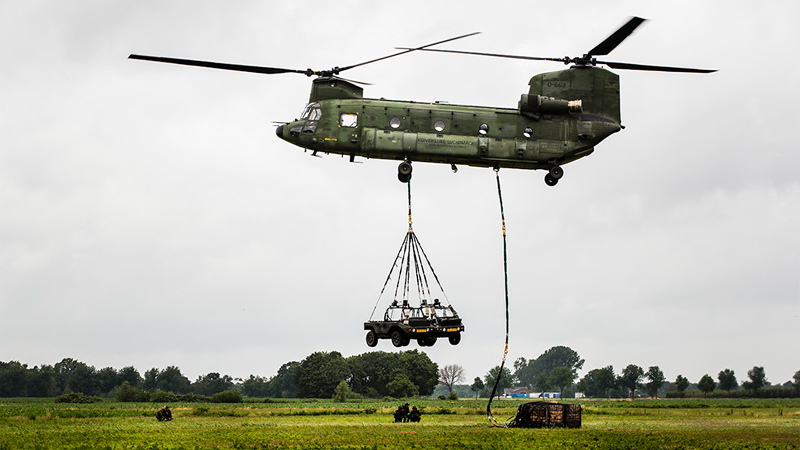
The primary operational rationale centers on support for the ninety-six AH-64E Apache attack helicopters Poland has ordered from Boeing. These gunships will require frequent ammunition, fuel, and maintenance resupply, particularly during dispersed or high-intensity operations. Heavy transport helicopters would enable the establishment of forward arming and refueling points that reduce reliance on vulnerable road convoys. Beyond Apache support, the aircraft would provide a genuine heavy-lift capability the Polish Land Forces currently lack, allowing the movement of substantial cargo, vehicles, artillery, or large numbers of troops into areas inaccessible by ground transport, as well as supporting humanitarian and disaster-relief missions. Recent flooding in southwestern Poland has already demonstrated the value of larger helicopters for such tasks.
Poland’s existing rotary-wing transport capacity rests primarily on aging Soviet-era Mil Mi-8 and Mi-17 medium helicopters. These platforms, introduced decades ago, offer useful utility but fall short of true heavy-lift performance; their external sling capacity is typically limited to around three tonnes, and spare-parts availability has grown more difficult. The Polish Army operates several dozen of these types across variants, supplemented by domestically produced PZL W-3 Sokół utility helicopters, a growing number of Leonardo AW149 multi-role aircraft, and a handful of AW101s assigned to the navy. No dedicated heavy-lift helicopter comparable to the Chinook currently serves in Polish Land Forces aviation.

Earlier ambitions to acquire Eurocopter EC725 Caracal helicopters were abandoned, leaving a persistent gap in the ability to move outsized loads or large troop formations rapidly. The planned Chinook acquisition, informally discussed in numbers exceeding twenty aircraft, would therefore represent a qualitative leap rather than a simple replacement. Neighboring Czech Republic faces a comparable situation, retaining a fleet of Mi-17 and Mi-171 transport helicopters while having already begun replacing its Mi-24 attack fleet with American AH-1Z and UH-1Y platforms; long-term Czech planning documents have at times identified the CH-47 as one possible future heavy-lift option alongside the AW101, though no firm acquisition decision has been taken.
A decision in favor of the Chinook would also strengthen interoperability with NATO partners that already operate or have ordered the type. The United Kingdom maintains one of Europe’s largest Chinook fleets and is receiving CH-47F Block II Extended Range variants with improved range and payload. The Netherlands operates approximately twenty CH-47F helicopters and has modernized its earlier airframes. Spain fields a squadron of CH-47D/F aircraft that are being upgraded. Italy operates the locally assembled ICH-47F. Greece and Turkey maintain Chinook fleets as well. Most significantly, Germany has ordered sixty CH-47F Block II helicopters, with production of the first airframes under way, to replace its aging CH-53G Sea Stallions; the German aircraft will feature air-to-air refueling capability and are intended to support rapid reinforcement of the eastern flank. Selecting the same platform would allow Poland to draw on shared logistics, training pipelines, and operational concepts already familiar to these allies.
No Chinook helicopters are present in Ukraine, nor does the Ukrainian armed forces operate any Western heavy-lift rotorcraft of this class. Ukrainian Army Aviation relies primarily on the Mi-8/Mi-17 family for medium transport, troop movement, and limited resupply, together with Mi-24 attack helicopters; a small number of Mi-26 heavy-lift helicopters inherited after the Soviet collapse were withdrawn from service and placed in storage in the 2000s. Russia, by contrast, continues to employ the much larger Mil Mi-26, capable of lifting roughly twenty tonnes internally or as a sling load, for logistical tasks including the movement of equipment, ammunition, and reinforcements.
Ukrainian forces have targeted Russian Mi-26s, confirming the destruction of at least one in occupied Crimea in 2025. In the high-threat environment of the current conflict, both sides have found rotary-wing operations constrained by air defenses and drones, with heavy-lift platforms generally kept farther from the immediate front and used for rear-area logistics rather than routine forward delivery. The absence of Chinook-class assets in Ukraine underscores the distinct role such helicopters would play for Poland: enabling sustained, dispersed operations for a modern Apache force and providing scalable heavy transport within a NATO framework rather than in a high-intensity peer conflict of the type currently seen further east.
Should Poland proceed, the Chinook would close a long-recognized capability shortfall, enhance the effectiveness of its incoming attack-helicopter fleet, and deepen integration with key NATO partners already invested in the type. The final decision will depend on cost, delivery timelines, industrial participation, and the precise allocation of U.S. financing, yet the renewed public confirmation of interest signals that heavy-lift rotary aviation has moved from conceptual discussion to a concrete procurement priority.